
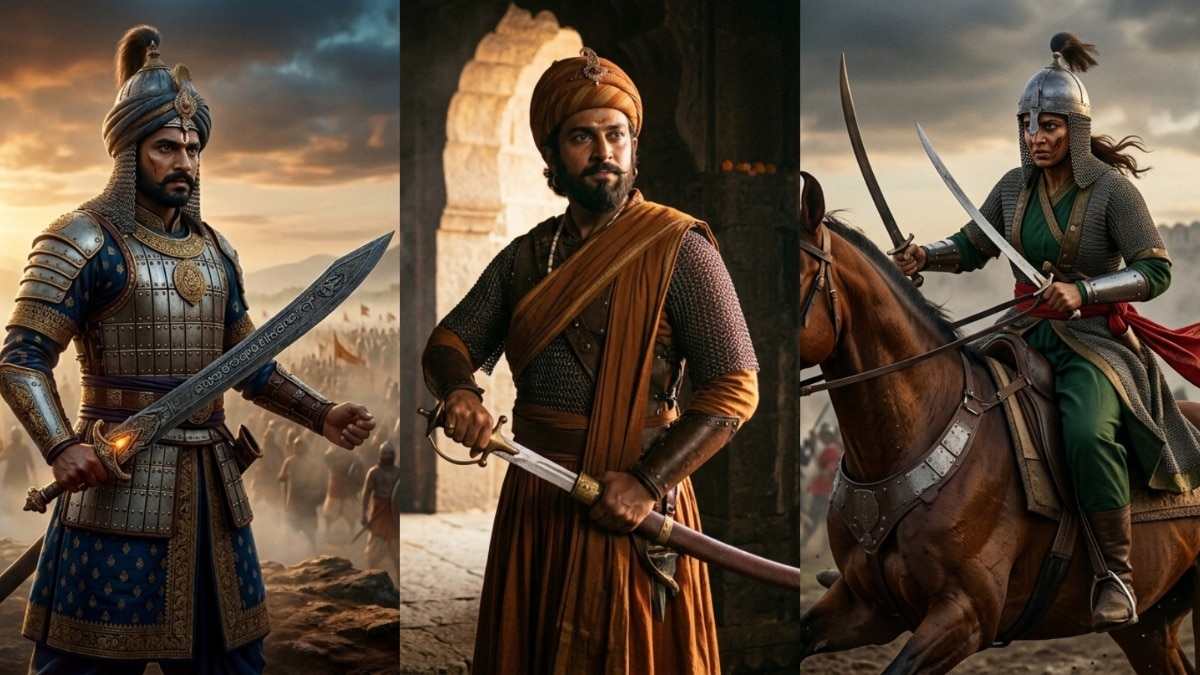
If you close your eyes and picture India's ancient battlefields, you don't just see kings charging on war elephants or warriors with armour glinting in the sun. You hear something else: the whisper of divine names carried on metal.Imagine a hush before dawn, when a warrior touches his forehead to a sword, whispering the name of a goddess. Imagine war not beginning with a command, but with a prayer.Across centuries, Indian rulers and warriors did not always see weapons as mere instruments of war. Some traditions gave swords divine origins. Others placed goddesses beside warriors as protectors. And in later legends, a weapon could become a symbol of divine right, kingship and courage.Some of these stories come from historical records. Others survive in epics, royal literature and popular memory. The line between history and legend is part of what makes them fascinating. SHIVAJI MAHARAJ AND THE CONTESTED BHAVANI SWORD (1630–1680)To understand the power of divine weaponry, begin in the rugged hills of 17th-century Maharashtra. Tradition holds that Shivaji Maharaj received a sword from Goddess Tulja Bhavani at her shrine in Tuljapur. Shivaji Maharaj and the sword from Goddess Tulja Bhavani (AI-generated image) The story has survived for centuries, but the identity of the actual Bhavani Talvar is far less certain. A 2024 study by historian Andrew Halladay in Modern Asian Studies examined competing claims surrounding Shivaji's famous sword and found that at least three different swords have, since the 19th century, been identified as the Bhavani Talvar. Their provenance remains disputed.Yet the legend itself became powerful. Over time, the Bhavani sword came to represent divine favour, kingship and Maratha identity.Whether the goddess literally placed a sword in Shivaji's hands is a matter of tradition. What is certain is that the story turned a weapon into something much larger than steel.RANI LAKSHMIBAI AND THE GODDESS WHO RODE WITH HER (1828–1858)More than a century later, the warrior-goddess image took human form in the legend of Rani Lakshmibai of Jhansi.When she fought during the uprising of 1857–58 and later rode towards Gwalior, accounts of her courage began to grow into something larger than the battlefield itself. Later retellings cast her as an embodiment of Durga or Shakti: a woman on horseback, armed with swords, refusing to surrender her kingdom. Rani Lakshmibai as the lore of the embodiment of Durga on the battlefield against the British (AI-generated image) The famous image of Lakshmibai fighting with a sword in each hand, sometimes with her son strapped to her back, became central to the heroic memory surrounding her. Such details appear in later accounts and popular retellings, rather than providing a straightforward eyewitness record of every moment of her final battle.She died fighting in June 1858.But the image that survived was larger than the historical woman: Shakti on horseback, with the sword becoming a symbol of resistance.KUMARA KAMPANA AND THE SWORD THAT CAME FROM THE GODS (C. 1360s–1370s)In the 14th century, another warrior entered the story carrying a weapon with a divine past.Kumara Kampana, son of Vijayanagara ruler Bukka I, led the southern campaign against the Madurai Sultanate. His wife, Gangadevi, recorded the campaign in the Sanskrit poem Madhura Vijayam.And in that poem, a mysterious woman appears before Kampana carrying a magnificent sword. Kumara Kampana of Vijayanagara with the sword crafted byVishvakarma (AI-generated image) She tells him that the weapon had been fashioned by the divine craftsman Vishvakarma from the weapons of the gods. It had then passed through a chain of divine and royal hands before reaching Kampana, who is urged to take up the campaign in the south.The military campaign belongs to history. The divine sword belongs to Gangadevi's poetic telling of it.That distinction does not make the story less remarkable. The poem was not merely describing an army marching south. It was giving Kampana a sacred inheritance, turning his weapon into a symbol of legitimacy and divine purpose.ANNAMARAJA AND THE GODDESS OF BASTAR (C. 1324)In Bastar, the sacred sword appears again, this time in the story of an early ruler.Popular tradition says that Annamaraja, remembered as a ruler of Bastar, received his sword from Manikyadevi, also known as Danteshvari. The weapon was not simply a royal possession. In the tradition, it became an embodiment of the goddess herself. Annamaraj of Bastar with the sword from Manikyadevi (AI-generated image) This is a royal legend rather than a securely documented battlefield event. But the goddess at its centre has a much deeper historical presence in the region, where Manikyadevi was associated with the political and religious world of earlier rulers.The symbolism is striking.A king did not merely possess a sword. He possessed a weapon believed to carry the goddess's power. In such stories, divine blessing could become a language of kingship itself.The legend survives because the sword represents more than victory. It represents the idea that a ruler's authority could come from somewhere beyond the battlefield.THE EPIC ROOTS: GANDIVA, VIJAYA AND THE DIVINE WARRIOR (ANCIENT INDIA)Long before these historical rulers, Indian epic tradition had already imagined weapons as things touched by the divine.In the Mahabharata, Arjuna's Gandiva is no ordinary bow. During the burning of the Khandava forest, Agni obtains divine weapons for Arjuna and Krishna, and Varuna gives Arjuna the Gandiva along with inexhaustible quivers and a celestial chariot. The bow then becomes inseparable from Arjuna's identity as the great archer of the Pandavas. Arjuna with Gandiva on the Kurukshetra battlefield (AI-generated image) Karna's Vijaya has an equally extraordinary lineage. In the Karna Parva, Karna describes it as a bow fashioned by Vishvakarma for Indra, later passed to Parashurama and then to him.The epic also brings the goddess directly into the warriors' story. In the Virata Parva, Yudhishthira invokes Durga for protection as the Pandavas approach Virata's kingdom. In the Bhishma Parva, Arjuna too invokes the goddess before the great battle. Karna with Vijaya on the Kurukshetra battlefield (AI-generated image) The important distinction is that Gandiva was not a “sword of Durga”, nor was Vijaya a weapon consecrated to Bhavani. The Mahabharata instead gives us something subtler: warriors with weapons of divine origin, turning to goddesses for protection before entering danger.WHY THESE STORIES STILL MATTERFrom Shivaji's contested Bhavani sword to Kumara Kampana's divine weapon and Annamaraja's sacred blade, these stories turn weapons into something more than instruments of war.Some belong to history, some to epic tradition, and some to royal legend. But across all of them runs the same enduring idea: the weapon may belong to the warrior, but its power is imagined as coming from something greater than the warrior himself.That is perhaps why these stories survived long after the battles ended.- Ends
Shivaji Maharaj to Rani Lakshmibai: Indian warriors who carried goddesses into battle
Full Article
Original Source
Read the full article at Indiatoday →KhanList aggregates and links to publicly available news content. We do not host full articles from third-party sources. Always verify important information with original sources.