
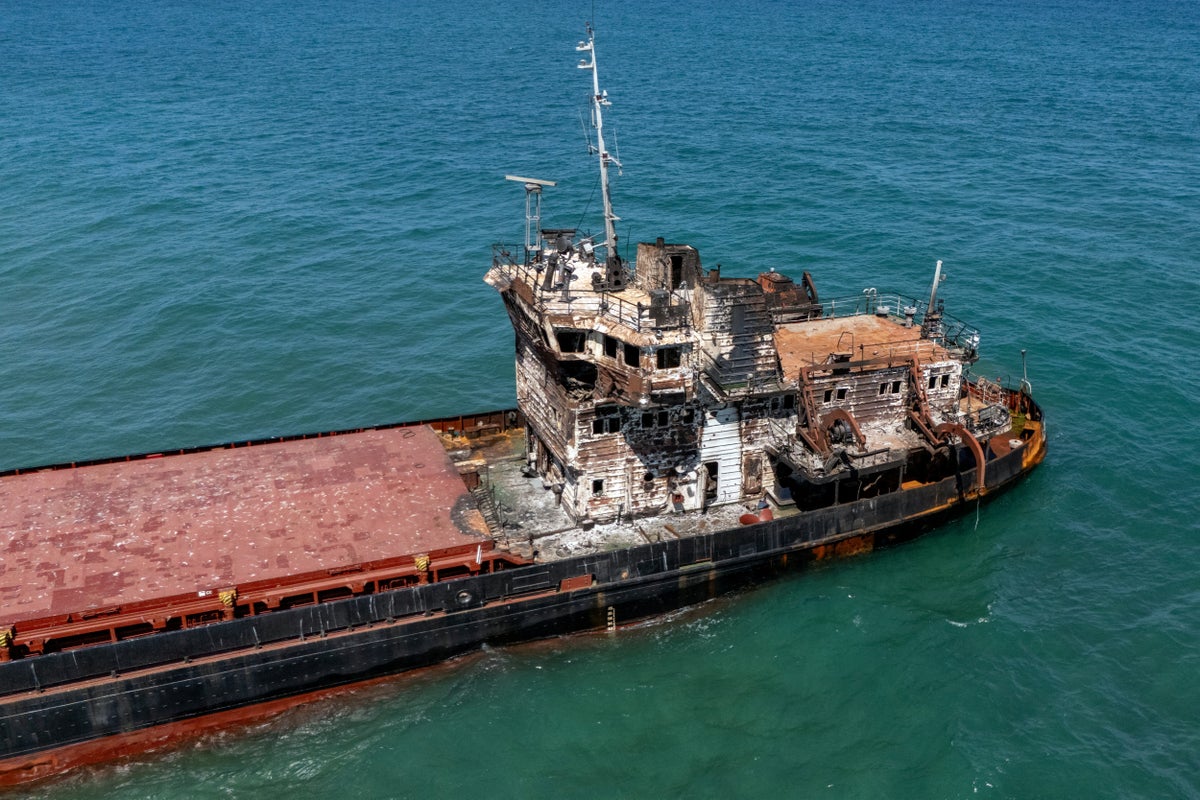
Merchant vessels and oil tankers navigating the Bosphorus strait are turning to improvised defences, including netting, water containers and tyres, in an effort to ward off intensifying Russian and Ukrainian drone strikes in the Black Sea, according to maritime security analysts and visual evidence.Highlighting the escalating danger to commercial shipping, the abandoned Russian-flagged cargo vessel Omskiy-107 — its command bridge destroyed by fire — drifted from Russian waters onto a beach east of Istanbul, adjacent to one of the world's busiest maritime transit routes.Ukrainian forces have stepped up targeted strikes against vessels and infrastructure facilitating Russian oil and grain exports since July. This followed a wave of intensified Russian missile and drone bombardments directed at Ukraine's primary export hubs in Odesa, Chornomorsk and Pivdennyi.Among those attempting to cushion potential impacts, the Sierra Leone-flagged crude oil tanker Caruzo passed through the strait on 11 August carrying water tanks suspended around its stern to protect the engine compartment. Later in the month, on 27 August, the Russian-flagged tanker Khrizopraz was observed transiting with tyres draped across its hull.The Russian-flagged general cargo ship Omskiy-107 lies aground off the coast of Sile in Istanbul, Turkey, September 1, 2026 (REUTERS)The volume of attacks launched by both sides against commercial shipping and port facilities has surged significantly and could escalate further, according to Corey Ranslem, chief executive of maritime security firm Dryad Global."There's a couple of popular countermeasures that we've seen onboard vessels that are transiting in Black Sea operations," he noted, citing the placement of water-filled containers alongside protective netting.The practice of fitting protective wire screens over a ship’s superstructure, known as "cope cages", has become increasingly common to shield against explosive aerial drones. Two crude oil tankers, Brisk and Integrator, were both seen fitted with these frames while traversing the Bosphorus last month."These tools can be effective for some of the smaller types of drones but when you look at the bigger military types of drones these tools may not be as effective, or in some cases, effective at all," Ranslem added.Other maritime experts have similarly questioned whether such makeshift measures can withstand rapid remote-controlled naval drones or airborne craft carrying substantial explosive payloads.Recent weeks have seen several heavily damaged vessels arriving at the Bosphorus under coastguard escort, including the Liberian-flagged bulk carrier Great Ocean.Liberian-flagged bulk carrier Anna S, with damage visible on its deck, is escorted by a coast safety boat as it returns from the Black Sea through the Bosphorus in Istanbul, Turkey, September 1, 2026 (REUTERS)Turkey, whose own commercial ships have been repeatedly targeted in the Black Sea, summoned Ukraine's ambassador to Ankara over the weekend following attacks on two vessels near the Russian port of Tuapse. Ukraine did not issue a comment.Turkish President Tayyip Erdogan warned on Wednesday that the Black Sea strikes had renewed global grain shortages, particularly in Africa, and called for an urgent resolution. On Monday, his foreign minister, Hakan Fidan, said Ankara had prepared a plan to restore safe grain corridors and was discussing it with both Moscow and Kyiv.However, Russia stated on Wednesday that it sees no grounds to resume the Black Sea grain arrangement. Turkey helped broker an agreement in July 2022 to allow the safe export of nearly 33 million metric tons of Ukrainian grain, but Russia withdrew in 2023, citing obstacles to its own food and fertiliser exports.Ranslem observed that while the 2022 deal had temporarily restored navigation, the current environment is considerably more volatile and resolving it will require broader steps towards peace.Russian President Vladimir Putin claimed on Tuesday that Russia was prevailing in the conflict initiated by its 2022 full-scale invasion of Ukraine, despite fuel shortages stemming from Ukrainian drone strikes and heavy casualties along a largely static front line.
Ships turn to ‘cope cages’ and makeshift anti-drone defences as Black Sea attacks intensify
Full Article
Original Source
Read the full article at Independent →KhanList aggregates and links to publicly available news content. We do not host full articles from third-party sources. Always verify important information with original sources.