
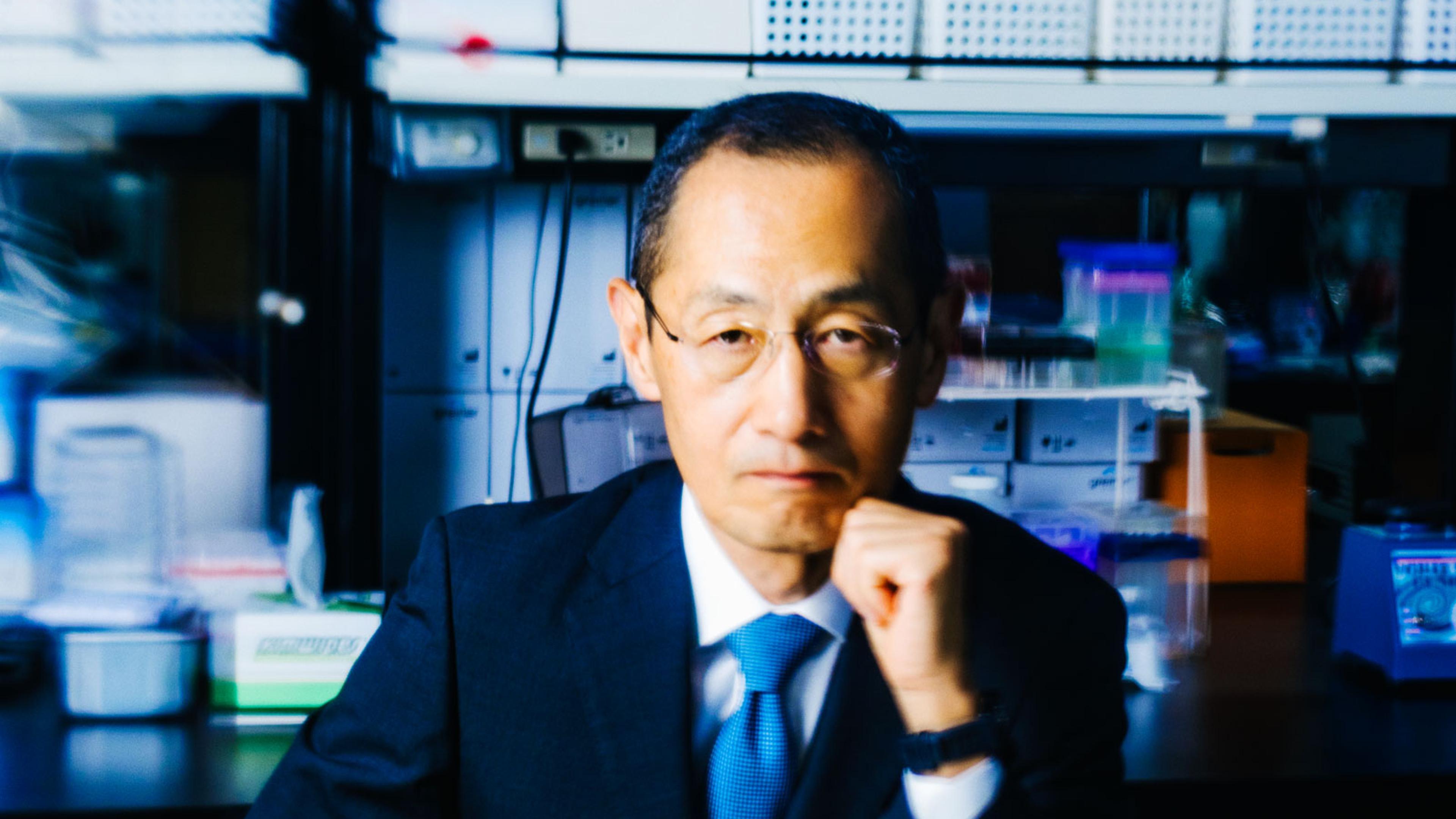
Takuya Maeda for TIMEDr. Shinya Yamanaka can no longer enjoy a beer in peace. After a long day at a recent conference in Montreal, the scientist found a seat at the quiet hotel bar, hoping for a few moments to himself. “But unfortunately, or fortunately, a group of Japanese businessmen came into the bar,” he says. And although scientists don’t get recognized very often, Yamanaka is a celebrity in Japan. He doesn’t mind. Celebrity, he knows, is a small price to pay for the profound impact that he has on an impressively wide range of scientific fields: developmental biology, regenerative medicine, chronic-disease treatments, and, increasingly, longevity. In 2006, he published a groundbreaking paper that would forever change our understanding about how the human body develops and ages, and how to reverse those processes. In 2012, Yamanaka earned the Nobel Prize in Physiology or Medicine for his work, becoming a hero in his country and inspiring generations of scientists worldwide. What Yamanaka achieved was long thought to be impossible: turning back the clock of human cells. Certain animals can regenerate cells, tissues, and entire limbs, but human cells seemed to develop only in one irreversible direction. Yamanaka proved that theory wrong, showing first in animals and then in people that any adult cell could become like those found in embryos, capable of developing into any of the body’s different types of cells. This discovery catalyzed new ways of treating disease by replacing failing cells. This year, the first treatments based on his discovery 20 years ago became available to some patients. “I can’t believe it’s been 20 years already,” Yamanaka said in a recent interview at the Center for iPS Cell Research and Application (CiRA) at Kyoto University, which he helped create and directed for 12 years. (He remains there as professor and director emeritus.) “And I would say, so far, so good. The technology has grown, so now we are seeing medical applications of this on a small scale.”We may be at just the start of how Yamanaka’s discovery transforms human health. If diseased or injured cells can be replaced, then why not reprogram aging ones to become youthful and vigorous again? It is one of the most actively researched areas in the longevity field. Scientists are finding that it may not even be necessary to reprogram older cells all the way back to an embryonic, blank-slate state; even partially reprogramming them could rejuvenate cells enough to slow some aging processes. The hope is that one day, aging itself may be “treatable” with fresh sets of cells and tissues that work like decades-younger versions of themselves. “It’s a very active area [of research],” Yamanaka says. “And I think partial reprogramming is a very powerful potential way to live healthier and longer.” Yamanaka didn’t start his career as a scientist but as a physician. Born in Osaka, where his father made saw parts, he liked to take apart clocks and radios, although he wasn’t always successful in putting them back together. He diligently read a monthly science magazine for schoolchildren and performed the included experiment kits. He attended medical school in Kobe at his father’s urging and became an orthopedic surgeon, influenced in part by the overtraining injuries he had endured playing judo and rugby. But Yamanaka soon realized that surgery didn’t inspire him. Just as he had been drawn as a boy toward understanding the mechanics of electronics, he was intrigued by basic science and learning how diseases take root.He earned a Ph.D. in pharmacology at Osaka University and completed a fellowship at the University of California, San Francisco’s Gladstone Institutes. (TIME co-chair and owner Marc Benioff is a past supporter of the Gladstone Foundation.) Yamanaka thrived there, studying a gene that lowered cholesterol in mice and learning how to culture embryonic stem cells in the animals, which served as a foundation for his later discovery. When his fellowship ended in 1996, Yamanaka returned to Japan. But he missed the scientific community at Gladstone. “I experienced post-America depression,” he says. He had trouble getting funding for his basic research projects and became so disillusioned with his career path in Japan that he considered practicing medicine again, admitting, “I nearly died once as a scientist.”But an opportunity to run his own lab at Japan’s Nara Institute of Science and Technology provided one last shot at the scientific career he yearned for. “I wanted to try something very big, very risky, but that will have a huge impact on medicine,” he says. “So that’s how I started this project”—his modest way of describing the work that would earn a Nobel Prize.At the time, other stem-cell scientists were focused on trying to coax embryonic stem cells to become the mature cells the body needs to treat disease—islet cells in the pancreas, for instance, which produce insulin. “I thought I wouldn’t be competitive enough if I just did a similar approach,” he says. So Yamanaka zagged. Rather than starting with embryonic cells, he started with mature, specialized cells and tried to turn them back to an embryo-like state.There was no guarantee this was even possible with human cells, but Yamanaka pinned his career on two studies that convinced him it might be. First, British biologist John Gurdon, with whom Yamanaka would share the Nobel, had shown in the 1960s that a cell from an already-developed tadpole still contained the genetic instructions it needed to become a new frog. Then, in 1996, Scottish embryologist Ian Wilmut took a mature cell from a female sheep and created an exact clone of the ewe. “Because of those two studies, I thought at least in theory, we could revert somatic [adult] cells back into the embryonic state,” Yamanaka says. “So I was not just a crazy scientist.” He started by trying to identify which genes were responsible for driving the development of embryonic cells. Then, he used engineered viruses that could infect cells (but no longer cause disease) to introduce these genes to adult cells; these, in turn, would instruct the cell to make the proteins that help the mature cells act more like embryonic ones. Yamanaka and his team winnowed 24 possible genes down to four.Even Yamanaka was surprised that the process worked. When his colleague first showed him the older mouse cells that seemed to have reverted back to young versions of themselves, he refused to believe it. “I thought it was a mistake,” he says. “I asked my colleague to repeat the experiment again and again and again, but it always worked,” even with different types of mature mouse and human cells. “So we gradually became confident in the results.”He called the cells induced pluripotent stem cells (iPS cells for short), and researchers raced to capitalize on the potential of these “Yamanaka factors” to generate replacements for diseased cells in conditions like diabetes and Parkinson’s disease. “iPS cells impact all sorts of areas, from the study of disease to the study of development,” says Dieter Egli, associate professor of developmental cell biology at Columbia University and a leading stem-cell scientist. “This fundamental insight of the reversion of time and cell specialization is absolutely a miracle.”To capitalize on the discovery, the Japanese government invested heavily in CiRA—where the scientists’ teams still call him Yamanaka-sensei—to refine the production of iPS cells. One of the key genes involved in the process can also promote tumors; Yamanaka found a way to omit it while reprogramming the cells, albeit less efficiently, and has since developed ways to manufacture high-quality iPS cells for use in human studies. He also initiated important discussions with the government on the ethical use of these cells. “When we succeeded in making human iPS cells, I was very happy for just one week,” Yamanaka says. The process bypassed the ethical challenges of needing embryos as a stem-cell source. “But I realized, ‘Wow, maybe I overcame one ethical hurdle, but now I generated another, even higher hurdle.’” Because any adult cell can be turned into any other type of cell in the human body, including egg and sperm, he quickly realized the potential for abuse. Eggs, sperm, and embryos that could theoretically be generated by iPS cells would cause permanent changes not just in individuals but to future generations, forever altering the human gene pool. He asked the Japanese government to help draft guidelines to navigate when and how using iPS cells to create such germ-line cells would be ethically justified, and invited ethicists to join the team at CiRA. “It’s an ongoing, very, very important issue,” he says. “The speed of scientific progress is becoming faster and faster, so we can’t just postpone these discussions. We have to talk [about them] and start deciding now.”While egg and sperm from iPS cells have not been approved for human studies, other iPS cells are already being used in people. In March 2026, the Japanese government issued the first conditional approvals of two treatments based on iPS cells: one for Parkinson’s and another for heart failure. If ongoing trials of these treatments continue to be successful, they could pave the way for exploring not just how dysfunctional or injured cells can be rejuvenated, but whether older ones can be reprogrammed to regain their youthful function. “Our first priority is to extend healthy longevity, not just longevity itself,” he says, “so that people can live through their 80s and 90s without the need of aid from other people.”One of the first efforts to test iPS cell-based rejuvenation began in May in the U.S., when the first patient was treated with iPS cells to reprogram aging eye cells that were causing glaucoma and optic neuropathy. These retinal cells can’t be regenerated by the body, so if they start to deteriorate over time, people can lose their vision. The hope is that by injecting a treatment using three of the Yamanaka factors, these older retinal cells can become rejuvenated to function normally again, and potentially rescue people from blindness.“Our first priority is to extend healthy longevity, not just longevity itself.”—Shinya YamanakaWhile efforts like this are important steps toward improving human health, they also open the door to extending human life. Reprogramming is becoming a mainstay of numerous longevity strategies, including one from a team at the University of Tokyo, which is using iPS cells to generate exosomes, small sacs that contain various components that cells need to survive and thrive, and injecting them into mice and humans. Research is early, but the therapy seems to reduce inflammation, a driver of aging in cells. Yamanaka is cautiously optimistic about the expansion of interest in iPS cells in the field of longevity. “I think the potential is very high, but the application of partial reprogramming may be a bit more challenging,” he says. Because they are relatively new, it isn’t clear yet whether reprogrammed cells are exactly equivalent in function and safety to normally developed adult cells, so Yamanaka continues to study the process in depth. He splits his time between CiRA and his lab at the Gladstone Institutes in San Francisco, where—again taking a contrarian approach—his latest research explores when reprogramming may not work, and how certain cells might protect themselves from being reverted to a younger state. Understanding the limitations of the method he discovered could also help solve more mysteries about how the body ages. While Yamanaka says the iPS field has made remarkable progress in the past 20 years, when it comes to the technology’s ultimate potential, “we are at the halfway point,” he says, drawing an analogy to marathons, which he began running in his 40s. “We are happy to reach the halfway point, but we still have to run the second half. And we all know that the remaining half is tougher.”In another 20 years, Yamanaka hopes to see more human approvals for iPS cell-based therapies. But just as few people could have predicted that it would be possible to reprogram mature cells back to a younger state, he also hopes that by then, there may be new discoveries that can’t be imagined today. “My hope is that in 20 years, we have other technologies so that iPS cells aren’t required anymore,” he says. “I hope the younger generation will come up with something even better.”
Shinya Yamanaka Made Cells Young Again. Can That Reverse Aging?
Full Article
Original Source
Read the full article at Time →KhanList aggregates and links to publicly available news content. We do not host full articles from third-party sources. Always verify important information with original sources.