
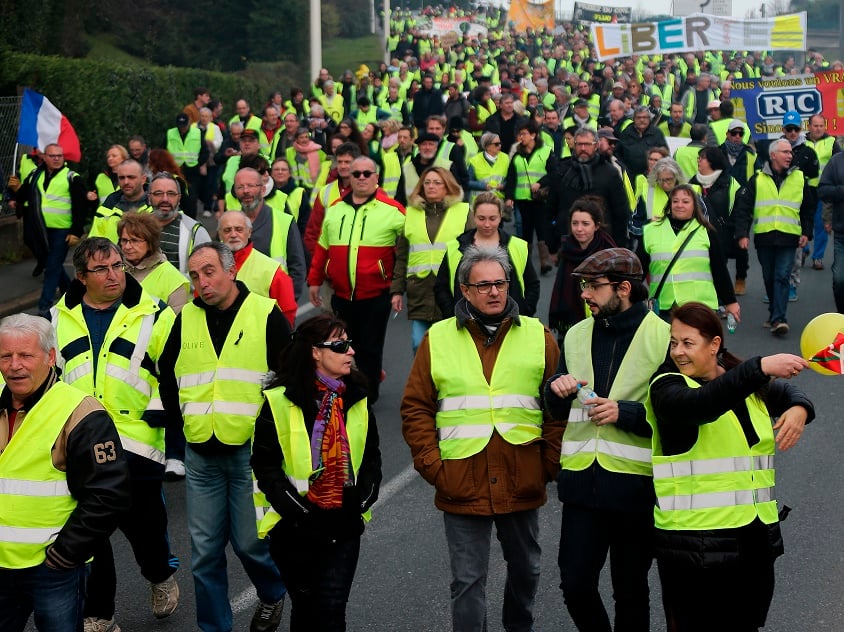
Police cited a cramped site, the risk of unrest and Paris’ offer of a larger alternative venue to convince the European court moving a three-day rally wasn't a human rights violation.(CN) — French yellow vest protesters wanted to take their message to President Emmanuel Macron’s doorstep, but Europe’s human rights judges said on Thursday Paris could make them move.The European Court of Human Rights unanimously ruled that France did not violate freedom of assembly when police blocked Le Syndicat des Gilets Jaunes from holding a three-day rally beside the Élysée Palace in 2022. The union argued restrictions on its chosen place and hours breached the European Convention and that repeated bans had quietly turned France’s advance notice system into one requiring official permission.The yellow vests became a national protest symbol on Nov. 17, 2018, when more than 280,000 people demonstrated across France over higher fuel taxes and living costs. The leaderless movement took its name and distinctive uniform from the reflective safety vests kept in French cars.The court accepted that moving a protest interfered with assembly rights because organizers normally can choose when and where to gather. But the Paris police had regulated the rally’s logistics, not its message, giving French authorities more room to assess the risks.Police backed their decision with specifics. The site had narrow sidewalks and numerous barriers, while an online appeal had spread among accounts reaching about 30,000 followers, casting doubt on the union’s estimate of 50 participants. Officials also documented injuries, arrests and damage at four recent demonstrations with similar demands.Rather than cancel the rally, Paris offered Place de la République on the same days. The square is a familiar stage for political protest and, by the government’s uncontested account, three times larger than the original site. French judges also reviewed the police order twice — once on the rally’s opening day and again the following day. The European court found that combination sufficient to balance protest rights with public safety.Roseline Letteron, professor of public law at Sorbonne University, said organizers generally control a demonstration’s time and place, while restrictions require concrete evidence of danger. “The availability of effective judicial review and of a suitable alternative venue was decisive,” she said.The yellow vest demands soon expanded to purchasing power, social inequality and direct democracy. Peaceful marches ran alongside burning barricades, looted shops and clashes with riot police. The Arc de Triomphe was vandalized in December 2018, and fresh violence struck the Champs-Élysées in March 2019. Macron’s government abandoned the planned tax increase, but arguments over policing and protest rights persisted.The union’s proposed 2022 rally reflected that wider agenda, with debates planned on constitutional reform, food and fuel prices, public services and the removal of Paris police prefect Didier Lallement. Police cited a high terrorism alert, limited staffing and unrest at four demonstrations in 2021 and 2022, including health pass protests and the banned Freedom Convoy.Béatrice Pastre-Belda, associate professor of public law at the University of Montpellier’s Institute of European Human Rights Law, called the outcome a straightforward application of established principles. The cramped site, documented unrest and workable alternative justified the restriction, she said, but the court had neither approved blanket bans around presidential palaces nor judged France’s notification system as a whole.Pauline Trouillard, a postdoctoral researcher at France’s National Centre for Scientific Research, was less reassured about the wider state of protest rights. She pointed to heavy policing at peaceful marches and restrictions on pro-Palestinian demonstrations.“Protesters should not see their freedom of assembly impeded because the state is not able to ensure that protests are supervised calmly,” she said.Alice Dejean de la Bâtie, assistant professor in criminal law at Tilburg University, focused on the strain repeated bans placed on organizers.“If exercising freedom of assembly repeatedly requires urgent litigation, sometimes overnight, through emergency proceedings and potentially up to France’s highest administrative court, the burden on organizers is substantial,” she said.Penalties for joining banned demonstrations could deepen that deterrent, she said, despite the 19 union rallies previously allowed.Neither the union nor the French government responded to requests for comment.The judgment is not yet final. Either side has three months to seek review by the Grand Chamber, which takes only exceptional cases. If no request succeeds, the protest that never reached the president’s garden will have reached the end of the legal road.Courthouse News reporter Eunseo Hong is based in the Netherlands.Subscribe to our free newslettersOur weekly newsletter Closing Arguments offers the latest about ongoing trials, major litigation and rulings in courthouses around the U.S. and the world, while the monthly Under the Lights dishes the legal dirt from Hollywood, sports, Big Tech and the arts.Additional Reads
Shifting a yellow vest protest falls short of obstruction
Full Article
Original Source
Read the full article at Courthousenews →KhanList aggregates and links to publicly available news content. We do not host full articles from third-party sources. Always verify important information with original sources.