
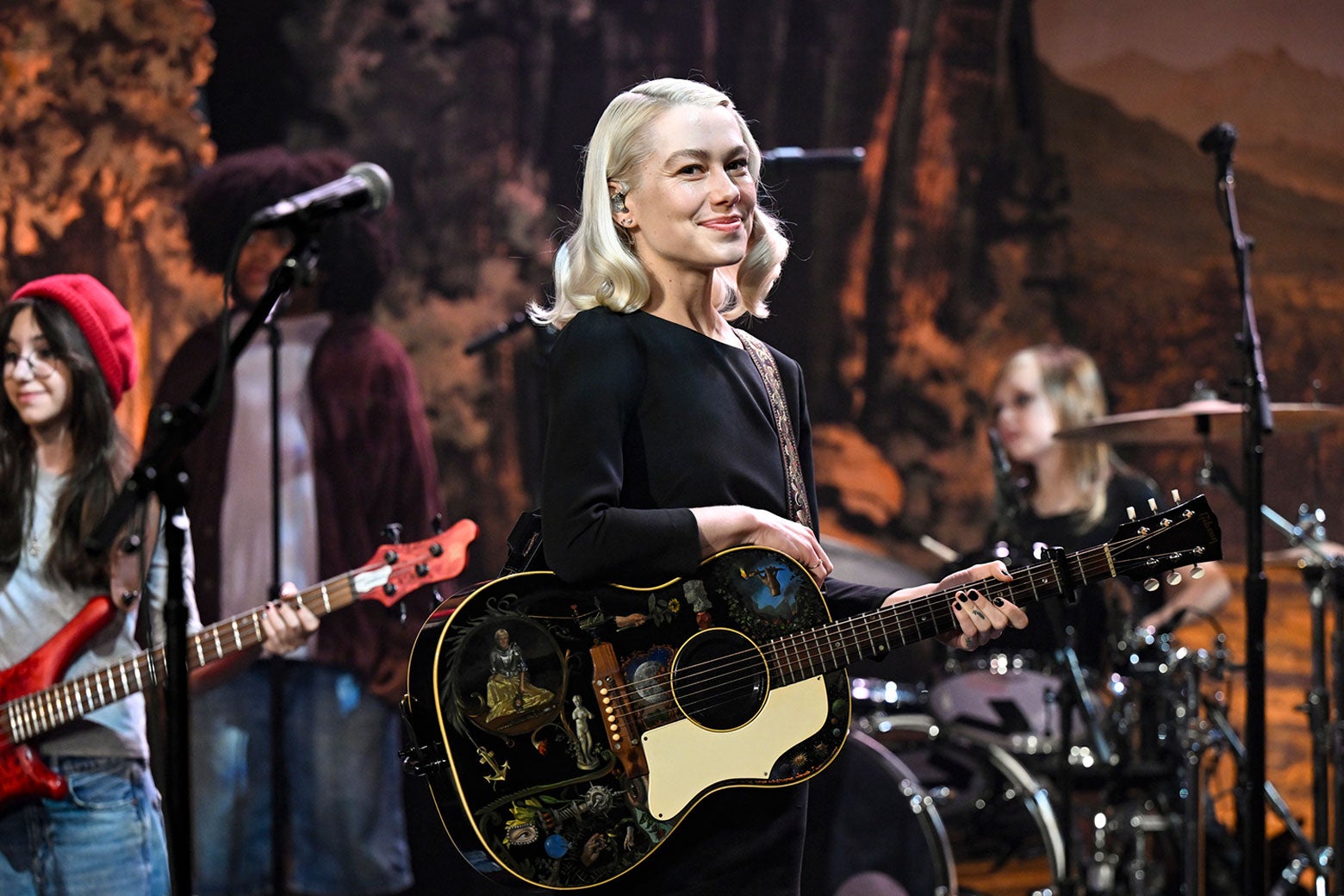
Music Phoebe Bridgers’ New Album Finds the Power in Singing Softly On her first solo record in six years, the indie rocker turned unlikely pop star confronts grief, new love, and sudden fame. Todd Owyoung/NBC via Getty Images Sign up for the Slatest to get the most insightful analysis, criticism, and advice out there, delivered to your inbox daily. For millennia, women’s voices have borne the burden of lamenting the dead, from the ancient Greek and Egyptian eras through to modernity, across cultures, including in Gaza today. But on “The Outside,” the track that opens Phoebe Bridgers’ return album after an extended bereavement leave from public life, she abjures obvious signs of feminine mourning, the sob or wail many listeners might expect from this supposed “sad girl” songwriter turned improbable pop star. Instead, she deploys a vocoder effect—that war-forged vocal filter with its emotionally and sexually neutered spectrum of drones—to turn herself into her own cybernetic Greek chorus. These Phoebe-bots step forward in the album’s first moments as if to update the listener on what’s happened offstage between acts. That is, in the long Lost Weekend, as the album title teasingly puts it, of the six-year gap since her second solo album, Punisher, which has become one of the defining records of the decade. Or at least the three years since her side “supergroup” Boygenius put out their own multiple-Grammy-winning album, The Record. To begin with, our hero has lost someone. “Crying in a suit and tie,” the vocoder narrates, calling to mind outfits fans are familiar with from Bridgers’ stage-wear and photo shoots, but also classic funeral garb. Then comes the trademark punch line: “But you should see the other guy.” Yeah, the one in the coffin probably got the worst of it. Mourning can be just the latest stage in a long combat. “One more time, for old time’s sake / I’ll watch him get carried away.” The deceased here is surely her father, who died in late 2022, and to whom the album is dedicated. His issues and parental shortcomings have been a subject of earlier songs. (“I’m gonna kill you, if you don’t beat me to it,” she sang at him on Punisher’s “Kyoto.”) So the double meaning of “carried away” here hits hard, perhaps as hard as Bridgers apparently drove her “fist through the drywall” in her grief. But then the voice switches to what listeners know as her “natural” soprano, and she sings in swelling cadences, “I am on the outside, watching.” That sense of distance and dissociation explains the need for the cyber-vocals, which return in the next verse to relate the memory of another ritual—stage-diving into the crowd at one of her own shows, letting fans prop her up, a third kind of being “carried away.” Her dad was there to see it. Still, she repeats, shifting back to the smaller human voice, “I was on the outside, watching.” In those first minutes, Bridgers, who turns 32 next week, sets up a lot of what she faced with this album. Lost Weekend is a record about grief that thankfully will also turn out to be one about new love, two forces that can overwhelm the senses and bring on expressive excess or stunned speechlessness. It’s a work that comes out of that funny, unnamable, Beckettian feeling, “I can’t go on, I’ll go on.” Beyond the upheavals in her life, a prime hurdle was her own success. Bridgers’ choice to retreat came soon after she complained about fans who “bullied” her for attention in an airport on the way to her father’s funeral. But there was also the dilemma of having so quickly fulfilled so many ambitions, on a scale she scarcely could have imagined in June 2020, when she released Punisher as a 25-year-old cult indie songwriter who followed the guiding star of the late Elliott Smith. In those strange early pandemic-lockdown days, her intimate, often conflicted and depressive but colorfully poetic songs struck a chord. So did, in her social-media posts and videos, her dry humor, hipster California drawl, and queer lefty sensibility (though inevitably never queer or lefty enough for some). Not to mention her platinum-blonde waifish looks, often clad in jokey skeleton costumes, which got sparklier and fancier as her star continued to rise. The attention snowballed as society opened back up, via gossip around the movie stars and musicians she dated; TV appearances, including a spot on Saturday Night Live where she scandalized squares by smashing her guitar (who did she think she was, a rock star? a man?); being picked up by Taylor Swift to open a leg of the “Eras” tour; making the fabled cover of Rolling Stone alongside her Boygenius songwriter comrades Julien Baker and Lucy Dacus, with whom she then sold out arenas to throngs of young female and LGBTQ+ fans singing along with every word; and finding herself echoed and imitated not only by newcomers like Gracie Abrams and Lizzy McAlpine but peers like Noah Kahan and that reliable wave-surfer Swift herself, who said of Bridgers in 2022, “she is the reference now,” and proved it in spots on her subsequent album The Tortured Poets Department. Though much of Bridgers’ music is shaped by the sound and skeptical mindset of the 1990s indie rock that was being made when she was a tot, she never seemed to share its squeamishness about mainstream fame. This lower-middle-class Pasadena kid looked happy to flirt with Hollywood and high fashion and attend the Met Gala. But as she sings on Lost Weekend’s closing track, “When a dream comes true, a fantasy dies.” Not only did she have to contend with the invasiveness of fans and press, but there was a growing risk that the delicate-yet-steely style she’d been honing since her teens as a precocious soloist and band member gigging around L.A. could become a dead end, a caricature of itself. Her contributions to the Boygenius album already carried a slight whiff of repetition. On an undated voicemail snippet touchingly included on one track on Lost Weekend, her father remarks, sounding a lot like his daughter for a second, “You’re everywhere, dude.” Did Bridgers get tired of the ubiquity of her own voice, one not always coming out of her own mouth? On one of the album’s standout tracks, “The Governor’s Waltz,” she shrugs at one would-be professional and romantic rival: “Being myself wasn’t easy / Do it for me.” (Fans are pretty sure they know who she means.) And she cautions on “Haunted”—otherwise a rollicking, hellbent-on-hope jamboree featuring bluegrass superstars Nickel Creek as well as her Boygenius pals on backup—“If you’re gonna make a wish, then you better be specific / You’re gonna have to live it every day.” It’s standard to want to slough off some of your own past schtick as you come out of your 20s, but tougher when that style and persona is one that’s made your fortune, one that tens of thousands of fans are attached to. As Bridgers says in Lost Weekend’s press bio, “I needed a different relationship to the music I was making and to the world in which it was going to appear.” Some of that adjustment has been apparent in the album rollout, with its series of pop-up shows in small venues where fans’ phones were sealed in inaccessible bags and they were asked to keep mum about the new songs. That plan was followed even with the surprise show at Madison Square Garden in June, as well as this week’s album listening parties. Those have taken place in selected planetariums, just as the earlier mini-tour followed a map of UFO-sighting hot spots. There’s nothing particularly spacey about Lost Weekend; it’s more that while reasserting control over her social contract with her audience, Bridgers was also renewing her gifts to them, including her own brand of whimsy. Musically, she had to reconsider even her literal physical voice, the surface embodiment of the reductive, sexist “sad girl” category for which Bridgers has so often been made an unwilling figurehead. Where some people have fetishized or mimicked her high moody hush, others scorned it as bloodless, or even coquettish. In Art Monsters author Lauren Elkin’s new book, Vocal Break: On Women, Music, and Power, she writes, “In indie music there’s been a fad for faint female voices. … The musicmakers and the market and not least the whisper girls themselves have constructed a sound of fragile white womanhood, and dressed it up as an aesthetic choice. … The whispery girls sing like they have nothing beneath the neck, no apparatus to produce more than wistful wisps of song.” She doesn’t mention Bridgers by name, focusing mainly on Billie Eilish (a dubious candidate for an “indie” singer), but I’ve heard other people similarly charge that Bridgers and her downbeat sisters’ understated tones are affectations to appeal to the aural equivalent of the male gaze. But these young women were coming up when big voices like Katy Perry, Lady Gaga, and Kelly Clarkson dominated the charts, so perhaps they reacted against that kind of bombastic, escapist recipe for supposed empowerment. They adopted an attitude that they were not going to lay it all out in bright colors, but insist through the closeness of their sound that you come to them instead, follow down into their shadows. Elkin herself cites the poet and classicist Anne Carson writing in “The Gender of Sound,” her recently reissued 1992 essay, that “high vocal pitch” has for centuries been used to “characterise a person who is deviant from or deficient in the masculine ideal of control.” But Elkin declines to quote Carson saying in the same essay: “Very few women in public life do not worry that their voices are too high or too light or too shrill to command respect”—or, in more recent terms, too “cursive,” with too much vocal fry, or too whispery. It’s a catch-22 in which everyone is always the wrong kind of feminine, too much or too little, too brash or too demure, such that even one as conventionally femme as Taylor Swift can end up fretting about her younger competition on “Anti-Hero” that “everybody is a sexy baby, and I’m a monster on the hill.” Granted, as Elkin delves deeper into Eilish’s work, she does eventually realize that perhaps she has to confront “my own preconceptions about soft female voices, my own internalised misogyny.” But those reflexive reactions and mixed signals continue to add up to one cultural message for Carson’s “women, catamites, eunuchs and androgynes”: shut up and go away. Bridgers has gone away, and on her return she seems determined to build vocal and musical soundscapes less apt to be misconstrued, truer to her own fluid sexuality, without surrendering her aesthetic essence. That begins with the vocoder, which later returns in the song fragment “Panorama.” Elsewhere she continues something she started on Punisher and with Boygenius, choosing moments for punk-rock shouts and heavy-metal screams that are all the more bracing given her usual soft-spokenness—the screech that opens the exuberant “Bobby” on Lost Weekend, or the way she yells repeatedly, in the climax of “As Above,” the words, “You won’t have to believe in magic / Leave it to me, and I’ll make it happen!” It overturns the tension the song sustains up till then, swooping it up in a sudden sonic tornado, briefly, before setting it down peacefully again. These are like the “high-pitched piercing cry” called the ololyga in Ancient Greek, made only by women, often as part of a ritual sacrifice, a sound confined to the outskirts and margins of the city, according to Carson: “No proper civic space would contain it unregulated.” But Bridgers’ music would. To extend her reach further, Bridgers has brought aboard the contemporary composer Caroline Shaw on vocal arrangements. Shaw became the youngest-ever winner of the Pulitzer Prize in Music in 2013 for her a cappella work Partita for Eight Voices, and previously crossed into the pop world working on Kanye West’s The Life of Pablo (before most of the awfulness) and last year on Rosalía’s acclaimed Lux. Here, where Bridgers in the past might mostly have harmonized with herself and occasional guests, Shaw helps weave multi-voiced background textures and codas that hint at vistas beyond the songwriter’s interiority. She’s probably also responsible for the use on the title track of a sample from composer Paul Lansky’s “Notjustmoreidlechatter,” part of a 1994 project that probed the overlapping territory between speech and sound. Occasional male voices slide into the mix, too, including the mysterious “Son-John Johnson” on “Kill Me” and “I Can’t Wait,” which is widely believed to be a pseudonym for the unmistakable pipes of Cameron Winter from Geese. That’s an entertaining little puzzle, though nowhere near as intriguing as why “Kill Me” uses the words “Tamám Shud” from the Rubaiyat of Omar Khayyam in an apparent reference to a notorious South Australian 1940s murder case. (Maybe Winter did it.) Likewise, instrumentally, large ensembles of musicians from across genres join Bridgers to build up atmospheric interludes between or within songs, and unexpected, unsettling jumps between styles. Some tracks are just quick sketches or outbursts, like “Never Going Back!”—a kind of campfire shout-along—and “Other Plans,” a pair that’s cordoned off in a way from the rest of the album by two instrumental versions of Punisher’s “Graceland Too,” for reasons I haven’t yet guessed. Many others cut off abruptly, denying the listener a sense of resolution. These are mostly not storytelling songs like the ones on Punisher or Bridgers’ 2017 debut album Stranger in the Alps, either lyrically or musically. Lost Weekend is not as eager to be your companion and comfort in hard times. It comes with guardrails to prevent the listener from over-identifying with her. It’s made to wrongfoot you, to divulge its depths only gradually with time, not to be immediately dissected and decoded online. The way the lyrics collage seemingly unrelated narratives and addressees are evasive maneuvers. As Bridgers sings on “Haunted,” “There is a difference between lying and deciding what not to say.” It’s as if the kind of coded allusions queer writers used to conceal taboo truths in the decades before Stonewall were now being reinvented out of necessity by a comfortably, openly bisexual pop star, merely to preserve her sanity in the social-media age. But then as now, such tactics also generate new subtexts and undertones. What might throw some fans off about this album, then, is the opposite of what they worried about when Bridgers released second track “Lost Boys” as a single in June and it came with the sort of standard, obvious pop chorus Bridgers had seldom used before. It also carried in its credits the name Jack Antonoff, the most overexposed producer today through his work with Swift as well as Lorde, Lana Del Rey, Sabrina Carpenter, and many others. In fact Antonoff is on all the songs here, and occasionally you can spot his touch, but only as one among many contributors. Though there are catchy hooks and pretty passages throughout, something usually comes along to disrupt or undermine them. And outside of “Lost Boys” itself, there’s nothing straining to be a hit—and even that single, as I’ve written elsewhere, gradually revealed its generational and gendered complexities on closer listening. One of the rewards of being somewhat cryptic in poetry or songs is that it’s all the more electric when you get direct. And what Bridgers is often wildly, exuberantly open about on Lost Weekend is being in love. Multiple songs are addressed to “Bobby,” as she calls her reputed partner of several years, better known to most people as the comedian–filmmaker–performance artist Robert “Bo” Burnham. I’m not given to tracking down “Easter eggs” about artists’ relationships, but this one’s not exactly subtle, given that Burnham himself sings on and co-wrote several of those songs. First they meet at a costume party in “Kill Me,” where “Bobby, you taught me that I know nothing.” That’s also the first track to sound a thematic note that arises again and again, about this love restoring her will to live. “This is gonna kill me,” she sings, but then, with a pause, “wait.” That redemptive moment would be unlikely in a Punisher song. The track actually called “Bobby,” meanwhile, is her most straight-ahead love song ever, with a forward-rushing energy. I tear up near the end when she sings, “Now I don’t know if I can make it tonight / But what are you doing the rest of my life?” But I laugh when she jokes about killing, if he doesn’t like them, “either one of my friends” (presumably Baker and Dacus), as well as retiring the “thing in a box I don’t fuck anymore.” Meanwhile “As Above” begins with shades of bygone family dramas, including “my mom driving herself to the hospital,” presumably because her dad had flaked out, maybe when she was in labor, before coming back around to that theme of love defying mortality: “I don’t want to live forever / But I don’t wanna die before I take you to Coney Island.” Speaking of circularity, there are two versions of the title track, each a melodic recitation over a droning, churchy organ, so near to the model of 2018’s lovely “The Last Great Washington” by the veteran Seattle songwriter Damien Jurado that he is given a credit. The first version seems to be an apology to an old friend from early in her career (“playing for no one, on top of the world”) for having let their bonds decay. But on the “Lost Weekend (Reprise)” that ends the album, it closes the circle from “The Outside” and returns explicitly to the subject of her father. “I am my old man’s oldest son,” she sings, no vocoder intervening between her lips and our ears now, and then makes a callback to that plaster-punching incident: “I fought the wall, and the wall won.” I love how the initial gender flip leads into the faux machismo of that wry play on the 1960s garage song turned Clash punk classic. But she also has tender things to say: “I still live by the things he taught me / Like how to forgive when they’re not sorry / And the government isn’t trying to kill you / They just don’t care if they kill you.” Then, in her softest, plainest, girliest Phoebe Bridgers voice, she sings, “But we’re gonna be alright / Me and you.” One love stands in for another. Change entails loss, but there are also gains, and important things that stay. Music Rock Pop
She’s Gone From Indie Rocker to Unlikely Pop Star. Now She’s Back With Her First Album Since the Big Change.
Full Article
Original Source
Read the full article at Slate →KhanList aggregates and links to publicly available news content. We do not host full articles from third-party sources. Always verify important information with original sources.