
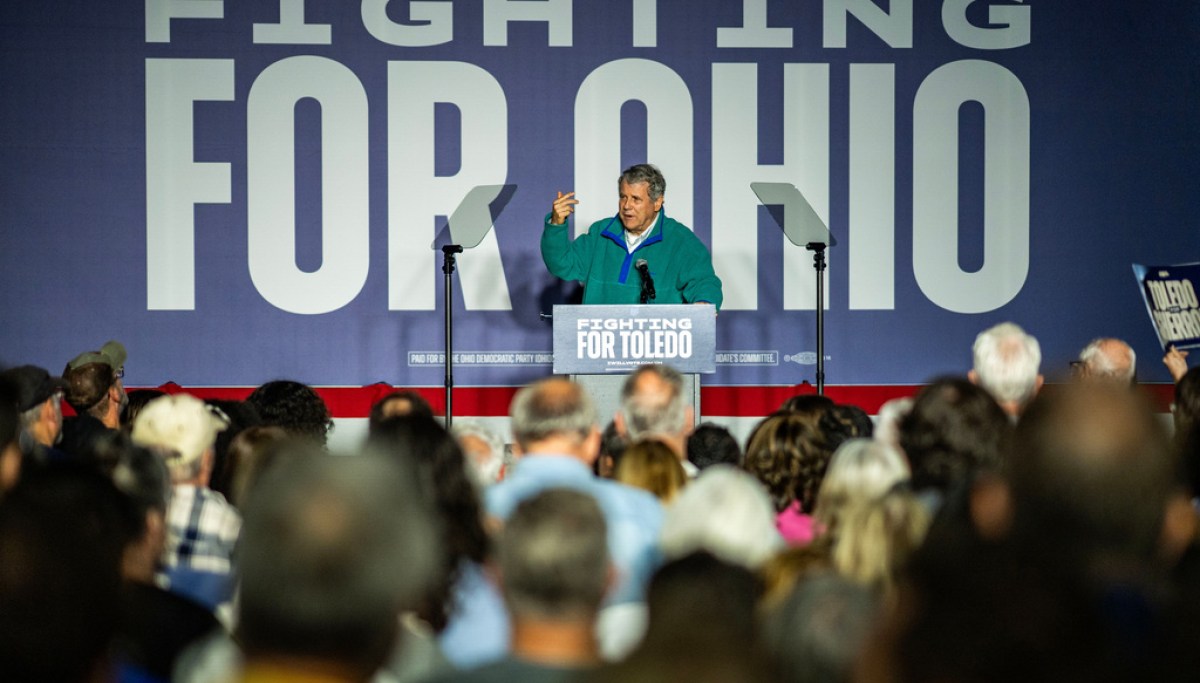
Ohio is emerging as a key battleground in the midterm elections, with competitive Senate and House races testing whether Democrats can win back the white working-class voters who have abandoned the party in favor of President Donald Trump.Few Democrats have a longer history of appealing to those voters than former Sen. Sherrod Brown, who built a reputation for championing blue-collar workers despite his liberal voting record.But that appeal was not enough to save Brown in 2024, when he lost reelection to Sen. Bernie Moreno (R-OH) after 18 years in the Senate and another 14 in the House. Two years later, Brown is seeking a political comeback against Sen. Jon Husted (R-OH), who was appointed to replace JD Vance after his election as vice president.In his comeback bid, Brown is trying to chart his own course and steer clear of national politics, emphasizing his record of taking on corporate interests.“I don’t care what the national political climate is,” Brown told the Washington Examiner. “It’s what I’ve done all my life. I’ve always, I’ve taken on the reg system. I’ve taken on Wall Street. I’ve taken on the drug companies. I’ve taken on the oil companies. I’m one of the leaders against these data centers where Jon Husted’s given them a $2.5 billion dollar tax break.”The message might just be resonating. Ahead of Election Day, Brown had an average 2.5-percentage-point-edge over Husted in polling. The race, however, remains in the margin of error.Meanwhile, in Ohio’s 7th Congressional District, which includes the southern suburbs of Cleveland, Democratic nominee Brian Poindexter told the Washington Examiner the cost of living and high gas prices were pushing blue-collar whites to give Democrats a second glance.“I got in it because the working families of our district are having a hard time, and it’s not just this district – across the country working people are having a hard time,” said Poindexter, who is running against scandal-tarred Rep. Max Miller (R-OH). “It’s because we don’t have representation, and what I would suggest for Democrats and even Republicans: run candidates that are representative of their district, run people who are authentic, authentic to themselves, who care about the issues that they’re fighting for, and I think in that way, you know, we’ll see our country get back on track.”Poindexter, a union ironworker and former Brook Park city councilman, conceded that Trump appealed to many working-class whites since his 2016 campaign promise of inaugurating a “golden age for workers.” Yet, Poindexter also argued the promises have not been lived up to.“Working people are still waiting for that golden age, and people have given up hope that anybody in Washington knows what they’re going through or even cares what they’re going through,” he said. “I think in that way, being a blue-collar worker, somebody who understands the value of work, is really going to hold a mirror up to Washington.”In Ohio’s 15th Congressional District, closer to Columbus, Democratic nominee Don Leonard, who is running against Rep. Mike Carey (R-OH), told the Washington Examiner that part of the Democratic Party’s problem with working-class voters is that it has “always had a big tent.”“One way to solve the big tent challenge is to try to triangulate, take the lowest common denominator of everyone’s shared beliefs, and try not to say anything that would offend anyone,” the Ohio State University city and regional planning professor said. “I think the problem with that is it doesn’t exactly exude conviction. There’s been a lot of talk about candidates being authentic, being relatable. I actually think what people are hungry for now are candidates with conviction that are willing to speak to their values, and then give the voters the, you know, trust their intelligence enough to decide, ‘All right, I don’t agree with that person 100% of the time. Maybe I agree with them 80% of the time, but I respect the words that are coming out of their mouth. I believe that they believe what they are saying.’”In 2018, 52% of voters without a college degree voted for Brown, compared to 48% who voted for then-Republican nominee Jim Renacci. Brown also earned 12% of the vote of Trump supporters, in contrast to Renacci’s 88%.Six years later, Brown’s support among voters who did not have a college degree decreased by 11 points, 41% to Moreno’s 55%. He also halved his support among Trump supporters to 6%, compared to Moreno’s 91%.Michael Vitiello, a 73-year-old Bloomingdale steelworker who attended a meet-and-greet with Brown in eastern Ohio this month, told the Washington Examiner that this election cycle could be different for Brown, with some of his Trump-supporting friends now considering other options.“With the way the president’s acting, they’re changing their party,” he said before providing reasons he had heard regarding why. “The economy, the gas, the fuel, the groceries.”Ron Green, 58, a Rayland letter carrier, agreed, citing a Trump-supporting friend who “burnt all his MAGA clothes and everything.”“He’s had enough,” Green said. “They’re a small business owner. He’s destroying it. He’s killing it with the cost of everything. You know, just the war and the price of gas.”In comparison, Sue Bradley, an independent voter who was at a Poindexter town hall, told the Washington Examiner she used to be a “diehard Republican that just voted straight Republican” before Trump.“The Republican Party right now has gone too right-wing, or too rogue, or on some issues,” she said. “I don’t support everything that the Democrats are for either. But I do like candidates that are willing to work against the aisle and get both people’s point of view.”IMPEACH TRUMP AGAIN? OHIO DEMOCRATS GRAPPLE WITH DIVISIVE QUESTION AHEAD OF MIDTERM ELECTIONSRegardless, Republican Sam Matthews, an at-times independent voter who dropped into the Ohio GOP bus tour launch party in Strongsville, remained adamant Democrats continued to be too extreme for most of the electorate.“The old Democrats used to be good,” the Broadview Heights retiree, 59, said. “The new Democrats are so far left and want this and want that for nothing and defund the police. I mean, golly, it’s just amazing. I don’t get it.”
Sherrod Brown tests whether Democrats can win back white working-class voters in Ohio
Full Article
Original Source
Read the full article at Washingtonexaminer →KhanList aggregates and links to publicly available news content. We do not host full articles from third-party sources. Always verify important information with original sources.