
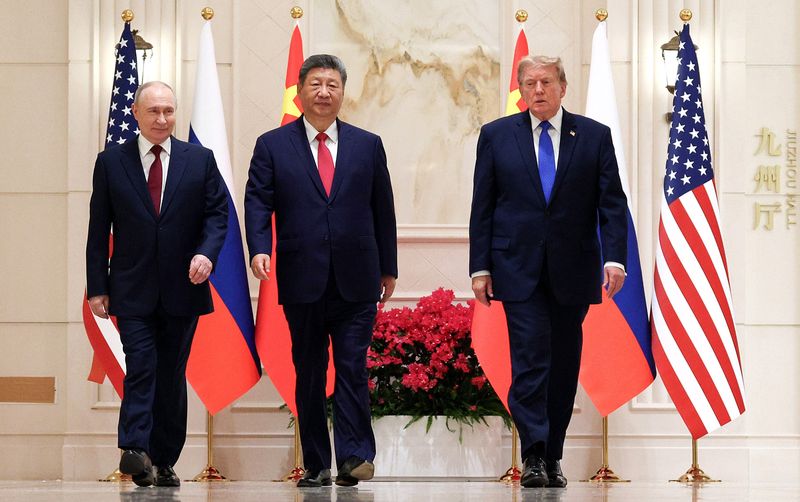
US President Donald Trump may have been fantasising about Yalta when he boasted, “We are really making history” at last week’s summit with the president of China, Xi Jinping and of Russia, Vladimir Putin, in Shenzhen, China.The trio would be addressing “issues impacting not just our people but the entire planet”, said Trump.The meeting was certainly historic in the narrow sense that it was the first time the leaders of all three countries met.But whether their deliberations would affect the entire planet and if so, how, was doubtful. Ahead of the meeting, commentators were quick to invoke the spectre of Yalta. In February 1945, as World War Two drew to a close, US President Franklin Roosevelt, Soviet leader Joseph Stalin and British Prime Minister Winston Churchill met in the Crimean resort town to draw the boundaries between communist dictatorship and capitalist democracy in post-war Europe – effectively carving up the world between them.(From left) Russian President Vladimir Putin, Chinese President Xi Jinping and US President Donald Trump attend a trilateral meeting in Shenzhen, China, on 19 November. (Photo: Vyacheslav Prokofyev / EPA / Sputnik / Kremlin Pool)The comparison with Yalta was always going to be “a bit overblown, because the conditions that existed in February 1945 compared to today are completely different”, said a South African official who requested anonymity because they are not authorised to speak to the media.“When those three leaders met in Yalta, the world was completely shattered and exhausted by the war, and the three parties were the undisputed preeminent leaders in terms of power. There was actually no one who could challenge them in any sort of way.”Their respective armies held the territories they claimed.“And Roosevelt and Churchill were so desperate to have an end to the war in the Pacific, and in general just to end the war, that they were willing to roll over on anything Stalin wanted.“But today I don’t see the same prevailing. Yes, the US and China and Russia to an extent are preeminent powers, but they’re not alone. There are still powers that can challenge them and contest whatever they may agree.“If there were to be something of a carve-up, that would be around the core interests of the three. But it’s not to say that Taiwan will just roll over. Ukraine has shown it’s definitely not going to roll over for anything agreed … by the three. Iran’s not rolling over. “And then there’s other forces. You’ve got the EU, you’ve got [Canadian Prime Minister] Mark Carney’s idea of the alliance of the like-minded middle powers. And other forces would also counter any carve-up deal by the three big powers.” Canadian Prime Minister Mark Carney. (Photo: Cindy Ord / Getty Images) The official added that if the three leaders had made – or could still make – progress towards ending the wars in Ukraine and Iran, it would benefit South Africa as much as anyone else by reopening the Strait of Hormuz and the Bab el-Mandeb Strait, and lowering oil and other prices, including those of fertiliser.But there was no sign of that, at least publicly, just a brief and rather vague “peace declaration” issued after the meeting, though of course they might have discussed other things in private in their 90-minute meeting. The very fact that two autocrats – and one would-be autocrat, as some commentators put it – got together and presumed to make decisions for the planet was itself ominous.Risks and opportunities for AfricaAs Priyal Singh, geopolitical analyst for Signal Risk and senior research consultant for the Institute for Security Studies (ISS), said, the meeting, “while producing few concrete outcomes, signals a potentially significant shift towards a more transactional international order in which major powers increasingly seek to negotiate the rules of global politics among themselves.“For African countries, this presents both opportunities to leverage competing economic and security interests, and risks that their priorities become secondary to broader great-power bargains. “For South Africa, the challenge will be to maintain strategic autonomy and diversify its partnerships without compromising its commitment to multilateralism, particularly as the interests of its BRICS partners and the United States increasingly intersect.”(From left) Russian President Vladimir Putin, Chinese President Xi Jinping and US President Donald Trump pose for a group photo before their trilateral meeting in Shenzhen, China, on 19 November. (Photo: Vyacheslav Prokofyev / EPA / Sputnik / Kremlin Pool)The Yalta 2.0 analogy did not seem far-fetched before the meeting. Trump has certainly given strong signals that he is ready to accept Putin’s claim to Ukraine, or at least a large slice of it. He has also raised doubts over whether he would come to Taiwan’s defence if China attacked it.Putin and Xi seem to support each other’s territorial ambitions and already support each other militarily. And both seem willing, in exchange for such concessions, to accept the “Donroe Doctrine”, Trump’s reassertion of the Western Hemisphere as a US sphere of influence.In its visible outcome, though, the meeting was far less ambitious and consequential. In their brief “Declaration towards Peace”, the three leaders “committed to maintaining strategic stability and international security ... to reform the UN so that the UN can respond more effectively to global challenges ... [and] to increase the production and supply of refined petroleum products for the benefit of all nations”.They “recognized that the principle of state consent and respect for immunities of State officials are of paramount importance, and concurred that the International Criminal Court and other similar bodies must not abuse their jurisdiction”.They “reaffirmed that a nuclear war cannot be won and must never be fought”, agreeing to “conduct a dialogue on reducing nuclear risks and preventing the proliferation of nuclear weapons”.The three leaders agreed that a nuclear war must never be fought. (Image: Adobestock) Trump, the loserMost commentators believed Xi and Putin were the winners of this encounter and Trump – or perhaps one should say the US – was the loser.“For Mr Putin, the meeting was the win,” said The Economist. “To sip tea with Mr Trump and Mr Xi, even while his missiles are murdering Ukrainian civilians in their homes and railway stations, exposes Western disunity and the failure of attempts to isolate him.”“Mr Xi also gains. The world saw Mr Putin and Mr Trump, two leaders embroiled in disastrous wars in Ukraine and Iran, paying tribute to a China that is at peace.”Trump added, the Economist said, that the three powers, “major victorious countries” of the Second World War, should now uphold world peace through mutual respect and avoiding one another’s “red lines”. If the meeting undercut Western efforts to ostracise Russia, “that suits China, too. Who knows when it might want to conquer Taiwan… How handy to inhabit a post-pariah world, in which big powers can invade the small with impunity. “In sad contrast, Mr Trump looked like a loser,” it said. He appeared to have been so awed by the Yalta-like optics that he missed the opportunity to discuss China and Russia’s military support for Iran. Or China’s support for Russia against Ukraine, one should add. DM
Shenzhen: Why the Trump-Xi-Putin summit was no Yalta — and what it means for SA
Full Article
Original Source
Read the full article at Dailymaverick →KhanList aggregates and links to publicly available news content. We do not host full articles from third-party sources. Always verify important information with original sources.