
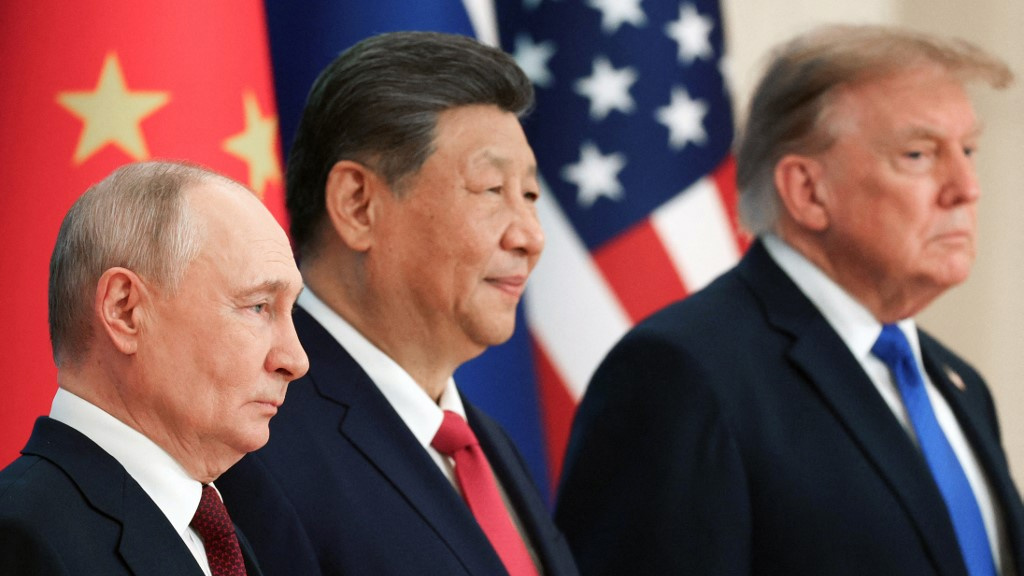
The first-ever US-Russia-China summit produced a thin declaration, and no carve-up of the world. But the format itself - three powers, one table, no Europeans - might matter more than anything they signed. In February 1945, US President Franklin Roosevelt, UK Prime Minister Winston Churchill and Soviet leader Joseph Stalin met in Yalta to settle the shape of the postwar world. Eight decades later, Donald Trump, Xi Jinping and Vladimir Putin sat down on the sidelines of the Apec summit in Shenzhen for the first trilateral meeting ever held among the leaders of the US, China and Russia. The comparison was irresistible. Yet after roughly 90 minutes of talks, what emerged was far more modest: a four-point joint “Declaration toward Peace”. The statement’s text suggests that what was supposed to be a historic event was mostly just a photo op. This brings to mind another photograph, one that adorned the front page of The New York Times a quarter of a century ago, during a United Nations summit in New York in September 2000 that was meant to mark the beginning of a new era focused on “Millennium Development Goals”. New MEE newsletter: Jerusalem Dispatch Sign up to get the latest insights and analysis on Israel-Palestine, alongside Turkey Unpacked and other MEE newsletters Instead of picturing the General Assembly Hall, the newspaper used an image of the leaders of the UN Security Council’s five permanent members around a table outside the summit - conveying to readers exactly who was really running the show. Twenty-six years later, the number of leaders dropped from five to three; the two Europeans (the UK and France) were missing in action, and along with them, sadly, the entire EU. What the declaration said The venue of the major event this time around was Shenzhen, the most technologically advanced city in the world, which a few decades ago was just a fishermen’s village. Incidentally, the only leader who sat at both tables was Putin; if symbols have value, the Chinese and the Russians appear to be the real winners here. As Xi said to Putin in March 2023 after a meeting in Moscow: “Right now there are changes - the likes of which we haven’t seen for 100 years - and we are the ones driving these changes together.” In Yalta, the US, UK and Soviet Union agreed on the post-conflict arrangements of a war they had already won. In Shenzhen, however, neither the Russia-Ukraine war nor the US-Iran conflict was approached with meaningful results - nor did the leaders deal with the looming clash between the US and China. Are the three leaders sending a veiled threat to other agencies, such the International Court of Justice, which is examining Israeli actions in Gaza as a possible genocide? The resulting declaration was short enough to summarise in a few sentences. Firstly, the three leaders committed to reforming the UN so that it could “respond more effectively to global challenges” - a goal they have pursued since the early 1990s, to no avail. Secondly, they pledged to increase the production and supply of refined petroleum products, stressing the importance of stable energy flows. If this is actually implemented, it would be the summit’s only concrete deliverable. Thirdly, they declared that state consent and the immunities of state officials were of “paramount importance”, warning that the International Criminal Court (ICC) and similar bodies “must not abuse their jurisdiction”. At first sight, this looks like a gift to Putin, who is the subject of an ICC arrest warrant - but the reference to “similar bodies” raises questions. Are the three leaders sending a veiled threat to other agencies, such as the International Court of Justice, which is examining Israeli actions in Gaza as a possible genocide? Time will tell. Finally, the declaration reaffirmed that “a nuclear war cannot be won and must never be fought”, and announced a trilateral dialogue on reducing nuclear risks and preventing proliferation. There was no mention of limiting or reducing their own nuclear arsenals. What the declaration omitted What was missing from the declaration spoke louder. Ukraine, Iran, North Korea, Gaza, Taiwan and artificial intelligence - the conflicts and flashpoints that actually threaten international security - went unmentioned. The three leaders did not even state a commitment to meet regularly. The decisive reason is Beijing, which hosted the meeting but has consistently rejected the Yalta analogy, with Chinese analysts going out of their way before the summit to insist that the logic of blocs and spheres of influence did not apply. This is not only rhetoric. A formal carve-up handing Russia a sphere in Eastern Europe would sit awkwardly with a foreign policy built on the vocabulary of sovereignty and non-interference. Xi was happy to host; he was not willing to underwrite a partition. The result was a text designed so that nobody conceded anything - which is precisely why it decides nothing. Of course, the distribution of economic power at the table was not equal. The economic weight was overwhelmingly American and Chinese. Russia brought nuclear parity, energy and a war, but it owns an economy whose nominal GDP is roughly the size of Italy’s. Nevertheless, the trilateral format flattered Moscow by placing it on par with the two genuine poles of the system - and that recognition, together with the symbolism, was in itself one of the summit’s main deliverables for the Kremlin. Europe outside the room If Yalta is the wrong analogy in substance, it is uncomfortably apt in one respect. The EU, whose trade with the rest of the world exceeded €8 trillion ($8.8 trillion) in 2025 - around 16 percent of global trade, more than the US or China - had no seat, and the declaration did not mention Europe once. The choreography of the day was telling. While the three leaders met in Shenzhen, Ukraine’s European backers gathered in Berlin for a “Coalition of the Willing” meeting, with Trump’s envoys Steve Witkoff and Jared Kushner attending. Washington, in other words, had a presence in both rooms, and Europe in only one - but the US leader sat in Shenzhen, and not in Berlin with his nominal allies. As China embraces Russia, the western narrative needs a rethink Read More » French Foreign Minister Jean-Noel Barrot tried to wave the Shenzhen summit away, remarking that “these three leaders fundamentally disagree on everything, so they cannot agree on anything”. It was a clever line, and to a certain extent accurate about the text - but perhaps less reassuring about the format. The real significance of Shenzhen lies not in what was agreed, but in who was considered necessary to agree. For three decades, the working assumption in Brussels was that great-power management of global issues - nuclear risk, energy security, the reform of international institutions - would run through the West, with Europe as a junior but indispensable partner of Washington. Apparently no more: Trump’s phone call to European leaders gathered in Berlin while he was flying back home was a small gesture devoid of meaning. So did Shenzhen mark the end of an era, or was it about three powers trying to secure their share of the cake? The honest answer is both - but not in the way the Yalta framing implies. It marks the end of an era in the sense that the liberal premise of the post-1991 order - that rules and institutions bind the strong as well as the weak - has been rejected in writing by the three most powerful militaries on earth. The immunity clause and the warning against “abuse” of jurisdiction were the most substantive passages in the text, pointing in one direction: towards a world in which great powers accept only the constraints they consent to. But it is not yet a new order, because there is no agreement on how to slice the cake. Key takeaways Each leader came for something different. Trump wanted the image of a dealmaker, able to sit with both rivals at once, plus energy and AI talking points for domestic audiences. Putin wanted recognition, as a peer of Washington and Beijing, and to send an implicit signal to Kyiv and Europe that their fate can be discussed elsewhere. Xi wanted to show that Beijing is now the venue where great-power diplomacy happens, while committing to nothing that would constrain China. All three got their photo op. None got the others to pay. What Shenzhen inaugurates, then, is less a Yalta-style partition than a club: an informal concert of nuclear powers that meets when convenient, shields its members from external judgement, and treats everyone else - Europe, Ukraine, Japan, India - as subjects of discussion rather than participants; they are on the menu, and not sitting at the table. True, the leaders of these three countries disagree on many topics. But Europe's influence cannot depend indefinitely on their disagreements Clubs of this kind do not need treaties to be consequential. They need only the habit of meeting. For European capitals, the temptation will be to take comfort in the thinness of the declaration. That would be a mistake. The lesson of Shenzhen is not that the big three agreed on Europe’s fate; it is that they no longer feel the need to consult Europe before discussing the questions that shape it. In almost five years of conflict in the old continent, European leaders have not been able to agree on a special representative for the Russia-Ukraine conflict. A few days ago, perhaps realising that EU foreign policy chief Kaja Kallas - a fanatic Russophobe who was not even aware of the outstanding contributions of the Soviet Union and China to the outcome of World War Two - was totally unfit for the role, they picked seven different European representatives to handle negotiations. In other words, they put aside Snow White, and decided to carry on with the seven dwarfs. How can they pretend to be taken seriously by Washington, Moscow and Beijing? True, the leaders of these three countries disagree on many topics. But Europe’s influence cannot depend indefinitely on their disagreements. Shenzhen was not Yalta. The danger is that it might have been a rehearsal. The views expressed in this article belong to the author and do not necessarily reflect the editorial policy of Middle East Eye.
Shenzhen was not Yalta, but Europe was definitively sidelined
Full Article
Original Source
Read the full article at Middleeasteye →KhanList aggregates and links to publicly available news content. We do not host full articles from third-party sources. Always verify important information with original sources.