
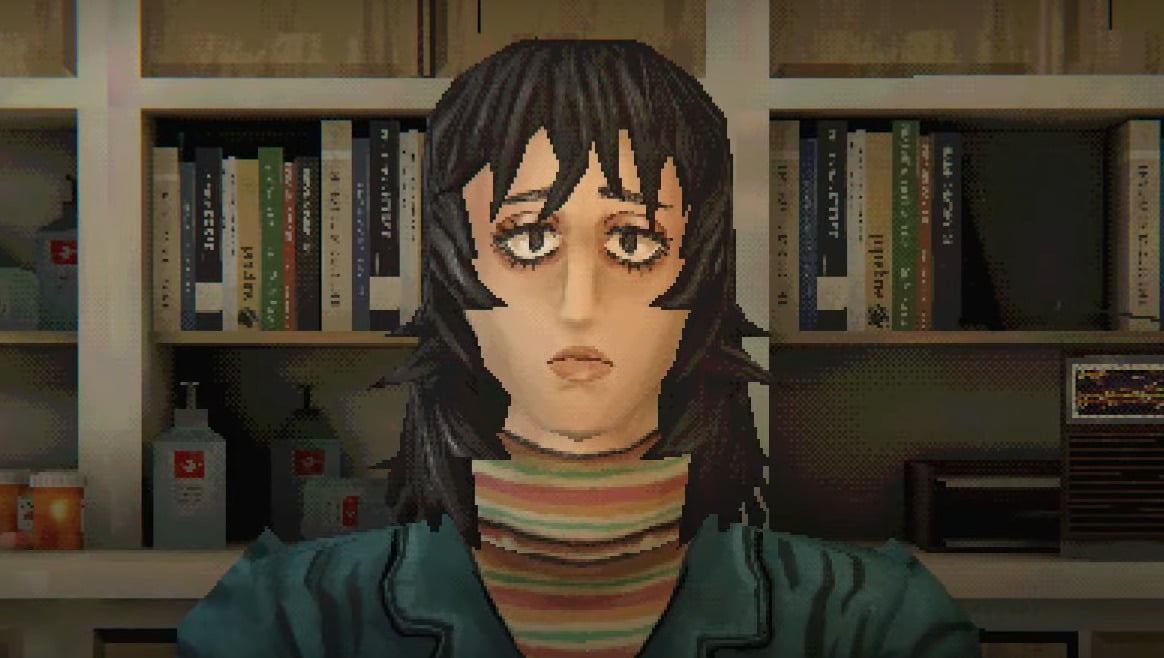
Shelley Duvall’s eyes gleam like moonstone whenever she’s caught on camera. Her odd mouth twists around a secret before her teeth make themselves known in a lovely, blueberry pie–eating smile, and I imagine a dull halo tilting over her head before Jack Nicholson tries to ax her in half in The Shining (1980). In 2024, the reclusive actress died after two decades away from Hollywood, but that image of Duvall looking as heavenly and poppable as a soap bubble stays in my mind, and in an increasing number of horror games. Duvall practically has a starring role in 2024 indie hit Mouthwashing, whose puddle-eyed nurse Anya was explicitly inspired by the actress, according to developer Wrong Organ. Rosemary Walten in the multimedia Five Nights at Freddy’s fan project The Walten Files likewise shares Duvall’s North Star eyes and Shetland pony hair, and fans are taking notice. As one Twitter post with over 151,000 likes says, “The People yearn for Shelley Duvall.” To me and her many other admirers, Duvall seemed like the only woman who managed to peel herself off a storybook page, leap into the world, and flash her doll lashes. At the peak of her acting career, between Robert Altman’s 1975 drama Nashville and the end of her self-produced Faerie Tale Theatre anthology series in 1987, Duvall’s on-camera presence could only be matched by a night-blooming tuberose: fragile, enigmatic, belonging to the moon. As Wendy Torrance in The Shining, trapped in an evil hotel with her ax-swinging husband, Duvall proves it’s possible for a person to melt like snow. A contemporary review in The Washington Post called her “jittery and amateurish,” but decades of additional scrutiny have instead revealed Duvall’s performance to be as deliciously vulnerable as a bloody bandage. Duvall then used her sensitivity to channel other worlds in Faerie Tale Theatre, for which she acted as both gracious host and downcast princess. It was always about how she looked—unusually grasshopper-like with milk saucer eyes and a long, thin body—because her appearance seemed irremovable from the startling feelings she was able to convey. So games and related horror media try to replicate it for their most unguarded female characters. Anya, Rosemary (who also appears in the popular fan game Bon’s Burgers: After Hours), and nervous ghost Zoey Bennett from Date Everything…These women all share dark hair, Duvall’s pleading eyes, and proximity to death. Death, after all, is the universal threat that makes someone seem at risk in the first place. Like Duvall as Wendy Torrance, Mouthwashing‘s Anya dares to care for those she loves even after they’ve proven they’ll hurt her. Like Duvall herself, Rosemary from The Walten Files uses film to express her fears and fantasies, while Zoey encapsulates Duvall’s shaky nature, quivering like a willow in the breeze. Both in her characters and as a real-life artist, Duvall seemingly lived between endurance and total breakdown. It’s a tender spot few people are willing to exist in, and that’s what makes Duvall one-of-a-kind in being suited for video games, which are too often masculine power trips—she even made a few of her own educational computer games in the ’90s. Her delicacy is also what makes her spirit haunt horror games in particular. A great horror game should make you feel exposed, just on the verge of frostbite, and nothing expresses that feeling better than the soft, wafer heart of Shelley Duvall. Other games might prefer to make homages to dead superstars by stealing their actual likeness, as Onimusha did with legendary Japanese actor Toshiro Mifune, or photocopying their soul with AI, as Stranger Than Heaven does with its aged-up version of Tupac. The results with this approach are jarring, more like grave-robbing someone’s bones than building a statue in their honor. But horror games respect Shelley Duvall’s legacy in the genre enough to borrow her just her beautiful wimpiness and let the rest of her sleep, approximating her face and demeanor for characters that either intentionally or subconsciously pay tribute. The English poet Thomas Hardy writes in “Shelley’s Skylark” (which was a reaction to Percy Shelley), “The dust of the lark that Shelley heard, / And made immortal through times to be; — / Though it only lived like another bird, / And knew not its immortality: / Lived its meek life; then, one day, fell.” While anyone’s descent toward the ground is inevitable, there was covetable power in Duvall’s meek life and body, especially in The Shining. So two years after her death, Duvall continues to teach people how to be gentle and, consequently, scared to the core.
Shelley Duvall Is Still Horror Gaming’s Scream Queen
Full Article
Original Source
Read the full article at Kotaku →KhanList aggregates and links to publicly available news content. We do not host full articles from third-party sources. Always verify important information with original sources.