
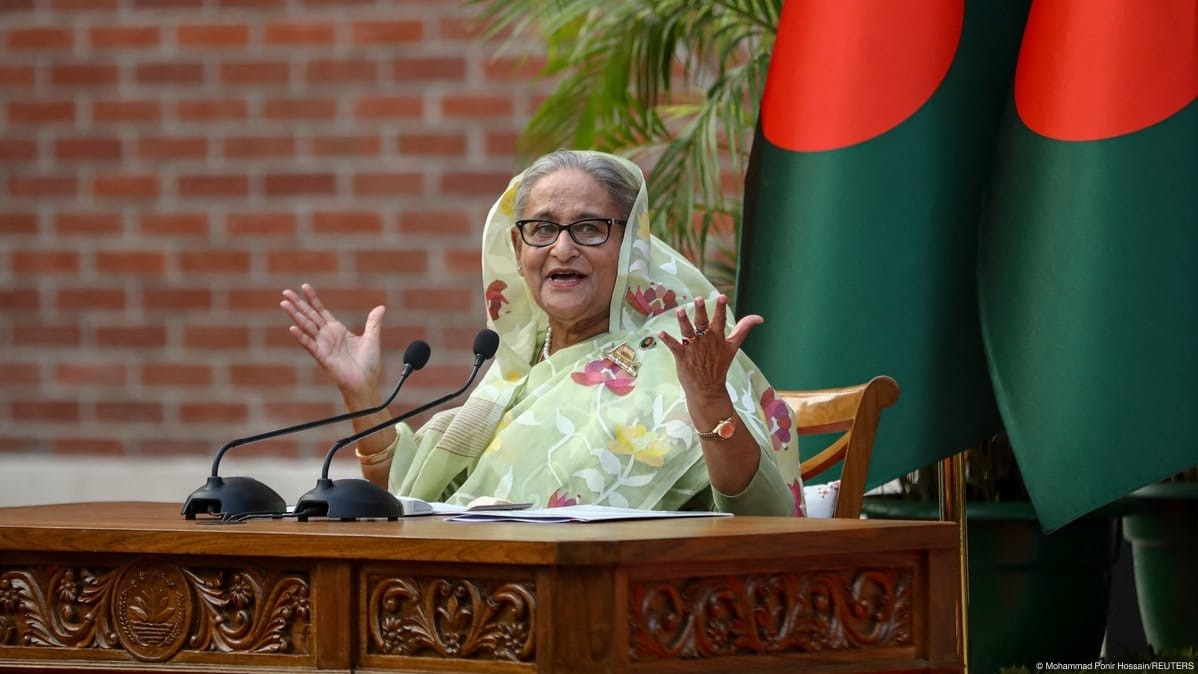
Deposed Bangladeshi Prime Minister Sheikh Hasina has set December 16 for her return, two years after fleeing to India following a bloody student-led uprising. However, the path home remains thorny, with a death sentence hanging over her. While Hasina has sought to return as a political leader, requesting a passport, Bangladesh wants her extradited - "in handcuffs" as a "terrorist".Since Hasina fled to India on August 5, 2024, her extradition has cast a shadow over India-Bangladesh ties. The Muhammad Yunus administration moved swiftly to revoke her diplomatic passport and block her national identity card (NIC). In November 2025, she was handed the death penalty after being convicted in absentia for alleged crimes against humanity during the 2024 agitation. It left over 1,000 dead. Protesters celebrate beside a defaced portrait of Prime Minister Sheikh Hasina after news of her resignation Hasina has rejected the verdict by the International Crimes Tribunal (ICT) in Dhaka. She has repeatedly stressed that she is ready to fight the case once back.However, the ICT has previously said that Hasina would not be able to appeal her death sentence as the required deadline had already passed. It has said there is no legal basis to stop her execution. Bangladesh law also provides for presidential clemency for convicts on death row. However, Hasina has never sought it, and has rejected the ICT verdict outright.PASSPORT ROW ADDS TO STANDOFFNow, with Hasina setting a specific date for her return, the standoff will only intensify amid a charged atmosphere in Bangladesh. Over the past few days, emboldened Awami League cadres have hit the streets, resulting in clashes and violence across Bangladesh. The residences of several Awami League leaders have also been torched. Against this backdrop, Hasina has urged the Tarique Rahman government to arrange a Biman Bangladesh flight to bring her back."Since Hasina was flown to India on a Bangladesh aircraft on August 5, 2024, she now calls upon the government to arrange for her air transport from Delhi back to Dhaka," her spokesperson said in a statement.The Awami League supremo applied for a fresh passport and NIC through London-based law firm Matrix Chambers on November 9. However, Bangladesh authorities pointed to the communication having no authorisation or signature of Hasina. Subsequently, a second letter was sent to the Bangladesh High Commission on November 19.However, it too sparked a controversy. Rashed Khan, political assistant to the Bangladesh PM, alleged that Hasina's signature on the authorisation letter was forged.Nevertheless, Bangladesh has categorically rejected issuing any travel document to Hasina, labelling her a "terrorist". The BNP government has made it clear that she could return only through extradition under a "prisoner transfer process".Humayun Kobir, Bangladesh's state minister for foreign affairs, said Hasina would be arrested upon her return and sent to jail."Reality is that a terrorist will never be allowed to come back other than through extradition. She can only be brought back in handcuffs," Kobir said on Tuesday.CAN SHEIKH HASINA BE EXTRADITED?India and Bangladesh signed an extradition treaty in 2013. However, it does not automatically mean that India has to hand over Hasina to Bangladesh.As per the treaty, a country can refuse extradition if the offence is of 'political nature'. There is also an exhaustive list of offences that cannot be deemed 'political'.For example, some of the offences under which Hasina has been convicted - murder, enforced disappearances and torture - are excluded from the definition of political crimes in the treaty.Thus, any extradition will require the cooperation of India. So far, New Delhi has walked a tightrope. It has previously said it was examining the extradition request and wanted to engage constructively with the Tarique Rahman government.Government officials have said Hasina can be extradited either on a Bangladeshi passport or an emergency certificate that would prove that she has Bangladeshi citizenship, according to a report in The Hindu.In more recent remarks, the MEA described the passport's requirement for extradition as a "technical issue". "Obviously, for the travel of people, you need a travel document," MEA spokesperson Randhir Jaiswal said in his weekly media briefing.The situation raises a pertinent question. Why is the Bangladesh government pressing India to extradite her on one hand, but refusing to issue her a passport to facilitate her voluntary return?WHY IS DHAKA WARY OF HASINA'S RETURN?It all lies in the optics. The recent protests in Bangladesh have shown that Hasina still enjoys some level of support.If Bangladesh manages to get Hasina extradited, the BNP government can boast that it brought back a wanted fugitive to face the law in the country. On the other hand, if Hasina is provided a passport to travel home, it would give her the upper hand. It would send a message that despite facing the death penalty, she did not seek asylum in India and was willing to return home.Essentially, it could generate a wave of sympathy for Bangladesh's longest-serving prime minister. Moreover, it would also provide a new lease of life to her fragmented Awami League party.The Tarique Rahman government, already under the pump over its handling of the economy and the power crisis, can ill afford such optics.It is why several experts have suggested that Bangladesh's insistence on Hasina's extradition could be a tactic aimed at delaying her homecoming.There is also a possible third option for Hasina. If she wants to return on her own, the option of using land border crossings, such as Benapole-Petrapole on the West Bengal border, may also be on the cards. However, such a move may quickly escalate into a tense confrontation on the border - something both New Delhi and Dhaka will want to avoid.Such a situation may be unique, but Bangladesh has a history of leaders going into exile before returning eventually. Tarique Rahman himself was in self-imposed exile in the UK before returning last year ahead of the elections.Hasina too returned to Dhaka from exile in India in 1981, but the circumstances were vastly different. She was then seen as a victim, having lost her father and most of her family in the 1975 assassination. Today, she is viewed in Bangladesh as a fugitive, convicted for allegedly ordering the deadly crackdown on protesters during the 2024 agitation.For now, all eyes will be firmly on how the situation unfolds in the coming weeks as December 16 draws closer.- Ends
Sheikh Hasina sets Bangladesh wapsi date. Will she be able to return?
Full Article
Original Source
Read the full article at Indiatoday →KhanList aggregates and links to publicly available news content. We do not host full articles from third-party sources. Always verify important information with original sources.