
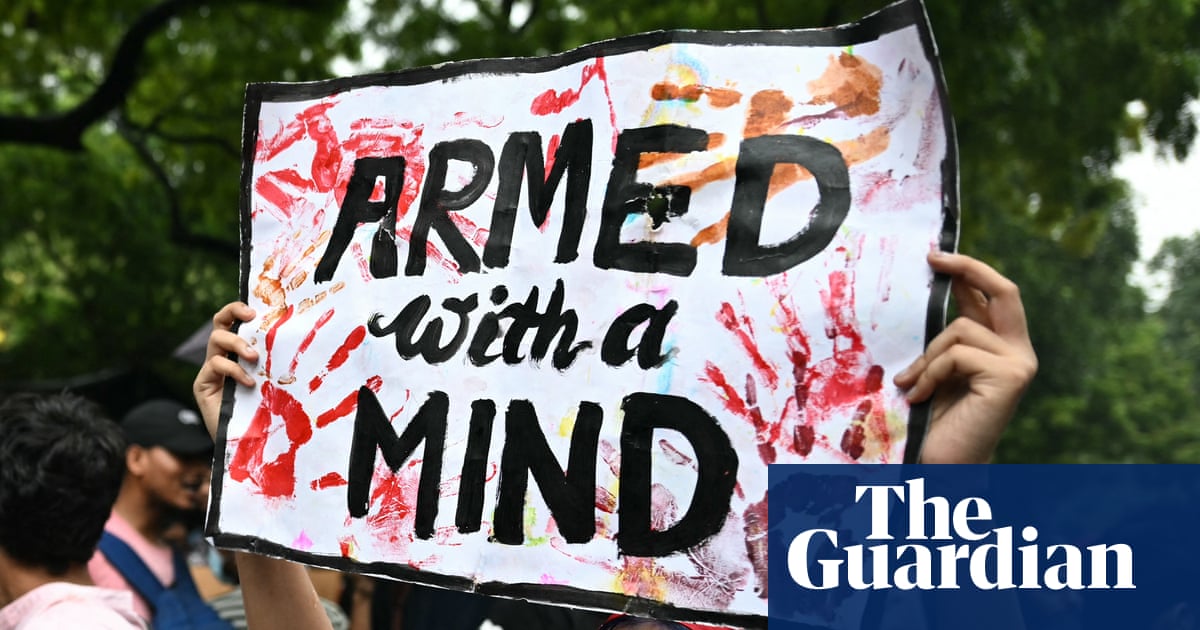
Before 24 July, a person I will call R was preoccupied with the ordinary routines of teenage life: experimenting with makeup, grumbling over mathematics homework and hanging out with friends at a tea stall.That month, as the fever of student protests spread across the country, the 15-year-old watched on her phone as young people poured into Jantar Mantar, the designated protest site in Delhi, demanding education reform. She went too. But an 11-second video clip from the protest site, in which she made crude and profane remarks about the prime minister, Narendra Modi, upended her life.“I feel like a criminal, as if I murdered someone,” R said in her first interview about life since the backlash. “I didn’t get a chance to make amends. In my own country, I am being treated like an enemy.”It’s been 86 days since that protest, but R doesn’t leave home over safety concerns, trapped in the reality the ordeal created.The summer agitation had for weeks demanded the ousting of the then-education minister, Dharmendra Pradhan, over repeated examination paper leaks. But after a violent police crackdown on a student march the anger spilled over to the Modi government.I went to Jantar Mantar every night that week as people from all walks of life streamed in. Protest signs once directed largely against Pradhan now increasingly targeted Modi and his powerful deputy, Amit Shah, whose ministry controls Delhi Police.The language was often profane and sexualised, and was quickly seized on by government supporters to condemn the protesters. Pro-government media channels ran heated debates about the disrespectful language and questioned the motives of those gathered. Women were singled out; BJP supporters identified them from social media clips and doxed them.R found herself at the centre of this storm. A police case was filed against her for insult intended to provoke a breach of the peace, and statements that could lead to public mischief and defamation. The complainant told Scroll, an independent news organisation, that she had called R and asked her to publicly apologise.After Pradhan resigned, Modi posted on Instagram about the use of vulgar abuses against him by “some mischievous children”, saying: “It is a cultural shock. How can our daughters speak like this?” Modi added that the children must be forgiven, instead of being punished.Meanwhile, R issued an apology to Modi. In a grainy video filmed in low light, R stands against a dull white wall wearing a striped T-shirt, her hands folded in a namaste. “I am so ashamed of saying those things that I am not even able to raise my eyes. I apologise to the whole nation for it. This is my first and last mistake,” she said. (Local media reported that the complainant withdrew the police case after R’s video was posted.)“I cried after making that video,” she told me. “I was feeling so helpless.”But her apology did little to stem the abuse. She received rape and death threats, abusive phone calls, incessant warnings on text, knocks on doors and cars outside her apartment building in a Delhi suburb.“I couldn’t understand what was happening,” R said, her eyes misting up as she recalled the initial days after the incident. “People older than my mother were calling me randi (prostitute), aatankwadi (terrorist), deshdrohi (enemy of the state). Others were offering Rs11,000 to find me and Rs21,000 to beat me.”With her phone and address leaked, R and her mother were compelled to leave their home. They struggled to find landlords willing to rent them a place to stay. They found one apartment, then another and then another. Her mother, a single parent, lost the income she earned from tutoring. To pay for the repeated moves, she sold her gold jewellery. That money is keeping them afloat. She estimates it will probably last another four months. As the clock runs out, her mother is desperately searching for work.During this time, R has not been to school and can no longer imagine returning. Some friends have cut off contact, leaving her increasingly isolated.Despite her apology video, pro-government media continued to hound her, she said. In late August, frustrated and angry at yet another media crew showing up, she uploaded a video to social media laying bare what she was going through.“Modiji, my life has become hell,” R said addressing the prime minister. “Now I can’t go anywhere, neither do I have any freedom. I can’t live anywhere. I have to live hiding my face,” she said.R told me she wants people to understand how traumatising her experience has been. “To make someone homeless overnight is a big deal,” she said.Now, stuck indoors, she is watching another wave of protests unfold. This time it’s over the controversial electoral rolls revision that has removed 130 million voters from the register. (If you missed it, read last week’s newsletter about this issue.)R feels solidarity with the students getting brutalised and detained. There have been moments she has felt tempted to join them. But the thought of her mother and their uncertain housing situation have held her back.“I am not scared any more. I have gone through the worst already,” she said. But she doesn’t want to put her mother through more pain.Days before the protest, R had been planning her 15th birthday. She wanted to cut her birthday cake inside an autorickshaw, to remake a trend she had seen on social media.It’s been a couple of months since she turned 15. I asked her what she wants or hopes for now. She paused and then said: “My past is not in my hands. I can’t change that. Now, I just want to look ahead and do well in my board exams.”What else we’re reading aboutA still from award-winning film Selvi.Culture | Two Indian films won awards at the Busan international film festival. Birds in the Dark by Shashank Walia was awarded the Songwon Vision audience prize and Sailesh Rathnakumar’s Selvi won the HyLife Vision as well as the Taipei Film Commission award.skip past newsletter promotionafter newsletter promotionPolitics | The US secretary of state, Marco Rubio, will land in Mumbai on 20 October for his second visit to India this year. Rubio will meet foreign minister S Jaishankar and then travel to Jamnagar, home to Reliance Industries’ massive refinery.Imran Khan | Days after the Bollywood actor Imran Khan appeared at a Mumbai protest against the chief election commissioner, Gyanesh Kumar, authorities asked him to leave the country by 28 October over what they described as a violation of the Foreigners Act. The action followed a complaint by BJP leader Kirit Somaiya against Khan, who is a US citizen.Guest shelfA recommendation from someone with great tasteMedia Ka Loktantra by Vineet Kumar. Photograph: SuppliedWith the chief justice of India criticising citizen journalist covering the recent protests, veteran television reporter Ravish Kumar, who now hosts a YouTube show, recommends a relevant book.“I had just finished reading Vineet Kumar’s book Media Ka Loktantra (Democracy of Media) when the chief justice’s statement came out, saying that if every citizen becomes a journalist, it will create problems for all of us. Published in 2024, Vineet’s book discusses the idea of do-it-yourself journalism. He shows how, when mainstream journalism began silencing the voices of ordinary people, they picked up cameras themselves and started practising journalism. They are becoming journalists to also assert their citizenship and rights guaranteed to them by the constitution. The mainstream media has a problem with journalism emerging on social media platforms because stories that it refuses to report – such as those concerning the electoral rolls – are being covered by others. The conflict between the media and DIY journalism has only now reached the courts. But it began a long time ago.”Count itA number worth knowingThe National Thermal Power Corporation (NTPC) plant in Dadri. Photograph: Prakash Singh/AFP/Getty Images84Close to 45% of thermal power plants in India – as many as 84 out of 191 – were critically low on coal stocks (£) as of early October. At the same time, the country’s demand for power grew by 10% this year, the highest year-on-year increase in the past 10 years.Vibe checkA felt sculpture by Sagarika Sundaram at the Henry Moore Institute. Photograph: Rob HarrisArtist Sagarika Sundaram has spent a decade working with wool, transforming it into felt for expansive sculptural pieces that feel almost otherworldly. Her latest exhibition, Reservoir recently opened at the Henry Moore Institute, in Leeds, and runs until 10 January.“There’s a clearer commitment to sculpture in this body of work, even though I’m still working with felt. I’m thinking spatially and making large volumes that explore what cloth can do: bend, collapse, gather, turn inward and support or surrender to its own weight,” she said of her latest works. Among them is Blue Mountain, which stretches almost seven metres long, creating a cave-like space that viewers can move through. That’s what I find compelling in the way her works are presented: they are not static objects offering a single perspective.The New York-based artist finds it exciting to give up a degree of agency during the making process, allowing the material to determine, in part, how the final form will unfurl. “Wool is a wonderfully responsive material. It can be soft and pliable but also dense, strong and structural. Wool takes dye exceptionally well and I can be quite expressive with colour and mark-making,” she said.Get in touchDo you have any thoughts or responses to this week’s newsletter? Is there anything you’d like us to cover in the future? Share your feedback by replying to this, or emailing us at thisisindia@theguardian.com and we may include your response in a future issue.
She was harassed for crude remarks about Modi at a Cockroach protest. Now she can’t leave home
Full Article
Original Source
Read the full article at Theguardian →KhanList aggregates and links to publicly available news content. We do not host full articles from third-party sources. Always verify important information with original sources.