
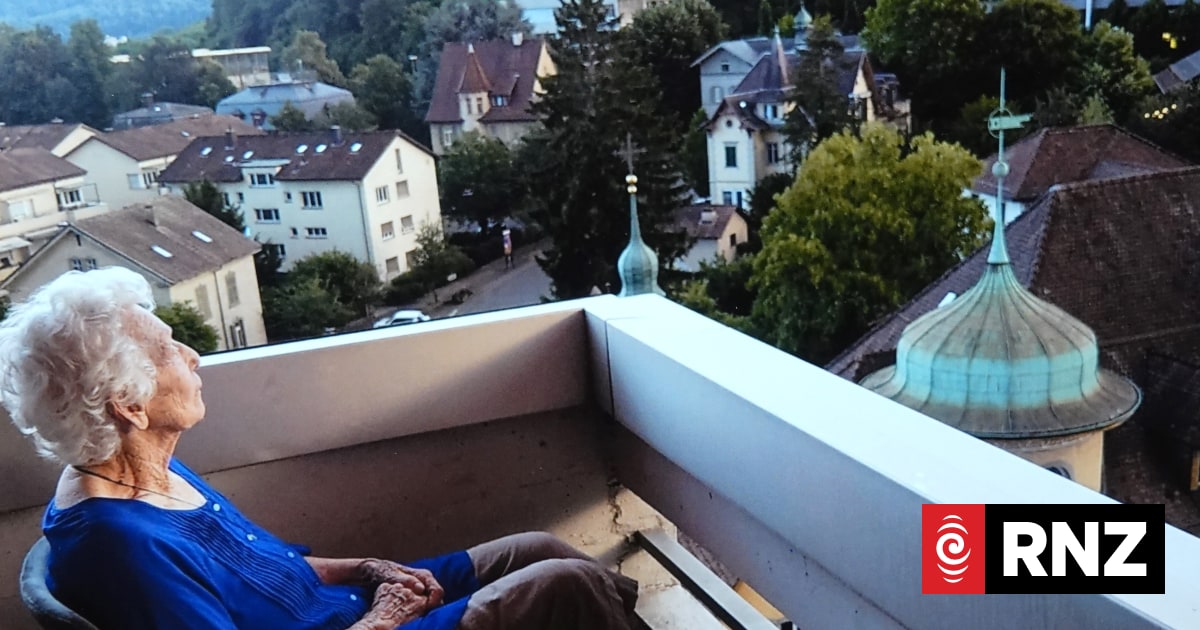
*Warning: This story contains details of assisted dying and may be upsetting for some readersA family forced to take their elderly mother to Switzerland to fulfil her wish of assisted dying are calling for a law change so others do not have to go through the same ordeal.Margaret Topzand, of Auckland, died in Zurich on 2 July. She was 93.Justin Topzand said his mother had led a full and happy life, and was still in good health."There was nothing wrong with her. She was starting to show mild dementia and forgetfulness, but she was basically sick of living," he said."She felt that she'd done and seen everything and that it was time for her to go. And she wanted to go on her terms, without having to linger in a retirement home for years and years."Margaret, a long-time supporter of voluntary euthanasia, called her sons together - Peter, Justin and Allister - to explain her wishes.However, that request turned out to be far more difficult than anyone expected.Margaret Topzand, seen here with son Peter, enjoying the sun during one of her last walks in the Swiss countryside.SuppliedThe brothers discovered that New Zealand's End of Life Choice Act, which became law in 2021, only allowed assisted dying for people who had a terminal illness and were expected to die within six months."She was upset and really frustrated," Justin said."She had a few meetings with the three of us brothers, and said: 'Can't you help me?' And we realised we couldn't. Legally, we could not help her until Peter, my older brother, discovered that we could go to Switzerland with her."What Peter Topzand had read in a newspaper article was that Swiss not-for-profit organisation Dignitas offered doctor-assisted suicide for foreign nationals - provided they met strict criteria.Peter said his mother was still living independently, but finding that increasingly difficult.Realising she needed a higher level of care, they visited a rest home to see if that would be a good option."There were all these old ladies in their wheelchairs, dribbling into their laps. It looked awful, even though it was a nice and expensive rest home, and mum said as we got in the car, 'I'm not doing it, I'm not going to be an old lady in a wheelchair, who doesn't know her own name, dribbling into her lap'. Her words were: 'Can't you help me to step out?'."It was then that Peter mentioned, just as conversation, what he had read about in Switzerland."And she said, 'Well, let's do that, I want you to organise that', and I thought: 'shit'. I agonised over it a bit and spoke to my wife and to friends, and I came to the conclusion that while it was not my job to talk her out of it or prevent her from doing it, I wasn't prepared to be the one who actually orchestrated and facilitated my own mother's death. I just didn't want that."Justin Topzand says his mother Margaret was a positive and inspirational woman who embraced life - and wanted the right to decide when to end it.RNZ / Peter de GraafHowever, during his research, Peter had also stumbled onto the concept of death doulas, professionals who guide people through the process of dying.It did not take long to find an end-of-life doula whose values meshed with their own.The doula took Margaret to the many medical and psychiatric check-ups the Swiss authorities demanded, and handled the mountain of reports and documentation.In particular the Swiss wanted to be certain Margaret was not suffering from depression, and that she was capable of making the decision to end her life.Justin said when they finally got a green light to travel to Switzerland, their plans were derailed by the war on Iran.They then had to repeat part of the process once it was safe to travel again, because too much time had passed since the psychiatrist's all-clear."So then we had to rush around trying to find airfares and hotels. But what was really good is in the last two weeks before mum went, a lot of family and friends came to see her and say goodbye," he said."She never changed her mind. She was stoic, she was happy that she was finally able to end her life. There were a lot of tears from the other side but she just said: 'Yes, this has been good, it's been nice knowing you, thank you'. And when we left her apartment the morning that we flew, she just looked back and said: 'This has been a great apartment', and closed the door and walked away. And it made our job so much easier."Margaret Topzand hiking with her son Justin Topzand.Supplied'It was bloody tough'Once in Switzerland, Margaret and her sons filled in the days waiting for final approval by going for walks in the countryside.Justin said the procedure took place in a clinic on the outskirts of Zurich.It was almost derailed again when the exacting officials checking Margaret's identity said her passport photo was too old."She'd aged considerably in the eight years since the photo was taken so initially they said: 'No, we can't accept this'. But within five minutes the Swiss police were there, they asked her who she was, got her to hold up her passport, took a photo of her and said: 'Yes, we accept that, off you go'."Peter Topzand became emotional as he recalled his last moments with his mother, his arm around her shoulders."It was bloody tough. But I'm very happy that she's got her wish."Justin said she never hesitated, even when the end was very close."Her last words were: 'I wonder if I'm going to heaven? I don't believe in heaven'. And within seconds, she was unconscious, and within minutes, she was dead… It was hard, but it's what she wanted. She also wanted tūī bird song so my brother had recorded some, and we had that for the last minutes. It was lovely and she died a happy old lady. Quickly."Justin Topzand says his mother Margaret loved New Zealand and was forever grateful to the International Red Cross for helping her emigrate after the horrors of a World War Two concentration camp in what is now Indonesia.Supplied'It's appalling': Family says law change neededJustin Topzand said he was grateful New Zealand had an assisted dying law but believed the criteria were too narrow."It seems ridiculous that you have to travel halfway across the planet to do a pretty simple procedure that could be done in New Zealand. I think we need to catch up with the Europeans and accept that a lot of people in New Zealand want to have options and they haven't got them."The ACT Party has a private members bill before Parliament that could ease the restrictions on assisted dying, by removing the requirements for a terminal illness and a six-month prognosis.However, opponents of a law change fear disabled people could then opt for assisted dying - not because they wanted it, but because they felt they were a burden on their families or were unable to get the support, housing and care they needed, especially in an era of cuts to health and disability services.Justin said there would always be concerns the law could be abused."And that's why you need psychologists and psychiatrists involved to talk to the individual and make sure this is what they want, not what the family wants."Peter Topzand said if someone was 93 and had demonstrated support for voluntary euthanasia for decades, they should have that option.Many people could not afford to travel to Switzerland, he said."I think it's appalling that she had to spend all that time and money going to Switzerland when, by rights, that service should have been provided here, probably at a fraction of the cost," he said."A lot of people wouldn't be able to afford it, the tickets to Switzerland and the Dignitas fees and the doula's fees and the psychiatrist's fees and the hotels. It all adds up."Margaret and Hajo Topzand on their wedding day.Supplied'She embraced the beauty of what was around her'Margaret Topzand was born in the Dutch East Indies, now Indonesia, in 1933, and somehow survived years in a Japanese internment camp during World War II.Justin Topzand said she was one of the few people he knew who said the atomic bomb had saved her life, because it hastened the end of the war.The family was reunited in the Netherlands after the Japanese surrender, then emigrated to New Zealand with help from the International Red Cross.They arrived with little money, but Margaret trained as a nurse and worked in hospitals around the country.She married Hajo Topzand and eventually settled in Titirangi, Auckland, where they raised their three sons.She travelled extensively, even visiting Madagascar and going hiking in Australia in her 80s.Justin put his mother's positivity down to surviving the concentration camp as a child."She always saw the better side of life, and embraced the beauty of what was around her," he said."She became a New Zealander through and through. She just loved it here, and was always thankful to New Zealand and the Red Cross for getting her here. She was an amazing woman, an inspiration."* The second part of this story, to be published tomorrow, will examine some of the arguments for and against changing New Zealand's assisted dying law.Where to get help:Need to Talk? Free call or text 1737 any time to speak to a trained counsellor, for any reasonLifeline: 0800 543 354 or text HELP to 4357Suicide Crisis Helpline: 0508 828 865 / 0508 TAUTOKO. This is a service for people who may be thinking about suicide, or those who are concerned about family or friendsDepression Helpline: 0800 111 757 or text 4202Samaritans: 0800 726 666Youthline: 0800 376 633 or text 234 or email talk@youthline.co.nzWhat's Up: 0800 WHATSUP / 0800 9428 787. This is free counselling for 5 to 19-year-oldsAsian Family Services: 0800 862 342 or text 832. Languages spoken: Mandarin, Cantonese, Korean, Vietnamese, Thai, Japanese, Hindi, and English.Victim Support 0800 842 846.Rural Support Trust Helpline: 0800 787 254Healthline: 0800 611 116Rainbow Youth: (09) 376 4155OUTLine: 0800 688 5463Aoake te Rā bereaved by suicide service: or call 0800 000 053If it is an emergency and you feel like you or someone else is at risk, call 111.
'She wanted to go on her terms' : Auckland mum, 93, fulfils wish of assisted dying in Zurich
Full Article
Original Source
Read the full article at Rnz →KhanList aggregates and links to publicly available news content. We do not host full articles from third-party sources. Always verify important information with original sources.