
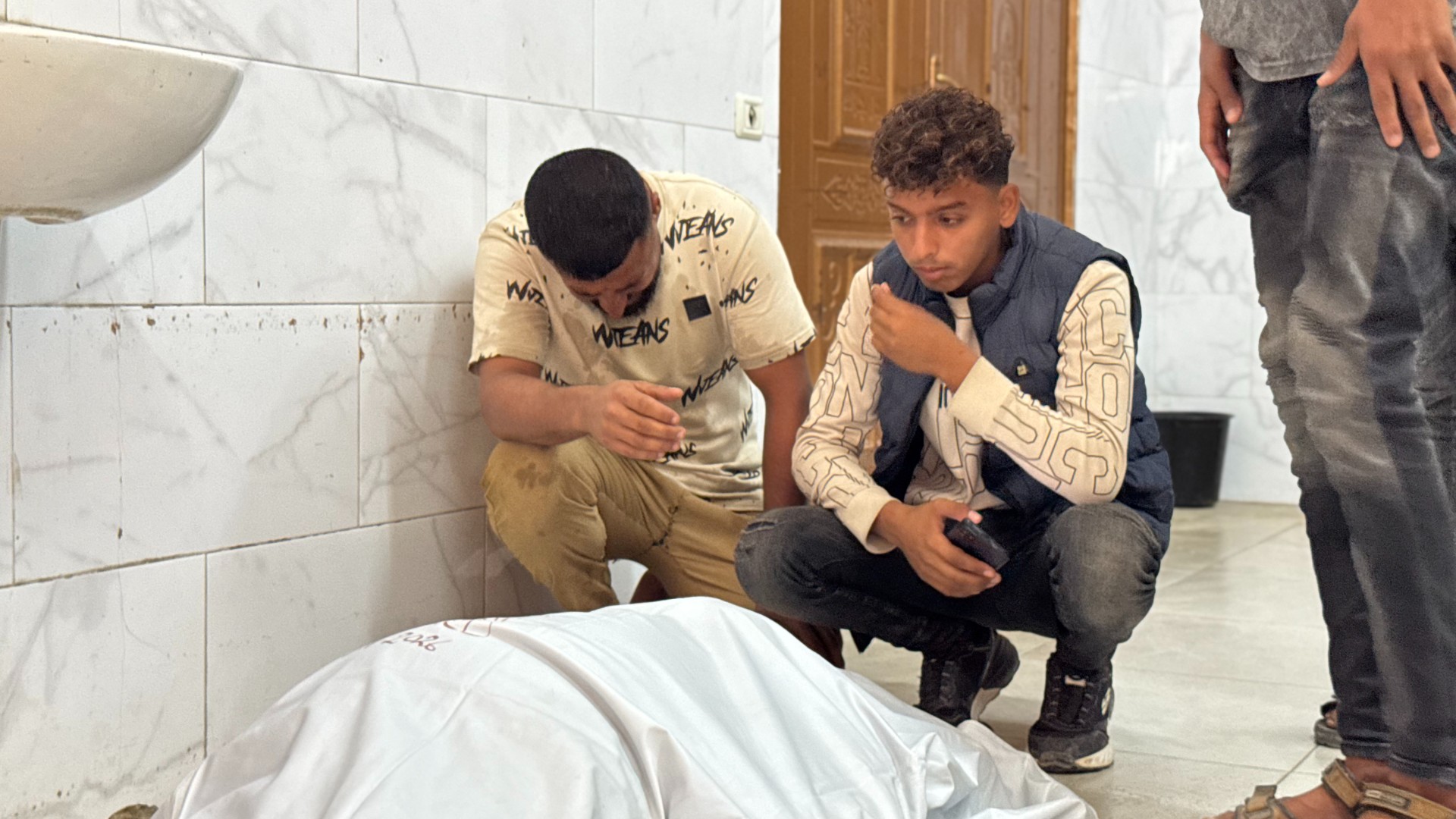
Noura Sheikh al-Eid bid farewell to her husband and daughter as they left Gaza for medical treatment in Egypt. It was meant to be a temporary goodbye. But as the 54-year-old Palestinian mother returned from the departure station to her displacement tent on 5 November, an Israeli sniper shot and killed her. “We are in shock,” Mohammed Sheikh al-Eid, Noura’s brother, told Middle East Eye. “I lost my 14-year-old son during the famine, while he was trying to get aid. I swear to God, I did not grieve for him the way I have grieved for my sister,” he said. New MEE newsletter: Jerusalem Dispatch Sign up to get the latest insights and analysis on Israel-Palestine, alongside Turkey Unpacked and other MEE newsletters “I considered her my second mother because she was the one who raised me.” Since the October 2025 ceasefire agreement, Israeli forces have repeatedly opened fire on Palestinians near the so-called "yellow line", which marks the boundary of areas under Israeli military control in Gaza. Residents face indiscriminate gunfire from Israeli soldiers, military vehicles, lifters and quadcopters, including in areas beyond the line where civilians attempt to go about their daily lives. ‘Come back a doctor’ The night before Noura was killed, relatives gathered at their tent in Khan Younis, in the southern Gaza Strip, to bid farewell to her husband, Atallah Abu Athra, and their daughter, Hiba Abu Athra. “Her husband suffers from heart disease and diabetes, and his condition has deteriorated to the point where he developed gangrene,” Sheikh al-Eid said. “Five of his toes and part of his foot had been amputated.” Israeli forces abuse Palestinians returning to Gaza at Rafah checkpoint Read More » Hiba had recently completed her secondary school exams. The family registered her as her father's medical companion so she could accompany him to Egypt and pursue her mother's dream of seeing her study medicine abroad. At around 4am on the day of their departure, the family woke to prepare for the journey from their displacement tent to a Palestine Red Crescent centre, where buses carrying travellers to Egypt were departing. “I told my Noura, ‘Just say goodbye to them here at the tent. You don't have to go with them.’ But she refused,” Sheikh al-Eid, 46, recalled. “She accompanied them to the Red Crescent, along with her four other daughters. They said goodbye to her husband and daughter and waited until the bus had departed.” Noura kissed Hiba and told her, in what would be her final words: “Come back to us as a doctor.” She and her other daughters then went their separate ways. Only Rula accompanied Noura on the journey back to their tent. The last ride home Unable to find a car to take them home, Noura and Rula came across a man with a donkey-drawn cart who offered them a free ride. “The road was extremely rough, and the donkey could not pull too much weight. The man told me that he could only take my mother because she seemed unwell. She had diabetes and felt dizzy,” Rula told MEE. “I agreed and told him that what mattered was that my mother got a ride. She climbed onto the cart, and I walked right beside her,” the 18-year-old added. Right after Noura climbed aboard, some of her teeth fell to the ground, followed by a gush of blood from her mouth. She then collapsed. Gaza: Indiscriminate Israeli gunfire kills and terrorises displaced families Read More » Rula then heard what sounded like a small explosion. “At first, I thought it was the sound of a ball or something, but then my mother’s teeth fell to the ground, blood began pouring from her mouth, and she fell off the cart,” Rula recounted. “I still hadn’t realised that she had been shot. I thought she had fallen into a diabetic coma.” People rushed to Noura's aid and took her to the British field hospital in al-Mawasi, western Khan Younis. On the way to the hospital, Rula said her mother was still alive. She recited the Shahada [Islamic declaration of faith] and tried to say something, but Rula could not make out her words. Eyewitnesses said Israeli forces routinely opened fire in the area. But nobody realised Noura had been hit by a bullet until she reached the hospital. At the hospital, a doctor examined Noura and showed those accompanying her where the bullet had entered beneath her lower jaw, near her teeth, and exited behind her right ear. MEE viewed a post-mortem photograph of Noura’s face showing a narrow wound beneath her lower lip, apparently caused by the bullet that exited through the right side of her head. “She was taken to the resuscitation room. But shortly after she arrived, a doctor came out and told me, ‘Your mother’s heart has stopped. She has passed away,’” Rula told MEE. “I rushed to the resuscitation room and looked for her on the bed, but it was empty. I looked around and found her already wrapped in a shroud, lying beside the bed. I screamed and shouted at them, begging them to unwrap her so she could breathe.” Israeli forces have killed at least 1,600 Palestinians since the October 2025 ceasefire, bringing the death toll since the beginning of the genocide to more than 74,000. At least 196 were killed near the “yellow line” between 10 October 2025 and early April 2026, according to the United Nations’ Independent International Commission of Inquiry on the Occupied Palestinian Territory, including East Jerusalem, and Israel. They include 18 women, 32 boys and 11 girls. ‘Hardest moment’ Doctors prepared Noura’s body for transfer to Nasser Hospital in Khan Younis, where the family would make burial arrangements. In the ambulance transporting her mother’s body, Rula sat silently beside her. On the way, she spotted her maternal uncle, Mahmoud, running towards the British field hospital after receiving a call saying his sister was there. She asked the driver to stop and pick him up. “He thought she had fallen into a diabetic coma. When he got into the ambulance, he asked me, ‘Where is your mother?’ I looked at the body and said, ‘Here she is. Don’t you see her? She is in the shroud,’” Rula said. The family completed the burial arrangements and laid Noura, originally from Rafah, to rest in Khan Younis, where she had been displaced for more than two years. 'She was devastated, screaming and crying. We tried to comfort her, but she was in an unbearable state. She has not shed a single tear... She is still in shock' - Mohammed Sheikh al-Eid, Noura's brother But her husband and daughter, who were in Egypt, did not learn what had happened until the following day. “We couldn’t tell them anything, but the next day, someone sent my sister a message offering condolences. She didn’t know who had died, so she searched online to find out who in our family had been killed,” Rula recalled. “The [local] media had already reported what happened, and that was how she found out it was our mother.” Sheikh al-Eid said none of Noura’s siblings could bring themselves to answer Hiba’s repeated calls after she learnt of her mother’s death. “This was the hardest moment we went through… because we knew Hiba would blame herself, and we simply did not know what to say,” he said. “We contacted relatives of her father in Egypt and asked them to go [and comfort] her. Once they arrived, they called us on a video call. She was devastated, screaming and crying. We tried to comfort her, but she was in an unbearable state.” Since Noura was buried, her daughter Rula has barely spoken, Sheikh al-Eid told MEE. “She has not shed a single tear. Even when she said goodbye to her mother [before burial], she did not cry at all. She is still in shock to this day,” he said. Three of Noura’s daughters remain alone in their tent: Rula, 18; Saba, 16; and Ruwaida, 14. Their uncle sends his wife to stay with them most of the time. “We spent that night at my sister’s tent because we wanted to say goodbye to her daughter and husband,” he said. “But in reality, we were saying goodbye to her.”
She saw her husband and daughter off to Egypt. An Israeli sniper killed her on the way home
Full Article
Original Source
Read the full article at Middleeasteye →KhanList aggregates and links to publicly available news content. We do not host full articles from third-party sources. Always verify important information with original sources.