For wedding photographer and former NCAA Division III track and field athlete Alyssa McElheny, the past 12 months have felt a bit surreal.Last fall, the 35-year-old achieved a decade-long dream of qualifying for the Olympic Trials in the marathon with a 2:34:27 performance at the Indianapolis Marathon, years after stalling out at 2:52 and thinking the goal was out of reach.A few short months later, she’s the reigning world champion in a completely different sport: Hyrox, a circuit training style fitness race that includes eight functional exercise stations sandwiched between 1K repeats—all completed for speed. The mass participation event has exploded in popularity since Olympic field hockey champion Moritz Fürste founded the event with German entrepreneur Christian Toetzke in 2017. During the 2025-2026 season, more than 1.5 million athletes participated in Hyrox events worldwide.For McElheny, who found herself popping champagne with the Adidas team on a hotel rooftop in Stockholm after winning the women’s Elite 15 singles division of the Hyrox World Championships in June, that’s meant signing her first professional sports contract with the global sports behemoth at the age of 35—and looking forward to chasing the world record in the event.“I’m a good runner but I’ve never been able to think about making running my living,” she says. “To find a sport that feels so meant for what my body is built to do is such a gift. To be able to say I can do this for a living now and to work with a brand like Adidas, it’s just something I never thought would be possible for me.“To be able to do movement, which I truly love, as my livelihood is incredible.”Her quick ascent in the sport has sparked some discussion of whether marathoners may be primed to “take over” the unique event as it grows more popular, but McElheny isn’t so sure.“I think I’ve always been a little more of a power, speed athlete,” she says. “It’s hard to compete in track and field as an adult, so I kind of forced myself into that marathoning box and took, you know, 10 years and lots of failure to get to qualifying for the Olympic Trials. I think finding Hyrox is so much more what my body was meant to do. Not that pure marathoners can’t be good at Hyrox, but I think it helps that I have a little more of that power/speed background instead of just the ability to run long forever or run fast forever.”She’s not the only elite runner whose talent has transferred over. Another top-ranked Hyrox athlete is Holly Archer of Great Britain, who has a 2:33 marathon best but more notably earned silver at the 2021 European Indoor Championships in the 1500 meters and owns an elite personal best of 4:07 in that distance.Finding her strengthsBefore joining the track team in sixth grade, McElheny participated in a variety of sports and describes herself as a very energetic kid. She came home feeling sluggish from school one day when she was around 5 years old, and her mother immediately clocked that something was wrong with her normally active, healthy daughter.She took her to the doctor right away for blood work, where they discovered McElheny had a rare condition called Kawasaki disease, an illness causing blood vessel inflammation.“It was a summer of [going] in and out of echocardiogram testing and ultrasounds and lots of blood draws and they said it would probably limit what [I] can do athletically for the rest of [my] life,” she says.Luckily, McElheny’s condition was caught early enough and she was able to get on the correct medication right away. She underwent annual testing for a few years to monitor her condition but fully recovered.“After a bit, they were like, ‘yeah, you’re good to go, live your life, do what you want to do,’” she says. “I’m grateful to be in a sport that’s really demanding on the heart and to have had no issues with it.”Courtesy Alyssa McElhenyMcElheny (left) celebrates crossing the finish line at the 2025 Indianapolis Marathon, securing an Olympic Trials qualifying time of 2:34:27.If anything, the brush with serious illness seemed to inspire a unique appreciation for movement in McElheny. As a collegiate runner at Calvin University, she trained under Brian Diemer, the 1984 Olympic bronze medalist in the steeplechase. His influence was palpable, but McElheny also found her brain drawn to the event because of its unique nature—and one that perhaps belied a later propensity for the circuit challenges of Hyrox.“I think I was drawn to it because of the variety,” she says. “I was never someone that wanted to run 25 laps on the track. [In steeplechase], every lap, I get these [7] things that help me break it up mentally and refocus. It was a fun event compared to, in my mind, what a 10K was.“[In Hyrox], it’s not straight 8K [of running]. Every time you get sick of running a little bit, you get to stop and push a sled, or you get to stop and throw a wall ball or ski. It’s great. The variety is never-ending. Every time you get sick of a certain station or the run, you’re already changing, so it’s great.”After college, she spent a few years running for fun and coaching a high school cross-country team. She entered her first marathon, but says she was undertrained and didn’t know how to fuel, and went out way too hard. She dropped out at 22 miles.During the qualifying period for the 2020 Olympic Trials, she decided to give it another go and made two attempts at the 2:45 standard, running 2:52 in both races.“I was optimistic that if I gave myself another four years, I could hit 2:45 and then the standard dropped to 2:37 and, almost immediately, I was like, ‘No, I can’t do that. If I can’t do 2:45, there’s no way I could do 2:37,’” she says. “The very next day, I reneged on that.”McElheny found a local elite team called Gazelle Elite through the local run specialty store Gazelle Sports in Grand Rapids, where she received coaching support from Sam Butler and some funding for travel and gear through a small team sponsorship with Adidas.McElheny missed the standard for the 2024 Trials, but didn’t give up and in the spring of 2025, she ran 2:35 at the Glass City Marathon in Toledo. However, the Trials qualifying window wasn’t open until the fall. It finally all came together at November’s Indianapolis Marathon, where she ran stride-for-stride with long-distance teammate Gabby Hentemann, who trains remotely under Butler in Texas, as both women easily qualified in 2:34:26 and 2:34:27.“It was so emotional,” McElheny says of Indy, a popular target race for OTQ hopefuls. “Continuing through things after failure … if you just keep sticking your nose in it, it can pay off in big ways. Not that every goal you set is going to be accomplished. But to me, coming back seven times after not hitting the goal I had set for myself allowed me to finally get where I needed to be.”She attributes her steady improvement in the sport to being able to stack high mileage weeks without injury, building from 80 to 90 to consistent 100-mile weeks for the last three years. While she’s always felt like a durable athlete, part of that has been getting more intentional about fueling.“In the competitive distance running space, there’s always the pressure that smaller is better, smaller is faster, and I’ve been lucky to not struggle with an eating disorder but I think throughout my years, I’ve definitely experienced disordered eating,” she says. “I’m always a little more conscious of what I’m putting in my body than I should be and not in a positive way. So I think focusing on making sure I’m getting enough fuel, especially right before and right after workouts, being able to take in enough carbs during the workouts and long runs, was a big deal.“I think Hyrox has been great for me in terms of, it’s been a mindshift away from smaller is better,” she says. “Hyrox has really taught me that I need to fuel and be prepared and give my body every tool it can have at its disposal in order to be really powerful and explosive and fast.”Training for the topThough her mileage has dropped to closer to 60 to 70 miles per week, her overall training volume while preparing for Hyrox has increased to closer to 20 hours per week. The race structure for a Hyrox event includes eight 1-kilometer runs, immediately followed by a functional workout station: 1,000-meter ski erg, 50-meter sled push, 50-meter sled pull, 80-meter burpee broad jumps, 1,000-meter rowing, 200-meter farmers carry, 100-meter sandbag lunges, and 100 wall balls.She trains at 8th Day Gym in Grand Rapids with coach Joe Cebulski, a former top-ranked decathlete. A typical training day might include 3K of running, 8 lengths of sled push and 100 dumbbell snatches for time, finishing with 7 sets of 300-meter run, 1 length sled push.She avoided the post-OTQ blues by stepping into Hyrox workouts with a friend and starting her competitive career with a mixed doubles race before she quickly fell in love with the sport. She won her debut in the pro division in Las Vegas in February and by April, she placed third at her first Elite 15 event in Warsaw, Poland in 55:56, the third-fastest women’s time ever.This earned her an invitation to the Hyrox World Championships, but she was still under the radar as a top competitor. Compounding things was a minor ankle sprain that she picked up several days before the race.“I think this injury forced me to actually recover [and] taper well,” she says. “I came into the race with super fresh legs because of this incident. My plan going into the race was to run a safe, smart race and hopefully achieve a podium position.”Courtesy Alyssa McElhenyMcElheny competes at the Hyrox World Championships in Stockholm.By emphasizing a conservative start and running around marathon pace for the 1Ks, McElheny was able to surprise her competitors when she took the lead at the sled pulls and didn’t look back.“A lot of the other top women do not come from the running side of things,” she says. “I watch everyone else burn so much extra energy in the first 1,000 meters and I just run my pace and don’t freak out if I’m not in the lead. It really pays off in the long run.”As she develops in the sport, she says she’ll “mourn the loss of my underdog status” but is looking forward to improving her technique at each station so she can tap into more of her speed for the running segments—where she feels she has a shot to take down the world record one day. Schedule-wise, her fall is booked with competitions in Beijing and on a cruise ship in the Mediterranean.For now, running has become secondary to this new sport where she’s suddenly found herself at the top of the leaderboard. But that doesn’t mean she’s not excited to line up at the Olympic Trials in 2028. It just might look a little bit different than she always dreamed.“I’m not someone who’s trying to go make a team,” she says. “I’m running the Trials because it’s been a lifetime goal of mine and whether or not I found a new sport, that’s something I’m not willing to give up on.”Johanna Gretschel is a freelance writer and broadcaster living in Austin, Texas, who has covered elite track and field and running in all its forms. She contributes to Runner’s World, ESPN, Austin American-Statesman, FloTrack, MileSplit, Women’s Running and Podium Runner. Yes, she has run a marathon!
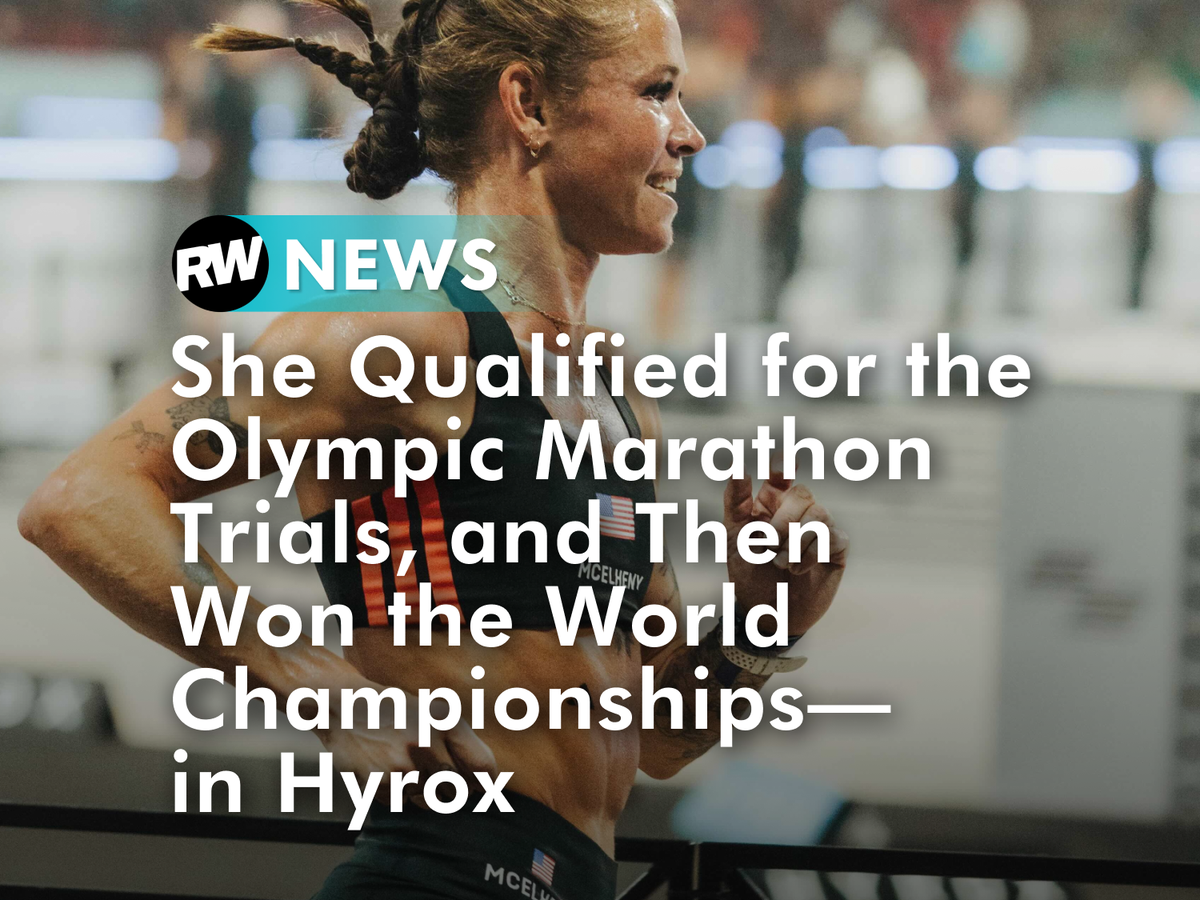
She Qualified for the Olympic Marathon Trials, and Then Won the World Championships—in Hyrox
Full Article
Original Source
Read the full article at Runnersworld →KhanList aggregates and links to publicly available news content. We do not host full articles from third-party sources. Always verify important information with original sources.