
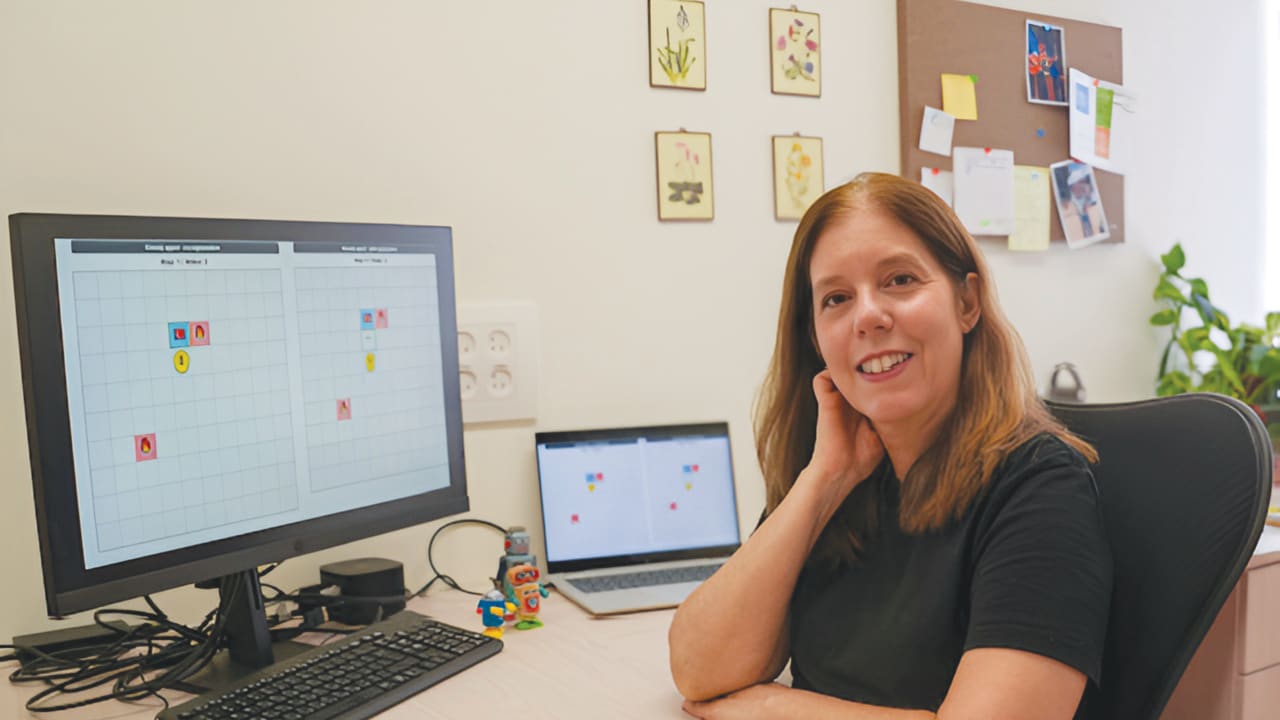
OCTOBER 24, 2026 19:10Using AI to solve real-world problems? That’s the aim of scientist Prof. Claudia V. Goldman.Since July 2024, she has been an associate professor in the Data Science Department at the Hebrew University Business School in Jerusalem.After making aliyah from Buenos Aires, Claudia graduated from Jerusalem’s Mae Boyer High School in 1986, followed by army service and three academic degrees from the Hebrew University: a BSc in Computer Science, Mathematics, and Electronics in 1991; an MSc in Computer Science in 1993; and a PhD in Computer Science in 1999, under the direction of Prof. Jeff Rosenschein, an award-winning scholar.From 1999 to 2005, Goldman held research positions at Bar-Ilan University, the University of Massachusetts Amherst, and the University of Haifa.She then transitioned into industry, spending three years as a team leader at Samsung Telecom Research in Herzliya, followed by 15 years as a research scientist in the Research and Development Organization of General Motors in Herzliya.Prof. Claudia V. Goldman. (credit: MICHAL REVIVO)Claudia is a distinguished inventor with a remarkable track record of 24 patents. Over the years, she has published more than 50 academic papers.She is married to a colleague, Prof. Roy Shenhar, a full professor at the Institute of Chemistry at the Hebrew University.Claudia answers our most pressing questionsThe Magazine recently sat down with Claudia in her Hebrew University office.Note: Books could be written in response to some of the following questions. For this article, the focus is on brief answers.Stanley Druckenmiller, a contributor to The Wall Street Journal, was challenged by readers for using AI in a recent article. He admitted to using the technology, responding, "I’m not embarrassed by it." How do you deal with AI in your classroom?I am clear when I want my students to use AI tools and for what purpose. When these tools are used, students are required to give credit and explain how it was used. I ask them not to provide full answers that were completely generated by AI. Students know that I can detect AI in their writing. I ask them to brainstorm with AI tools and remain critical about the responses they receive. For example, they need to determine whether the information is biased and whether the source exists or was simply made up.The evaluation of my students always combines work in class and presentations with discussions and activities that students organize for the whole class. This way, I can evaluate their understanding in person.We discuss our responsibility as humans, our values, and what kind of researcher, professional, or person it is important to be.At GatesNotes.com, Bill Gates recently wrote about the effects of AI and noted the many jobs that could disappear forever. He suggested that leadership consider a concept he calls ‘Human Reserved’ – setting aside some jobs for humans. Your thoughts?It is not a simple binary question about which professions are going to remain human and which will be deferred to AI. It is a matter of understanding the benefits of AI playing different roles in different contexts and the need for critical skills to strengthen these benefits.Much has been written about the damage that can be done to society by AI. I understand that, for you, the important issue is to study AI’s contribution to human value. With this goal in mind, what courses are offered at the Hebrew University Business School?• AI for Social Good (#55982)• Responsible AI (#55983)• When AI Meets Humans and Society (#55022)Note: Hebrew University offers a Free Listener Program that allows senior citizens to audit university courses. The fall semester is now beginning. For information, visit magid.huji.ac.il/course-19/It’s been reported that more than 1 billion people worldwide use AI each month. Who coined the phrase ‘artificial intelligence’?The term was coined by John McCarthy, a mathematics professor at Dartmouth College, together with Marvin Minsky, Nathaniel Rochester, and Claude Shannon, in a 1955 proposal submitted to the Rockefeller Foundation.In 1950, the British mathematician Alan Turing had already posed the question of whether machines can think.Note: Readers might be interested in the 2014 Hollywood movie The Imitation Game, which tells the story of Turing.What was one issue you worked on during your tenure at General Motors?Introducing learning agents to the vehicle user experience so that drivers could remain focused on the road and understand better autonomous driving functions.What’s your family background?My grandparents came to Argentina before many family members were murdered in the Holocaust. My parents were born in Argentina, and I was their only child. I went to a Jewish school in Buenos Aires through seventh grade, where we studied in Yiddish, Hebrew, and Spanish.I then told my parents that I wanted to go to public school. For the next three years, I attended public secondary school in the mornings while continuing to study at the Jewish school in the afternoons.What prompted your family to make aliyah when you were 16?For many years, my father wanted to leave Argentina to search for a better future for the family. In 1983, in one of our conversations, I said: “The only place I can see myself growing up is Israel.” It then took six months until we made aliyah in January 1984.When did you meet your husband?When we were both studying on the Givat Ram campus of the Hebrew University. We met for the first time on the stairs of the Ross Building. When we met a third time, we remembered the Hebrew expression [“pa’am shlishit glida”] – when you unexpectedly run into the same person three times in a short period of time, one person owes the other person ice cream.And so, he treated me to ice cream. The year was 1995, and we were married in 1999.■Claudia V. GoldmanFrom Buenos Aires to Jerusalem, 1984Follow us on Google
She made aliyah at 16 - today, she's teaching the next generation about AI
Full Article
Original Source
Read the full article at Jpost →KhanList aggregates and links to publicly available news content. We do not host full articles from third-party sources. Always verify important information with original sources.