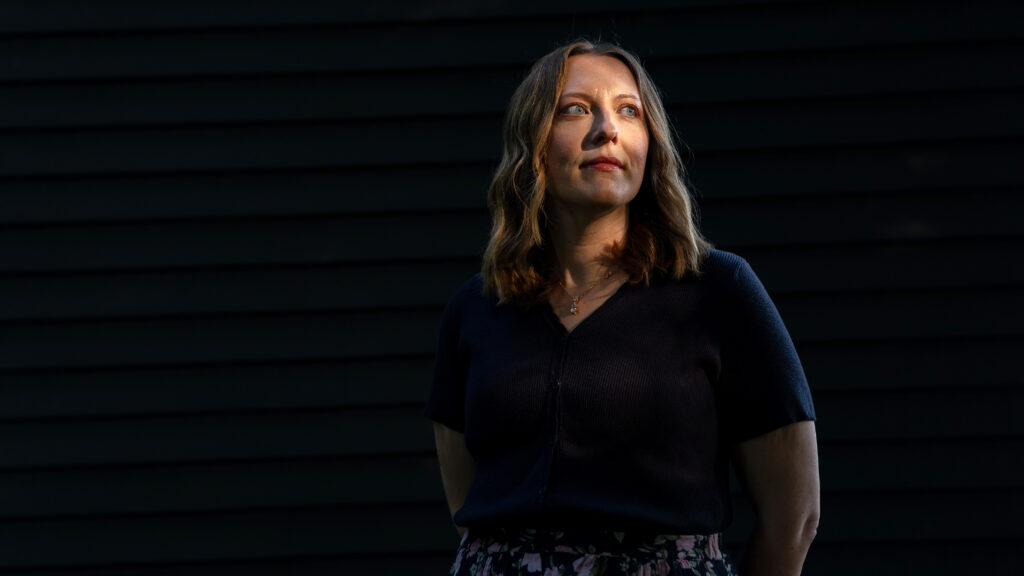
At the age of 23, Elisabeth Marnik approached her doctor with an unusual request: Vaccinate me. Against everything. She had never received a single vaccine. But now, angry and defiant, she was turning away from the beliefs of her childhood, instilled by a mother who distrusted science. A doctor for adults doesn’t typically have childhood immunizations on hand, so she made her way to a travel clinic and eventually got all the once-forbidden shots. A year would pass before she told her mother about the vaccines. And several more years would go by before Marnik came to have sympathy for her mother’s choices. That happened, as it so often does, when Marnik became a mother herself, in 2019. A harrowing childbirth necessitated several blood transfusions. Overwhelmed and foggy-headed, Marnik balked when a nurse asked to give the baby a hepatitis B shot, saying she’d do it later. A friend gently reminded her why it’s important to vaccinate at birth, and the baby did get the shot before leaving the hospital. But Marnik had hesitated. And she was starting to understand her mother’s burdens. “That moment, plus the whole entry into motherhood, really changed my perspective,” Marnik said. “You have this immense pressure that if you don’t do it right, things could happen. That really gave me more compassion.” Marnik’s mother, Teresa Ryan, can still recall the pamphlet she came across decades ago, one of many such tales that she read. It described a healthy child who, after a series of vaccinations, started crying uncontrollably and running a high fever, and then went limp. The family’s doctor merely stated that children must follow an immunization schedule. He offered no balm for her worries. Ryan decided her two children would absolutely not get those shots. Today, Marnik, now 37 and with a Ph.D. in immunology, is striving to counteract the kind of misinformation that ensnared her mother. With 64,000 followers on Instagram as @ScienceWhizLiz and 4,500 subscribers on her Substack, the Science Classroom, she speaks to those who already support vaccines, urging empathy and patience for the doubters. Shaming and excluding people like her mother, she argues, will do nothing to improve vaccine acceptance. Although strong evidence shows that vaccines are safe, facts alone rarely change minds. Since February, Marnik has been the executive director of The Evidence Collective, a group of clinicians and scientists who are active on social media and pool their efforts in communicating accurate information about public health. In her writing and public appearances — she once gave a talk in a brewery — Marnik aims to explain science in a way that anyone can understand, through stories, often from her own life. “Liz is one of the few experts on vaccines who has been telling her own story in the process of coming to be an enthusiast for vaccine technology,” said Jennifer Reich, professor of sociology at the University of Colorado, Denver, and author of the book, “Calling the Shots: Why Parents Reject Vaccines.” “Her willingness to share the journey that she and her family went through and to get to where she is, I think is a really valuable contribution to the conversation.” ‘I was all in’ on an evangelical upbringing That journey began in the small town of Thomaston, Conn., about 50 miles west of Hartford, where Liz lived with her mother and younger brother. The family’s life revolved around an evangelical church in Waterbury. “Pretty much the only thing we did was go to church,” she recalled recently, speaking above the hubbub in a Boston cafe. Her wavy light-brown hair drifts down the sides of her face, and her guileless gray-blue eyes and peaches-and-cream complexion make it easy to envision her teaching Sunday school, which she did. “I was all in,” she said. A friend from those days, Megan Wolfe-Pelletier, remembers Liz as a “gung-ho” organizer of church youth activities, baking pies to raise scholarship money for Indian orphans, distributing clothing, hot soup, and cocoa to kids in the poorest parts of Waterbury. “She’s very organized and just hardworking,” Wolfe-Pelletier said. But her family struggled. Her parents split when Liz was a young girl. Her mother didn’t work, and while her father paid the rent, he was mostly absent from their lives. Sometimes he delivered a $20 bill for a day’s worth of groceries for the three of them. They ate a lot of boxed macaroni and cheese. Fresh fruits and vegetables cost too much, and Liz, as she later described it, became “obese.” Liz and her brother were pulled out of elementary school, because students were about to read Harry Potter books, which involve stories of wizardry. They never donned costumes for Halloween. Nor were they allowed to watch Disney movies, which often included magic, and most secular television shows were off-limits. Creation, they were told, literally occurred over seven days; science and scientists contradicted the Bible and could not be trusted. For three years, Liz and her brother were homeschooled informally, and for a couple of years they attended a private Christian school until the family could no longer pay for it. But Liz had a hunger to learn. She persuaded her grandmother to buy her a homeschooling course, which she followed on her own for a year. “I would do the books, I would take the quizzes, I would then grade my own quizzes,” she said. Eventually she convinced her mother to enroll her in public school, starting with her junior year in high school. There she first encountered science, learning about atoms and calculating chemical reactions. She loved it. At a teacher’s urging, Liz applied to college and enrolled at Central Connecticut State University. She was so quiet and withdrawn as a freshman that her adviser, chemistry professor Barry Westcott, feared she wouldn’t make it to graduation. That all changed, Westcott said, when she started research on genetics in a faculty member’s laboratory “and then was suddenly a nearly 4.0 student.” Liz was “a natural” at science, despite her anti-science upbringing, said James Mulrooney, her biomolecular science professor. As an undergrad, she was among the authors of two published research papers. In college, for the first time, Liz had friends who weren’t Christians, who held beliefs that were different from hers. Legairre Radden, one of her lab mates at the time, described her as shy, “nerdy, and into science,” part of a tight group of four “introverts” who all worked in the laboratory and became like a second family. But few knew much about what was happening in Liz’s own family back in Thomaston — until one morning near the end of her junior year. “I remember that day vividly,” Mulrooney said. He found her sitting in the lobby of the Nicolaus Copernicus Hall, sobbing. Surprised, he asked what was wrong. For starters, she had a flat tire. Mulrooney and two other professors headed to the parking garage to try to change the tire. A portrait of Marnik as a child.Ashley L. Conti for STAT A shift in perspective Soon they learned more. “It was the first indication that there was more than just shyness here,” Mulrooney said. She’d been commuting 40 minutes each way to campus in a junk car. In addition to her classes and lab research, Liz had a job at a dentist’s office and was working on grad school applications. Her mother and brother didn’t drive and depended on her to take them everywhere, leaving her to study in the car while they ran errands. Her brother was prone to outbursts. The previous night he’d been throwing plates. She couldn’t take it anymore. She left the house and called her pastor’s wife, begging to come live with them. The wife advised her to stick it out at home. Instead Liz spent most of the night driving around, thinking about quitting school. And then she pulled into the garage on campus and saw the flat tire. As she watched three professors hack away at her car’s rusted lug nuts, something shifted in her mind. She’d been told that people outside her faith were evil, and yet her pastor’s wife had turned her away while these scientists were literally bending over to help her. “It was that moment,” she said, “where I saw the contradiction between these two kinds of people.” Her professors urged her to stick with her education and connected her with a school counselor. One professor even invited Liz to stay in her home near campus. Their support eased her way to graduation in 2011. And when her grad school asked for proof of vaccination, Liz Marnik was finally ready to defy her upbringing and get the shots. To avoid adding to her mother’s anxiety over her move to a distant school, and fearing her reaction, Marnik waited a year before revealing her choice. Mother and daughter have differing recollections of that conversation some 14 years ago. Ryan said she was mostly worried about the effect of so many injections at once. Marnik remembers her mother raising her voice in anger. Marnik enrolled in a Ph.D. program offered by Tufts University but based at the Jackson Laboratory in Bar Harbor, Maine, where she studied autoimmune disease in mice and published three research papers. By the time she started as a postdoctoral researcher at another Bar Harbor institution, the MDI Biological Laboratory, she knew she wouldn’t pursue the typical next step — setting up her own lab. Much as she loved doing science, Marnik found herself most drawn to teaching people about it. She invited fourth graders to her lab and developed a summer program that brought high school students to Mount Desert Island to learn about research. Eventually, she became the MDI lab’s director of science education and outreach. Her mentors came to accept her decision to abandon research. “I realized at one point that she’s doing something a lot bigger than I’m capable of doing and really making the science relevant in ways that most of us scientists can’t do,” said Dustin Updike, her adviser at MDI. Breaking the information bubbles Just how big her new chosen career would be became apparent in 2020, when the pandemic struck. “It was like my two worlds were colliding,” Marnik said. “All of the people who were spreading misinformation about Covid-19 were people like my family that I had grown up with. … I felt a responsibility to kind of try to help navigate this moment.” She started posting on Facebook and Instagram as “@ScienceWhizLiz” and contributed to Those Nerdy Girls, an all-woman group providing health information online. (Marnik is now their chief scientific officer.) Through that group, she became acquainted with Katelyn Jetelina, who founded the “Your Local Epidemiologist” newsletter that clarifies the latest health issues for the public. In 2025, Your Local Epidemiologist spawned The Evidence Collective, and Marnik was hired as executive director this year. The collective produces briefs on current scientific topics — such as the hantavirus and changes to the vaccine schedule — to speed the dissemination of accurate information by science communicators and journalists. It also holds in-person meetings with online content creators who have lay followers, seeking to “break echo chambers” in which scientists are reading each other’s posts but not reaching beyond. In one daylong meeting last year, Marnik convened “mom scientists” with “mom influencers” to teach the influencers how to talk about science and public health and bring those ideas to a wider audience. In another, she had scientists team up with religious leaders to help them share public health concepts that align with their faith values. They developed a pamphlet on faith-based messaging to encourage measles vaccination. “People who have faith don’t always see that it conflicts with science,” Marnik said. “It’s scientists who tend to feel like you can’t do both.” But if science is portrayed as a pursuit only for those who leave their faith, she cautioned, that makes it harder for religious people to engage with it. For her part, Marnik did leave the faith that was once the mainstay of her life. She considers herself agnostic. But she misses the embrace of a church community, and she and her family have started attending a United Church of Christ congregation. Recently, Marnik published two op-eds that drew some harsh reactions from people who support vaccines. In the Boston Globe, she wrote that were it not for the religious exemption to school vaccination requirements (since eliminated in Connecticut), she would never have been able to attend a public high school and take the chemistry course that sparked her love of science and changed her life. Her experience, she wrote, illustrates the trade-offs inherent in vaccine requirements. She doesn’t oppose such mandates but argues that they must be accompanied by the “slower, harder” work of understanding and addressing the reasons people avoid vaccines. In the New York Times, she described growing up unvaccinated and later coming to understand that her mother only wanted to protect her children. One commenter in the Times wrote: “I have zero empathy or compassion for those whose myopic worldviews endanger those most vulnerable to communicable diseases.” Another declared: “I would have charged your Mom with Child endangerment.” These critiques assume that people rejecting vaccines have access to good information about them, but that’s not always the case, Marnik said. “My mom only ever finished eighth grade,” she said. “The one person she asked questions to wouldn’t answer them, and then we didn’t have the privilege to be able to go to another provider.” Being empathetic and talking to people doesn’t amount to condoning their behavior, Marnik added. You can have empathy, she said, and still require people to get vaccinated if they want to attend school, work in health care, or join the military. Marnik’s views are widely shared among public health communicators. “She is a great voice for reason in a space that’s very emotionalized,” said Stefanie Friedhoff, co-founder and director of Brown University’s Information Futures Lab. “She tells her own story. She doesn’t claim it’s true for everybody. And she brings evidence to the table.” Dorit Reiss, professor of law at the University of California, San Francisco, said that reasonable, thoughtful, caring parents can be sucked in by vaccine disinformation. “Anti-vaccine groups are very good at packaging what they’re saying in convincing ways,” said Reiss, whose research focuses on vaccine policy. “Often I think that there but for the grace of God go I in the sense that I can see myself falling for it.” Reich, the Colorado sociologist, says that many families “feel alone” in figuring out how to keep their children safe, and very few see the vaccine question as “one and done.” Perhaps, she said, some families can be persuaded to accept at least the vaccines for the most dangerous and contagious illnesses. Marnik pitches to her son, Owen, in the yard of her home in Ellsworth, Maine. It was when she became a mother herself that she came to have sympathy for her mother’s choices about vaccination.Ashley L. Conti for STAT ‘A completely different person’ A couple of years after Marnik graduated college, her undergraduate adviser, Westcott, was visiting Bar Harbor and suggested they get together. “When she showed up, I didn’t even recognize her,” he recalled. “She was a completely different person.” She had lost 100 pounds. In Maine, where she was surrounded by outdoorsy types jogging and hiking, and had access to a free gym on campus and money for healthy foods, Marnik had remade herself. She became an avid runner and has since run three marathons. “I couldn’t have done those things if the lifestyle or if the situation around me hadn’t changed,” she said. Marnik would later write about her physical transformation as another public health lesson drawn from her own life: Merely instructing people to eat good food and exercise won’t make them healthy if their environment and finances don’t allow such behaviors. Growing up, she wrote, “There was no gym, no running shoes that fit right, no new exercise clothes, no meal plans full of fresh or organic produce.” Now that she’s married and living in Ellsworth, Maine, her children — Owen, 7, and Adelaide, 4 — have a better chance at health. They eat berries and apples they pick themselves. Her husband, Isaac Marnik, works with a nonprofit that provides after-school and summer programs for youngsters, and the family enjoys hiking and camping. Her mother, Teresa Ryan, moved to Ellsworth several years ago. They see each other often, and mother and daughter seem to have buffed the edges of their disagreements. Because, despite all Marnik’s work, Ryan hasn’t changed her mind about vaccines. On a recent Zoom call with Marnik at her side, Ryan said she fears the possible side effects more than any illness the vaccines would prevent. “Once you have that in your system, it’s hard to do anything about it,” she said. “It’s just not good for you. It’s the way I feel.” Asked how she felt when her grandson Owen received the full slate of childhood vaccines, Ryan said, “I was concerned maybe a little bit.” At those words Marnik broke into a knowing smile. “You were very concerned,” she said, touching her mother’s shoulder affectionately. “You’ve come a long way since then, but you definitely expressed some disagreement at the time.” When Marnik had her second child, she insisted that her mother either get vaccinated or wear a mask while holding the baby, who was too young for some of the childhood vaccines. Ryan chose the mask. Ryan doesn’t get the seasonal flu shot and has never been immunized against Covid-19. But she said she would take a shot if she were bit by a rabid animal or stepped on a rusty nail, and she has acknowledged the value of the measles vaccine, given the severity of the illness. Marnik calls this “progress,” the result of an ongoing conversation that she urges others to pursue. At a panel discussion in June at the Huntington Theatre in Boston, Marnik explained that her own change of heart about vaccination occurred only after many talks with kind, attentive friends and professors over four years of college. “People tell me, ‘I’m not going to engage with people that I disagree with because it’s a waste of time,’” Marnik told the audience. “And then I ask them, ‘Well, what did you do?’ And they told me they had a 5- to 10-minute conversation, and they didn’t change the person’s mind. I’m like, ‘It’s not going to happen in a 5- to 10-minute conversation.’” The theater had invited Marnik to moderate the event after a play about a school vaccine controversy. Striding across the stage, microphone in hand, she engaged the panelists, fielded questions from the audience, and told her personal story. Marnik’s lab mate from college, Radden, had joined her at an event at Yale earlier this year. He marvels that the person he knew as a shy science nerd today has the poise and nerve to navigate these public appearances. He used the same words as her former professor — she’s “completely different.” But is she truly? What does it mean to become someone new? Marnik took a moment to consider the question. “In some ways it feels like another life,” she said of her upbringing. But then she added, “If it wasn’t for that prior version of me, I wouldn’t be the me that I am now, right? I wouldn’t be doing the work that I am doing.” STAT’s coverage of trust in science and public health is supported by the Dana Foundation, Greenwall Foundation, John Templeton Foundation, and Boston Foundation. Our financial supporters are not involved in any decisions about our journalism.
She grew up unvaccinated. Now she’s a leading voice for science — and empathy
Full Article
Original Source
Read the full article at Statnews →KhanList aggregates and links to publicly available news content. We do not host full articles from third-party sources. Always verify important information with original sources.