
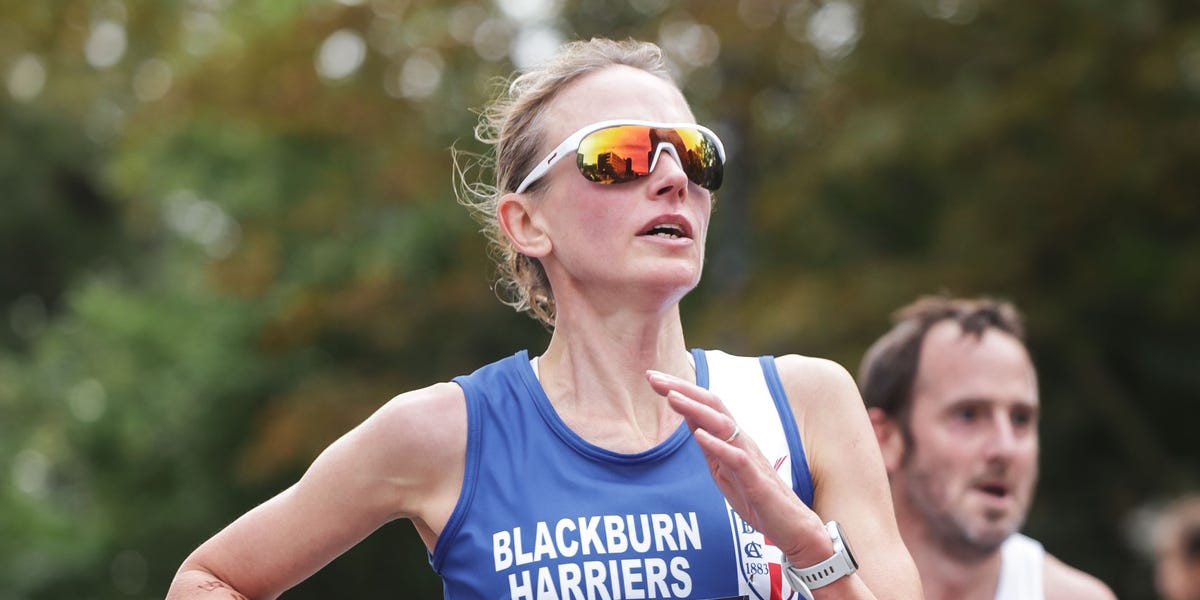
Children are often inspired by their parents, but Vikki Robertshaw’s motivation was sparked by her two daughters.“They ran cross country and track, so I would be taking them to events nearly every weekend, and thinking, ‘oh my gosh, they’re amazing,’” says the 47-year-old from Barrowford, Lancashire, in the U.K. As she watched them bravely show up to the starting line again and again, often getting excessively competitive and hard on themselves, she realized she “wanted to show them that it’s not all about winning,” she says. “It doesn’t matter how you do; it’s just about giving it a go.” What’s more, she wanted to set an example for her girls, showing them they can keep doing hard things at any stage of life.Vikki swam competitively as a teenager, but she had never tried running before. And while she always made it a priority to take her daughters to athletic clubs and races, as a full-time working mom, she never prioritized her own fitness journey.By the time she got the running itch four years ago, her daughters were teenagers, old enough to be left on their own. “I started very slowly, doing a little bit here and there with no intention of doing anything major. I just wanted to do something for myself, really,” she says.Vikki pushed herself to run farther and farther, and at some point signed up for a few half marathons—that’s when she discovered she absolutely loved racing. At the time, “I was running with no real routine or plan at all, just seeing how it went,” she says.But that all changed when she joined a running club and signed up for her first marathon.“I had one pair of trainers that did everything; I had no idea what a tempo meant; I’d never done intervals, and never run on a track,” Vikki says. Through the club, she started working with a running coach, George Woodburn. “He’s been really instrumental,” says Vikki, emphasizing the importance of having a human coach who understands that, as a working mom, she has other priorities. “As much as I love running, it’s not my whole life. So he made it more realistic, and for me to be able to achieve my goals rather than compare myself to other people.”Her coach kept things very simple, advising Vikki to add one weekly track workout to help build her speed, on top of her weekend long run, and outside her easy runs. She kept up this two-key-runs-per-week routine for the four months leading up to her first marathon. “Because I started to get more of a structure, that goal became achievable.”She stood at the start line of the 2024 MBNA Chester Marathon with an ambitious goal for her first race of that distance: to finish in 3:30. “I’d kind of worked out at that point, with a bit of support, what I was going to aim for,” she recalls.Vikki remembers taking off a bit too fast, propelled by the excitement of her first marathon. As she was running out of steam in the final miles, she serendipitously bumped into her friend Katie—who was running the metric marathon (26.2 kilometers instead of miles, or 16.28 miles)—at the point where the two race courses converged. “She kind of almost dragged me to the end,” Vikki laughs. “So I did actually pick my pace up in those last few miles. I’m not sure it would have happened otherwise, but it was like fate that she was there.”At the end of the race, Vikki was overjoyed at her accomplishment—before she even learned about her finishing time of 3:17:20.She was excited to learn that the time qualified her for the 2026 London Marathon. Leading up to it, she became even more intentional about her training, researching nutrition and including strength training to better support her overall strength and recovery. Before the race, she wrote her splits on her arm—in case her GPS glitched—which helped her maintain a steady pace through each mile. She finished in 3:13:08.Vikki has more ambitious running goals, however, with so much messaging about women simply maintaining speed or getting slower in their 40s, she admits there are times she questions whether she’s already hit her peak, and wonders if it’s possible to keep increasing speed. “I’ve only been running since 2022, so for me it’s all very exciting and great fun,” she says. But then she looks at stories about achievements of women her age and older and feels hopeful that together they’re rewriting what’s possible for them. That their prime is far from over. “I look at other women that are faster, so it is feasible—whether it’s realistic for me, I don’t know, but I’m enjoying trying,” she says. “And I feel like I’ve got a bit more left.”Here’s what made Vikki’s running a success:➡️ Start small. You don’t have to sign up for a full marathon right off the bat. “Start with 30 minutes, three times per week, and just build consistency from there,” Vikki says. “You never know where it’ll take you or what you’re capable of achieving until you try—so just give it a go.”➡️ Include strength training. When Vikki started her running journey, strength training was the farthest thing from her mind, but now she sees it as vital. “My intention is to make sure I do like a couple of sessions of strength work each week, to prevent injury and things like that going forward,” she says.➡️ Don’t skimp on nutrition or sleep.In a similar camp of taking care of your body, Vikki is a big advocate for proper fueling, plus plenty of rest and recovery. “There is no one key thing, but it is always about getting enough sleep.”➡️ Don’t overthink it. Vikki didn’t find running until her 40s: It’s never too late, and there is no perfect time to start. “Just know that you don’t have to have all the gear, and you don’t need the perfect conditions,” she says. “You literally just go out there and put one foot in front of the other.”Kristine Thomason is a writer and editor with over a decade of experience creating content for print and digital publications. Previously, she was the health and fitness director at mindbodygreen, and the fitness and wellness editor at Women’s Health. Kristine's work has appeared in Men's Health, Travel + Leisure, Health, and Refinery29, among others. She holds a journalism degree from New York University, and is certified in personal training by the National Academy of Sports Medicine (NASM).
She Didn’t Start Running Until Her 40s. At 47, She Finished Her First Marathon in 3:17—and Then Got Even Faster
Full Article
Original Source
Read the full article at Runnersworld →KhanList aggregates and links to publicly available news content. We do not host full articles from third-party sources. Always verify important information with original sources.