
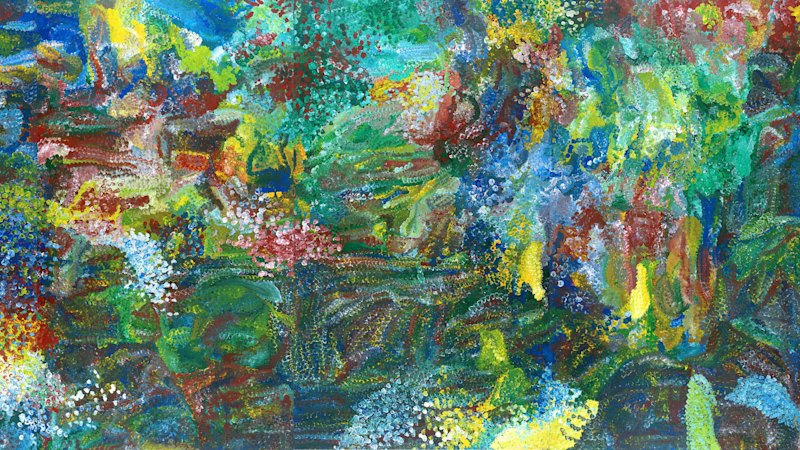
Warning: This story contains the name and images of an Indigenous person who has died.Thirty-eight years ago, 11 tall ships from Britain swept into Sydney Harbour for the 1988 Bicentennial re-enactment of the First Fleet’s arrival, and in that historic moment, artist and gallerist Christopher Hodges was struck by a terrible sense of unease.Watching the celebratory scene with a glass of champagne, Hodges immediately realised that one crucial element was missing: the involvement of Aboriginal Australians who were, instead, in another part of the city, marching through Sydney in protest.“Looking back, how the hell did Australians think the ships coming in was an appropriate event to celebrate 200 years of settlement?” he asks today, standing in Utopia Art Sydney, the gallery he founded that same year with the goal of championing Indigenous artists. “People were there from around the world, but there was no Aboriginal presence at all. I can clearly remember my chagrin. I knew I was in the wrong place. I should have been in La Perouse with all those First Nations people.”In the wake of the commemorative event, Hodges decided to act. First, he persuaded prominent Sydney gallerist Chandler Coventry and James Mollison, the founding director of the Australian National Gallery (later to become the National Gallery of Australia), to accompany him to Alice Springs. Hodges wanted to look at some of the art that had begun coming out of the remote Utopia community, 250 kilometres to the north-east.There they were shown the work of an Indigenous elder and Central Desert law woman in her late 70s, who had just started painting on canvas that year. Her name was Emily Kame Kngwarreye. Mollison, who’d come to prominence by buying Jackson Pollock’s Blue Poles, immediately bought one of her paintings, only the third Kngwarreye had ever produced, for the national collection. She was, he said, “one of the finest abstract expressionists” he had ever encountered.It was the moment of professional discovery – one that launched Kngwarreye into the Australian art world, providing the impetus for a number of landmark exhibitions. Her abstract paintings hit the mainstream, then ended up being exhibited around the world – an unexpected yet undisputed critical, commercial and cultural success. Her rise to prominence was stratospheric and coincided with a period of profound change in Australia when it came to Indigenous culture, says Andrew Bailey, the author of a major new book, Emily: Emily Kame Kngwarreye, the Artist Who Changed Australia.Between 1988 and 2000, a series of key events occurred, notes Bailey, from the Mabo decision in 1992 to the Native Title Act 1993, the Wik decision in 1996 and the Bringing Them Home Report the next year, followed by the first National Sorry Day in 1998. Against that backdrop, there was the rise of other notable Indigenous artists, such as Clifford Possum Tjapaltjarri, Rover Thomas, Gordon Bennett, Tracey Moffatt and Sally Morgan.Emily Kame Kngwarreye at Utopia, her Country.Tara Ebes“But the main factor was the emergence of Emily Kame Kngwarreye,” Bailey argues. “She changed the art world so much, both Indigenous and mainstream, and then became a catalyst for profound national cultural change as well.“By 1998, a new idea was forming: mainstream Australians had begun to consider that Indigenous art provided a visual representation of the nation, themselves included. It seemed to articulate a visual identity that all Australians could feel was authentic – something they had wanted for a long time.”Celebrated Ngan’gikurrungurr artist Regina Pilawuk Wilson, whose paintings are held in major state and national collections and have been exhibited internationally, including at New York’s Metropolitan Museum of Art, agrees. “Emily opened the eyes of the world to Indigenous painting,” she says. “Today I paint my weaving designs, and my paintings are shown around the world. Emily started this.”Emily Kame Kngwarreye only started painting late in life at Alhalker, a rock hole in south-western Utopia, an isolated 2000-square-kilometre area belonging to the Anmatyerr and Alyawarre people, where she worked on cattle stations, mustering, looking after camels and doing housework. She began painting in batik in the 1970s, but after being introduced to acrylics became absolutely prolific. She is believed to have produced more than 3000 paintings over her eight years as an artist until her death in 1996. Her first solo exhibition was held at Utopia Art Sydney in 1990, and her artworks went on to represent Australia at the 1997 and 2015 Venice Biennales, and have been shown in France, Tokyo, New York, Switzerland and at the Tate Modern in London.Starting as a dot painter, using the familiar technique to underpin representations of Country, Kngwarreye later moved on to larger dots or blobs in luminous colour, then to stripe compositions and linear “yam dreaming” paintings and, in the final year of her life, complex arrangements of abstract blocks. She’s now regularly referred to as perhaps Australia’s most significant, and celebrated, artist.Kngwarreye working on one of the 3000-odd paintings she produced in eight years, averaging about one per day.©️Mayumi Uchida“Emily created work that people with no kind of Indigenous art knowledge could understand, to some degree, and appreciate,” says Mirri Leven, the managing director and owner of Art Leven, formerly Cooee Art, Australia’s oldest exhibiting Indigenous-focused fine-art gallery. “Obviously, they can’t get the full cultural meaning and understand that those dots and snakes on the canvas are the blood that runs through people’s veins. Her art somehow transcended contemporary modern abstract art even though it wasn’t modern or contemporary at all. But it crossed into that for ‘white eyes’. It was less ethnographic and had a soul that everyone can see.”Andrew Bailey is a perhaps surprising person to have written Kngwarreye’s biography. A neat, lean, precisely spoken, non-Indigenous man, he looks in every way the retired economist and business executive he is, with roles at the federal treasury, management consultants McKinsey & Company and Optus among others. He describes himself as “no art expert” and has no professional background in art, although he does publish the weekly art newsletter The Easel.Long an admirer of Kngwarreye’s work, he was, however, amazed to discover that there had never been a full biography written, and decided to tackle it himself. Three-and-a-half years into the writing, however, he felt he had hit a brick wall. Despite conducting a marathon of about 50 interviews with people from the art world and beyond, no one could explain exactly how she became so prominent.“I would be asking, ‘What actually happened?’ and nobody could give a straight answer,” says Bailey, now 74. He, too, saw the conspicuous absence of any Aboriginal iconography at the Bicentennial in 1988, and yet 12 years later, he could see that very imagery everywhere at the opening of the 2000 Sydney Olympics – including a Kngwarreye-inspired artwork displayed on the stadium floor for the opening ceremony – but it was hard to tell if there was a link.“As I continued interviewing and writing, I had no sense I was getting any closer to an answer,” he says. “I recall being immensely frustrated that no one could tell me exactly the events that took Emily from being an unknown to being famous. Getting clear about that is what led me to going down a rabbit hole.”That rabbit hole was completely untraversed ground. With no reliable records of art exhibitions throughout the country featuring Indigenous work, Bailey set himself the task of trawling through the ephemera boxes – archived jumbles of cards, letters, pamphlets and photocopied sheets advertising exhibitions – of 26 of the main commercial galleries operating in Sydney and Melbourne. From the details of their 4983 commercial exhibitions, Bailey assembled a database of activity over the two decades to 2000.A Kngwarreye work from 1994, two years before the artist’s death.Emily Kam Kngwarray, Anmatyerr people, Alhalker Country, 1994, Private collection, Naarm/Narrm/Melbourne © Emily Kam Kngwarray/Copyright Agency, 2023. Image courtesy of Deutscher and Hackett. To provide context, he also collected data on the exhibition activity of four major public art galleries, Queensland Art Gallery, the Art Gallery of NSW, the National Gallery of Victoria and the National Gallery of Australia. They’d held 1418 exhibitions. The whole operation was a laborious five-month process that no one had ever attempted before, with every one of the more than 6000 exhibitions compiled and analysed by hand. Perhaps an economist was, after all, the ideal match for the task.‘No one could tell me exactly the events that took Emily from being an unknown to being famous.’Andrew Bailey, author of Emily Kame Kngwarreye’s biographyWhat Bailey discovered from that exercise stunned him. Between 1980 and 1988, Indigenous art featured in barely 2 per cent of Sydney and Melbourne commercial gallery shows. Public gallery activity was similarly modest, at 3 per cent. But between 1989 and 1996 – “the Emily years” – the number of Indigenous commercial exhibitions skyrocketed, from just one in 1980 to 86 in 1989 and 1990 alone. In the four major public galleries, Indigenous shows as a portion of total shows went from 2 per cent in 1985 to 12 per cent in 2000.As a result, Bailey argues that the art world’s recognition of Kngwarreye’s work became the catalyst for the modern Aboriginal art movement. Before her, Aboriginal art was largely considered ethnographic and belonging in a museum or a tourist souvenir shop. Her art was the first to be perceived as modern abstract art, rightfully belonging in an art gallery and, with that shift, First Nations art became so successful that it’s now a major part of the Australian art market and a consistent attraction for overseas tourists.“Up until the late 1980s,” he points out, “there were almost no Indigenous exhibitions. Then there was an absolute explosion, a bonfire, that’s kept on growing. The emergence of Indigenous art was not – as I’d repeatedly been told – gradual. It was sudden. Explosively sudden. I can’t exaggerate how surprised I was by those figures, and how profound that change was. And Emily was demonstrably the catalyst, because she was, by orders of magnitude, more prominent than any other Indigenous artist of the period.”If he’s being honest, he completely mistook what the data would show. It had answered his question about Kngwarreye’s rise to fame, but the real surprise was what it revealed about mainstream Australia – where it had come from in the early 1980s, and how it changed during the time she was painting and why. “The phrase that comes to mind,” he says, “is that I went fishing for a sardine and caught a whale.”Tracking the commentary in newspapers through those two decades revealed another surprise – the seeming search for national identity that was well underway. Up until then, the Great Australian Silence – a term coined by anthropologist W. E. H. (Bill) Stanner in his 1968 Boyer lecture to describe the omission of Indigenous Australians from national history – still seemed to rule.Nicolas Peterson, emeritus professor of anthropology at Australian National University, says the only real attention being paid to Aboriginal Australians was from fellow anthropologists in writings never intended for mainstream consumption. Kngwarreye helped change all that. “When Qantas starts painting its planes with dot paintings, we know that Aboriginal art has become mainstream,” Peterson says. “Now, the whole profile of Aboriginal Australia has been magnified through Aboriginal art and has become part of the national imagination.”Beyond the many social and political events that contributed to the rise of Indigenous art, there was a broader social and demographic shift underway, too. One small measure: in the 2021 Australian census, 25 per cent more people identified as Indigenous (3.2 per cent) than in the previous national survey in 2016 (2.8 per cent).“I would frame Kngwarray not as the sole cause, but as a crucial catalyst within a much larger transformation in the Indigenous art sector, including the increasing visibility of Indigenous artists, major exhibitions, collecting by public institutions, galleries and private collectors, and growing international attention,” says curator Kelli Cole, a Warumungu and Luritja woman from Central Australia, who worked with Hetti Perkins on the 4th National Indigenous Art Triennial: Ceremony.Cole also co-curated the major exhibition Emily Kam Kngwarray (Cole’s spelling of the name is different, on her family’s wishes) for the National Gallery of Australia, which subsequently toured to the Tate Modern in London and Fondation Opale in Switzerland, and says Kngwarray’s success coincided with – and helped accelerate – a wider conversion in which Aboriginal art moved from the margins of Australia’s cultural institutions into the centre of its national vision.“Kngwarray’s work became particularly significant,” Cole says, “because it enabled non-Indigenous Australia to embrace Indigenous art as an expression of cultural identity, even as the paintings themselves asserted radically different understandings of Country, knowledge and belonging.”Bailey sees it differently, asserting that Kngwarreye was “the spark” that led to change. “I am fully aware that is incautious language,” he says. “Yet, there is simply no other way to fairly represent the evidence. That’s the meta-narrative: Emily, as our most important artist ever, changed Australia.”Certainly, Indigenous art has never been more popular. This year’s National Indigenous Art Fair, held on July 3-5, generated more than $1.2 million for exhibitors, a record $450,000 more than the previous year. “None of us was expecting this kind of increase in sales in these hard economic times,” says Sarah Martin, the founder and general manager. “It shows there is such an appetite for Indigenous art, and a genuine interest in learning about the artists and their stories.”Kngwarreye’s 1994 work Earth’s Creation, which, at $2.1 million, holds the record for an Australian female artist and is the second-highest price ever paid for an Indigenous work.Christopher PearceThe four-day Sydney Contemporary, which concludes September 6 with a line-up of more than 100 galleries and its celebrated component of First Nations art, now has its largest-ever public art and city-wide installation program.First Nations APY Lands artist and cultural consultant Sally Scales says Indigenous artists owe a huge amount to Kngwarreye. “She absolutely made such a difference for us,” she says. “She was a superstar, and one of the most important artists for all Australians, as well as for First Nations artists. She’d lived a full life then painted her story, her lore and her culture later in life and in multitudes of ways. The doors she opened for us, and I’m getting teary even thinking about it, made an incredible difference for everyone who followed. It’s an amazing legacy.”Wiradjuri artist Brett Groves says Kngwarreye was deeply inspirational, living her traditional life and being inspired by Country, and ceremony and family. “I run workshops and many people say they’re put off creating art as they feel they need to go to university,” he says. “But she was a stirring example of painting from the heart and letting the paint on the canvas speak for her. But while so many more people are now interested in Indigenous art, we still encounter racism about our art.”Kngwarreye holds the record for an Australian female artist with her 1994 masterpiece Earth’s Creation, which sold through Art Leven for $2.1 million in 2017. It was also the second-highest price ever paid for an Indigenous work after Clifford Possum Tjapaltjarri’s 1977 Warlugulong which, with its 25 per cent buyers’ premium, came to $2.4 million in 2007.Her enduring significance is clear to social anthropologist Dr Peter Sutton. “She got to people through beauty, reaching even people who don’t know the narrative or spiritual meaning of her work,” he says. “Her use of colour tones and arrangement of forms are very satisfying. People sometimes hate to admit they like beauty, but most people do. Emily had a fantastic run in a very good market.”Toby Meagher, director of Michael Reid Sydney + Berlin, the galleries that represent contemporary Australian and New Zealand artists (with half of their artists being First Nations), says that Kngwarreye, even posthumously, continues to wield huge power and influence. “We certainly watch closely the global response to Emily because, in lots of ways, she is iconic and her success is a window into First Nations contemporary art today,” Meagher says. “She really opened the doors to others, like Regina Pilawuk Wilson, who’s our most important senior woman artist.”He wouldn’t say Kngwarreye was the only influential First Nations artist, but her practices and energy and art-making propelled her to another level, generating a momentum that made her symbolic of something larger. “With Emily, there’s a depth to her work and a beauty and a story-telling that really resonates and builds an emotional connection,” he says. “In a lot of ways, Emily has become emblematic of the shift that happened with First Nations art over that period.”‘She got to people through beauty, reaching even people who don’t know the narrative or spiritual meaning of her work.’Anthropologist Dr Peter SuttonBailey makes the case, of course, that Kngwarreye is Australia’s greatest artist ever, and even though Brett Whiteley is a contender for the title, the strength of his rivalry ebbs when their solo shows and retrospectives are compared, especially on the international stage. At least by the numbers.In 2008, Kngwarreye had her Tokyo retrospective, and then the Venice Biennale again in 2015, but Bailey says it was with her 2025 retrospective at the Tate Modern – the first major exhibition there for any Australian artist – that she left Whiteley behind.“Of course, Whiteley was a tremendous artist, no question, but Emily, having a solo show at one of the four to five most influential contemporary art galleries in the world, that puts her in the pantheon of internationally important artists like Van Gogh, Picasso, Mondrian and Jackson Pollock,” he says. “If you ask people who’s our most important artist … not a lot of people would say Emily. But she’s someone who changed our view of Indigenous art, of Australian art and, along the way, transformed the Australian national identity.”Christopher Hodges, the man who sat watching those tall ships and wishing he was elsewhere, and who played a role in introducing so much of the outside world to Kngwarreye’s work, has little doubt, either.“Emily’s work is so aesthetically pleasing, beautiful and appealing, and people react to it with an almost back-of-brain response,” he says. “Her work insinuates itself inside, it seeps in, and it beats all the filters. Even people who say they don’t like modern art are drawn to hers. It has such a charismatic quality, just like Emily herself, and has left an enduring legacy.”Emily: Emily Kame Kngwarreye, the Artist Who Changed Australia by Andrew Bailey (Allen & Unwin, $50) is published on September 29.Get the best of Good Weekend delivered to your inbox every Saturday morning. Sign up for our newsletter.Read more from Good Weekend magazine:Height restrictions, marriage bans and serving the prime minister: the life of a 1950s flight attendantThe great furniture blanding: How neutral tones took over our living rooms‘I think the universe wants us to be friends’: Why it took Nell and Kylie Kwong two years to get together
She didn’t start painting until her 60s. Now she’s considered our most important artist
Full Article
Original Source
Read the full article at Smh →KhanList aggregates and links to publicly available news content. We do not host full articles from third-party sources. Always verify important information with original sources.