
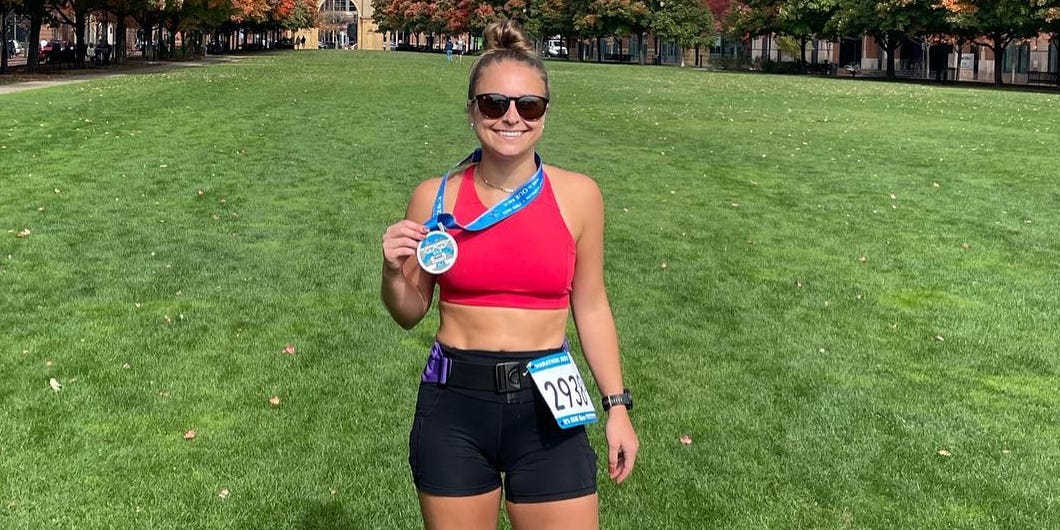
Courtesy Hannah Zarzecki//Hearst OwnedOn a rainy Saturday in June 2024, Hannah Zarzecki cried as she crossed the Grandma’s Marathon finish line. It was her eighth marathon, and despite following a training plan, she didn’t achieve her sub-4 goal—again. “I kept telling myself, ‘Why did I sign up for this? I still can’t PR. I’m freezing cold. My feet hurt,’” she says. “It was so miserable.”She didn’t know that a chance encounter at that race was about to change that.A high school cross-country runner, Zarzecki returned to the sport after graduating from Harvard University, where she played ice hockey. Wanting a goal to work toward, she entered the 2018 Chicago Marathon lottery and won a bib in her hometown race.Leading up to the race, Zarzecki had not run more than about 15 miles and didn’t follow a training plan. She was in good shape from teaching spin classes several nights a week and wasn’t sure how else to prepare. I’m either gonna finish this marathon, or I am gonna end up in the hospital, she remembers thinking. She was surprised and proud when, taking walk breaks, she ran her way to the finish in 5:04:59.Not convinced that marathons were for her, Zarzecki turned her focus to shorter distances, 10Ks and half marathons—until a spin class student told her about completing the Berlin Marathon. She loved the idea of traveling to run races in other countries, so she applied for and got into the same marathon. After loosely following a training plan she found online this time, she ran and walked the 2021 Berlin Marathon in 5:16:32. Disappointed, she decided to commit to working on her time.Zarzecki found a coach on Instagram whom she paid to create a training plan for her. She devoted herself to this regimen, which included her first experience with speedwork and intervals. She also joined the Electric Athletic Club in Chicago and participated in their group runs.Zarzecki raced the 2022 Rock ’n’ Roll Nashville Marathon. Without taking walking breaks, she finished in 4:12:11, improving her Berlin time by more than an hour seven months later. “When I actually put my mind to training and following this plan, everything kind of came together, and I’m like, ‘Oh, this is how you’re supposed to do a marathon,’” she says. She was hooked.For the next couple of years, Zarzecki used the same training plan, running about 30 miles each week. In May 2023, she surprised herself on her 28th birthday when she finished the Wisconsin Marathon in 4:00:28.After that, her one goal became to break four hours. In the fall of 2023, she ran the Berlin Marathon followed by the Chicago Marathon two weeks later, finishing in 4:11:26 and 4:01:23, respectively. She came so close again yet couldn’t reach the elusive goal. When she finished the 2024 Grandma’s Marathon about eight minutes slower than her Chicago time, Zarzecki was in tears.But Grandma’s was pivotal for a different reason. After the race, Zarzecki began talking with two female runners while she waited for her boyfriend to return with their car. They commiserated about the race and bad weather. The other two runners were trying to book a rideshare but were having no luck, so they asked if it would be possible to get a ride to the airport with Zarzecki. She and her boyfriend agreed even though it added 40 minutes to their return drive to Chicago. After Zarzecki refused compensation, one of the runners, a New York Road Runners coach, Maria Romano, suggested payment in kind: she would train Zarzecki for her next marathon.Through texts, emails, and phone calls, Romano began advising Zarzecki, encouraging her to work up to running 60 miles per week, varying short and long runs and speedwork. “If I text her and say I had such a great run today, she’s the biggest cheerleader, and it’s crazy the mental difference that makes,” Zarzecki says. Romano taught her how to taper and spend the 24 hours before racing.In April 2025, Zarzecki tested her training at the London Marathon. Although she felt energized, the race felt tough. When she thought of quitting, Zarzecki reminded herself that she was running for Midge, her 20-year-old dog. She’d adopted Midge from PAWS Chicago, an animal shelter where she’d volunteered, and for which she was now fundraising with her charity bib. She couldn’t stop!In the end, her preparation more than paid off. Zarzecki even increased her pace in the final two miles and finished in 3:43:58. She was “over the moon,” she says. “I had to sit down and just sit there for 10 minutes because I was like, ‘I can’t believe that happened.’”In February of this year, Zarzecki improved her marathon PR by another 10 minutes at Arizona’s Mesa Marathon. Now she’s preparing for the 2026 New York City Marathon after getting a spot on the Runner’s World+ team. While she would really like to finish in 3:25 to qualify for the Boston Marathon, nursing school has kept her busy, keeping her from focusing on training the way she’d like. “My goal for New York is just to really have fun and appreciate how far I’ve come,” she says.4 Lessons From a Coach That Helped Zarzecki Finally Run a Sub-4 Marathon➡️ Vary your paces.Romano told Zarzecki to run half of each long run slow and the other half at her marathon pace, and Zarzecki began working up to this a few miles at a time. Romano also told her to run very slow on easy runs. “I have to relax and run almost 11-minute miles so I can recover, and my body isn’t built to be going the same pace every single run,” Zarzecki says.➡️ Take ice baths.A couple of times a week after running, Zarzecki spends a few minutes in her gym’s ice bath, alternating with a few minutes in a hot tub, on Romano’s advice. The habit has improved her recovery, she says.➡️ Rotate shoes.Zarzecki now cycles through three to four pairs of shoes. She’s learned that different shoes are better for certain activities; cushioned ones are a better fit for easier runs, while stiffer ones propel her during speed sessions. Giving each pair a break helps them return to their original shape. “I run in pair one on Monday, and I don't rotate that shoe back in until Friday,” she says. “That shoe has from Monday till Friday for the foam to just kind of breathe and come back to life versus that constant pounding.”➡️ Fuel properly during a race.During the 2025 London Marathon, Zarzecki ate a gel at the beginning and then every 5K, which made a big difference in her energy level. “It was mentally a big challenge; it always is,” she says. “But my body didn’t feel like it was dying. I felt capable the whole way.”Maggie Gigandet is a former trial attorney with 15 years of training and experience in writing, researching, and interviewing. She writes about the outdoors, people with interesting passions, and anything unusual.
She Couldn’t Break 4 Hours in Eight Marathons. Before Her Next Attempt, She Tweaked Her Training—and Finished in 3:43.
Full Article
Original Source
Read the full article at Runnersworld →KhanList aggregates and links to publicly available news content. We do not host full articles from third-party sources. Always verify important information with original sources.