
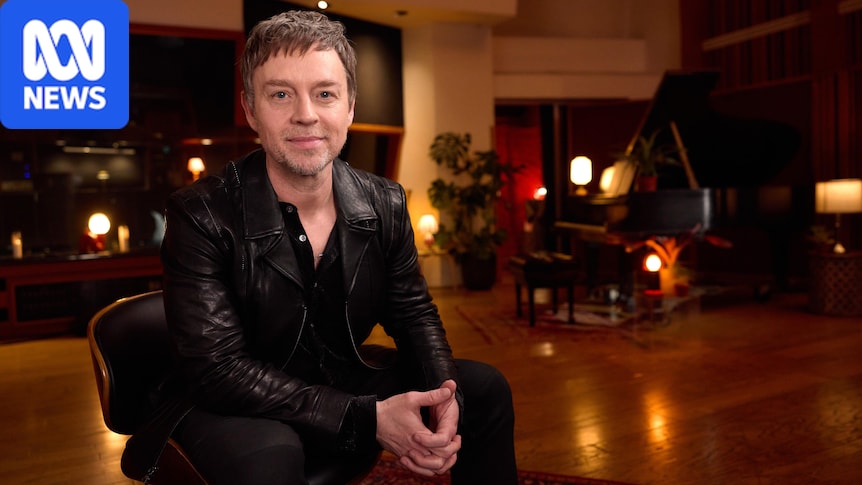
Darren Hayes learned to sing by listening to his mother."She had the most beautiful, melodic voice and I would mimic her," the musician and former frontman of Savage Garden says."A lot of my singing education came from mimicking people — but she was the first person I ripped off."Hayes's mother, Judy, would never have admitted her influence."She wouldn't think that she taught me how to sing because she had such a low self-esteem," he says on Take 5 With Zan Rowe.Hayes grew up in a home wracked by domestic violence, saying his father was "an extremely violent man"."But my mother was an angel, and she was the very inception, the seed, the beginning of music for me."And he says it was music that saved his life."I know that's a cliché and everyone says this, but I was a very, very lost kid."'I'm not a freak … I'm famous'Growing up in Logan, Queensland, Hayes never fit in."It was a very hyper masculine community, I remember being afraid of that. Everyone smoked, everyone played football," he says."And I was just this delicate kid that was recreating scenes from Star Wars by making the toys kiss.""I can't believe that I survived my childhood," Darren Hayes tells Zan Rowe on Take 5. (Supplied: Facebook)He was bullied from a young age for being gay, years before he even knew what that was."My father was the first person to call me the F word, and it's not the one that rhymes with truck."His way of coping with that was deep denial."I just decided, 'Oh no, I'm not a freak, I'm not all these terms they call me'. From a very early age, I decided that I was just famous."Throughout it all, he also felt a strong duty to protect his mum from violence, particularly if his father had been drinking. That could look like driving the car to get her out of the house in the middle of the night, or using his sister's hockey sticks to fight back.Pretending he was a star, years before he actually was, helped him see a way out."I knew [I'd be famous], but not for the arrogant reasons you might think," he says. "I knew because it was either be famous and magical and special, or die."I lived in a family where my job was to keep my mum alive. But I thought if I could just be famous, I could save her, us, me, everything."Success and secretsWhile Hayes never doubted his fame, it wasn't until high school that he realised he could sing.His music teacher made him join the school choir, and it was a revelation."I felt the molecules in the room change, as they always do when people sing. That's what music does," he says."But I could feel it and that was it."Daniel Jones and Darren Hayes played together in a pub rock band called Red Edge before forming Savage Garden. (Supplied: Tim Roney/Getty Images)Hayes was in his early 20s in 1996 when Savage Garden, the pop duo he formed with friend Daniel Jones, released its first hit single 'I Want You'.From there, Savage Garden's ascent was dizzying. Their debut, self-titled album won a record 10 ARIA Awards in 1997.Being so firmly in the public eye also brought extreme vulnerability for the young man."I was so grateful to have it…in the beginning," he says."But there were secrets. Gay: secret. Depression: secret. Don't tell anyone."Hayes says the American record companies did everything they could to ensure the audience didn't "find out" he was gay, including changing his hair, telling him not to move much in music videos and doing audience surveys about which pictures were the "most masculine"."So it became hell, but I learned how to keep it in," says Hayes."I mean, you never know, it could end tomorrow."Savage Garden performs in Melbourne in 2000. (Supplied: Martin Philbey/Redferns)But it didn't end, even when Savage Garden called it quits in 2001. Hayes has gone on to have a successful solo career, releasing five studio albums. In 2019, he received an Order of Australia for services to the music industry.And when he came out publicly, he could be the artist he'd always wanted to be."Oh my god, to be able to use the pronoun that I want to use," he says with a relieved laugh."My biggest success to me is my least commercially successful record. It's called Homosexual — how fun was that, to make an album basically called 'Super Gay'?"Released in 2022, Homosexual is Darren Hayes's fifth studio album. (Supplied: Powdered Sugar)Hayes says the biggest personal impact was when he started to see queer people turn up in the audience of his shows."I felt so seen and understood," he says."It was like having lived in solitary confinement without a window all your life and suddenly the first dapple of sunlight hits your face."'Fly on, ride through'Getting out of Logan and being able to perform as a proud gay man "is the equivalent of winning the Lotto" for Hayes."I'm really happy that I think maybe I got to break the cycle of toxic abuse."As for his mum, he says she "couldn't have given a shit" if he was famous or not, she just wanted him to be happy — and that came through music."I remember laying in Mum's lap and her just letting me cry and letting me know that I'm going to be OK," Darren Hayes says of his mum Judy. (Supplied: Darren Hayes)"Do you know what music was for me? It was that I was able to pay cash for a house for my mum so she could finally leave him."Hayes still struggles to speak in the past tense about his mum, who died in early 2025 from complications with COPD.While he'd known she was terminally ill, Hayes had thought they'd get "a decade or more with her". But she died suddenly when he was away."The thing that makes me sad about Mum is she was so afraid to die because she loved being alive," he says."She used to say, 'oh, I don't want to die because I'm going to miss you all so much'."The grief still sits raw and heavy on Hayes, but music helps him cope. When it came to choosing a song for her memorial, he decided on 'O' by Coldplay."There's this line where he says: 'Fly on, ride through/Maybe one day I'll fly next to you', and that's how I feel about my mum."I remember trying to hold onto her, because all of our lives there was an invisible string connecting us, there was a tether," he says.But at her wake he realised he had to cut the string, "like a beautiful balloon"."I had to let her go," says Hayes, with tears in his eyes."I think that's a theme of my entire life."
'She could leave him': What fame really meant for Darren Hayes
Full Article
Original Source
Read the full article at Abc →KhanList aggregates and links to publicly available news content. We do not host full articles from third-party sources. Always verify important information with original sources.