
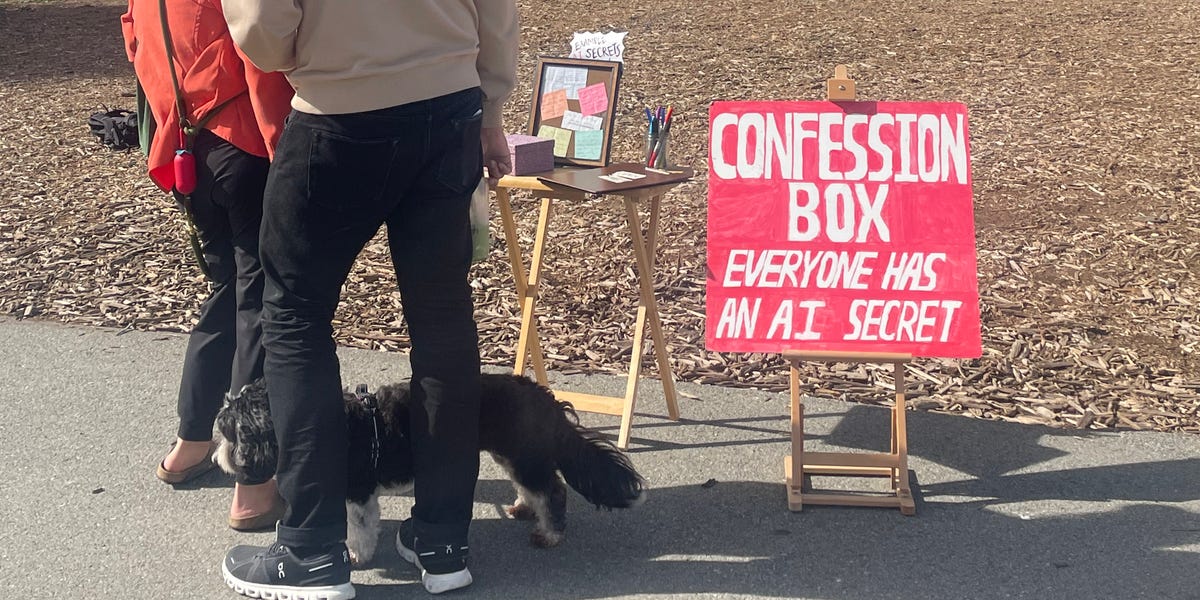
She asked people to write down their AI secrets. The confessions came pouring in. Olivia Tai asked people to write down their AI secrets. She turned the confessions into a website. Olivia Tai Olivia Tai stood in a San Jose mall with her bright red sign, proclaiming: "Everyone has an AI secret."Two tween girls approached, arms full of shopping bags. They quickly scribbled down their confessions, chatting with Tai in their Valley Girl affect. Tai asked about how they used AI at school."Everyone uses AI, and if you don't use it, you're an overachiever," the girls told her.Tai wasn't just fishing for tech secrets. The 26-year-old from San Francisco was developing her art project, called "What We Tell AI." She asked strangers across the country to leave anonymous notes about their AI-related shames — and then displayed them on a website. Olivia Tai collected the AI confessions on small notecards. Olivia Tai Americans are forming increasingly personal relationships with AI. A September survey from Elon University and YouGov found that 27% of US adult internet users had "significant emotional or social interactions" with AI.Tai saw this first hand. The project turned her into something like a radio host accepting late-night calls, she said. Friends told her about their ChatGPT-written wedding vows; strangers told her they lied to their managers about AI. A look at the notes published on the What We Tell AI website What We Tell AI/Olivia Tai "I didn't know how this project would impact people," she said. "What I'm learning is that, sometimes, the poignancy of a single, really clear story in the form of a note can actually spread way more dialogue."The origins of the projectTai was tired of people turning into "debate kids" when they talked about AI.In the summer of 2025, she hosted a series of workshops in New York and San Francisco about AI's impact on the world. She noticed that people would get too abstract or think too far into the future. So, she introduced the confessions. At the start of the workshop, she'd ask attendees to write down a secret about their relationship with AI. They'd put the notes in a bowl, mix them up, redistribute them, and have everyone read the admissions aloud."It makes the stakes really personal," she said. "It makes things real."After a few workshops, she thought the confessions would make a good art project. She set up a prototype in San Francisco's Dolores Park, with a cardboard box and a Sharpie-written sign. Tai set up the confessions box in parks around San Francisco and New York. Olivia Tai One note that day, in particular, struck her. It was about cloning an ex-boyfriend's voice to "have a last connection with him." The AI cloning "helped me finally move on," the note read.Tai found it "poignant" and "strange" — and decided to turn it into a proper art project in multiple cities.She painted a wooden sign bright red. "It's meant to be provocative," Tai said. She'd load it into her granny cart, along with an instruction folder and a picture frame containing six example notes.Not everyone got it. Some would leave confessions about long-lost loves with no AI relation. Others would leave prank notes. Still, she ended up with a trove of thoughtful responses. Confessors told Tai about AI-written emails and texts. Olivia Tai After collecting the notes, Tai kept them in little plastic bags, organized by where they were written. She then uploaded them to her site, designed by her friend Arin Pantja.Tai is still scanning the notes, so the site is being updated continually and could continue to grow. People are asking Tai if they can contribute and complete the experiment in Mexico, Australia, and China, she said.An unscientific studyTai called the project a "snapshot" of San Francisco.It's not that she only collected data from the city; she hopped between San Francisco, San Jose, and New York. Rather, it's about the spirit of the confessors."You won't come up to the booth if you don't actively have a relationship with AI," she said. "I'm in a lot of spaces that are going to have early adopters." Many of the responses were about chatbot romances. Olivia Tai Of the cities, San Francisco had the boldest responses. In New York's Luddite community, it's shameful to say you wrote an email with AI, Tai said. In the Bay Area, that's table stakes.Some of the San Francisco confessors wondered if she was doing market research for an AI company. "People who work in AI would be scared, and a little bit suspicious," Tai said.She compared it to New York, where people worried she was a content creator, filming them as they wrote. Respondents in New York were afraid that Tai was a TikToker. Olivia Tai Tai calls herself an "artist-researcher." She later clarifies that she more identifies with the artist title, but that the process of collecting notes felt like an "anthropological, ethnographic snapshot."She isn't an expert, Tai said, and she's not telling people to "have some takeaway." Rather, she's asking people to reflect more deeply on the "slippery slope" of AI."There are all these new norms coming about," Tai said. "Which ones do we actually want?" Read next Henry Chandonnet is a senior reporter on the Business News desk. He writes about tech culture, from Silicon Valley's startup class to the everyday AI user. He also closely covers Big Tech and the workplace. Henry previously wrote for Fast Company, where he covered trending tech news. He's written for The Daily Beast, People Magazine, and Vulture.Email Henry at hchandonnet@insider.com, reach him on Signal at henrychand.30, or follow him on X @HenryChandonnet. Art AI San Francisco More
She asked people to write down their AI secrets. The confessions came pouring in.
Full Article
Original Source
Read the full article at Businessinsider →KhanList aggregates and links to publicly available news content. We do not host full articles from third-party sources. Always verify important information with original sources.