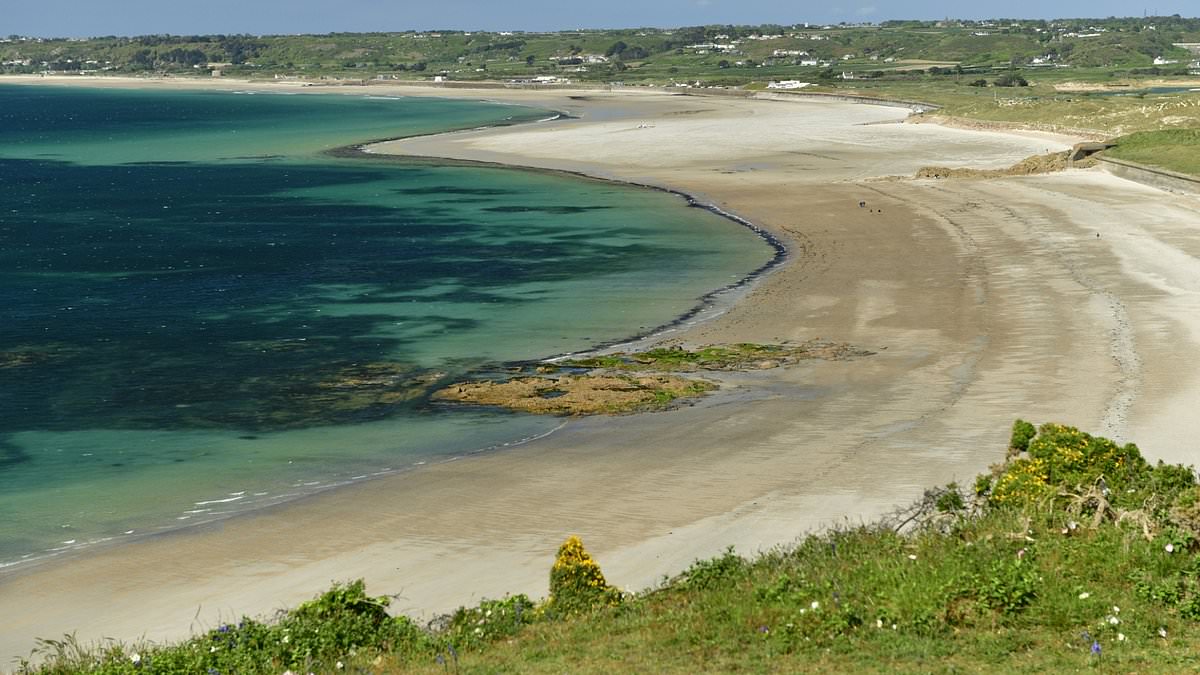
A beach in Jersey was closed to the public on Saturday after a huge shark was spotted in the water. The Royal National Lifeboat Institution (RNLI) closed off St Ouen's Bay for 45 minutes after lifeguards spotted a large, grey animal around 40 metres from the water's edge. Tom Rolls, a lifeguard with the RNLI, said the animal was estimated to be between 10ft and 12ft long, and was spotted at around 10:40am after entering the bay from the west. 'We got the call through from one of the guards at Watersplash, and he basically said that a shark had been spotted in the lineup,' he told the Bailiwick Express.'Initially, we were like, "that's a joke, you're having us on here". 'But then he was persistent. He said multiple sightings had been seen by members of the public.' Lifeguards couldn't immediately identify the species, so took the decision to raise the red flag across the whole bay.Thankfully, the shark soon left the bay heading south, with no beachgoers harmed. The Royal National Lifeboat Institution (RNLI) closed off St Ouen's Bay for 45 minutes after lifeguards spotted a large, grey animal around 40 metres from the water's edgeMr Rolls explained that the shark swam directly beneath the board of his colleague, Nick.'He said it looked definitely more like a shark than anything else,' Mr Rolls said.'He even said he kind of punched it as he was paddling, so it must have been really close to the surface.'It was darkish grey, about 10 to 12 feet long, and then it swam away really quickly from under his board.'The lifeguards asked people to leave the sea – and were met with a few 'surprised looks'.'Everyone was super calm about it,' Mr Rolls said. 'There were lots of surprised looks, obviously – us included – as it's never happened before.'It's the first time in history that Jersey has closed the beach for a shark sighting.' The sighting comes shortly after an endangered shark was stranded at another beach in Jersey, Grève d'AzetteJesse Heddercott, a surf instructor, was teaching people to surf when the lifeguards told people to get out of the water. 'Nothing like this has ever happened in Jersey before, so it's pretty crazy,' Mr Heddercott, 16, told the BBC. 'We thought it was just a tuna, or something, but then another lifeguard spotted it and it was confirmed to be – probably – a shark.'They red–flagged the beach and we all had to get out.'The sighting comes shortly after an endangered shark was stranded at another beach in Jersey, Grève d'Azette.Marine Mammal Medics attended the scene and found a 600kg, four–metre–long shark stranded in a tidal pool. Sadly, the shark died shortly after their arrival. 'The animal was identified as a smalltooth sand tiger shark,' British Divers Marine Life Rescue explained. 'It is an elusive and deep–water species, typically found in warm and tropical oceans globally. 'They are also listed as Endangered on the IUCN Red List and are considered naturally uncommon, with minimal research into the species to date.'The first confirmed records in the UK and Irish waters of this species were only published in 2023, when three individual sharks were recorded in the English Channel and Celtic Sea. 'Their sightings may be linked to warmer than average sea temperatures contributing to a northward shift in the species' range.'HOW SHARKS EARNED THEIR RUTHLESS REPUTATIONSharks are the most efficient predators on earth and have long terrified humans.Their basic design has never really changed over the course of 200million years and they are considered to be complex and intelligent.Their teeth are fear factor number one, with the great white's teeth growing up to two-and-a-half inches in length.Their prey are impaled on the pointed teeth of the lower jaw where they saw away sections of the flesh. The serrated edges of the teeth help with this process.Their teeth are brittle and are constantly breaking off but are also constantly regrowing and on average there are 15 rows of teeth present in the mouth at one time. Sharks are the most efficient predators on earth. Their basic design has never really changed over the course of 200million yearsTheir speed is fear factor number two. They are very fast in the water compared to humans with the mako shark able to reach an incredible 60mph in bursts.The great white can reach speeds of 25mph. By comparison, 5mph is the fastest a human being can reach.A shark's power and size terrifies us, too. The great white shark can grow up to 20 feet and while it has no particular taste for humans even an exploratory bite is enough to cut a man in half.Most sharks release a human after its first bite but sometimes, that's all it take to kill a person. However, sharks have far more reason to be afraid of humans. We kill up to a million of them a year, often just cutting off their fins to make into soup and throwing the rest of the shark back into the water, where it starves or drowns.
Shark sighting closes Jersey beach for the first time in HISTORY: Lifeguards clear the water after a 12ft creature is spotted
Full Article
Original Source
Read the full article at Dailymail →KhanList aggregates and links to publicly available news content. We do not host full articles from third-party sources. Always verify important information with original sources.