
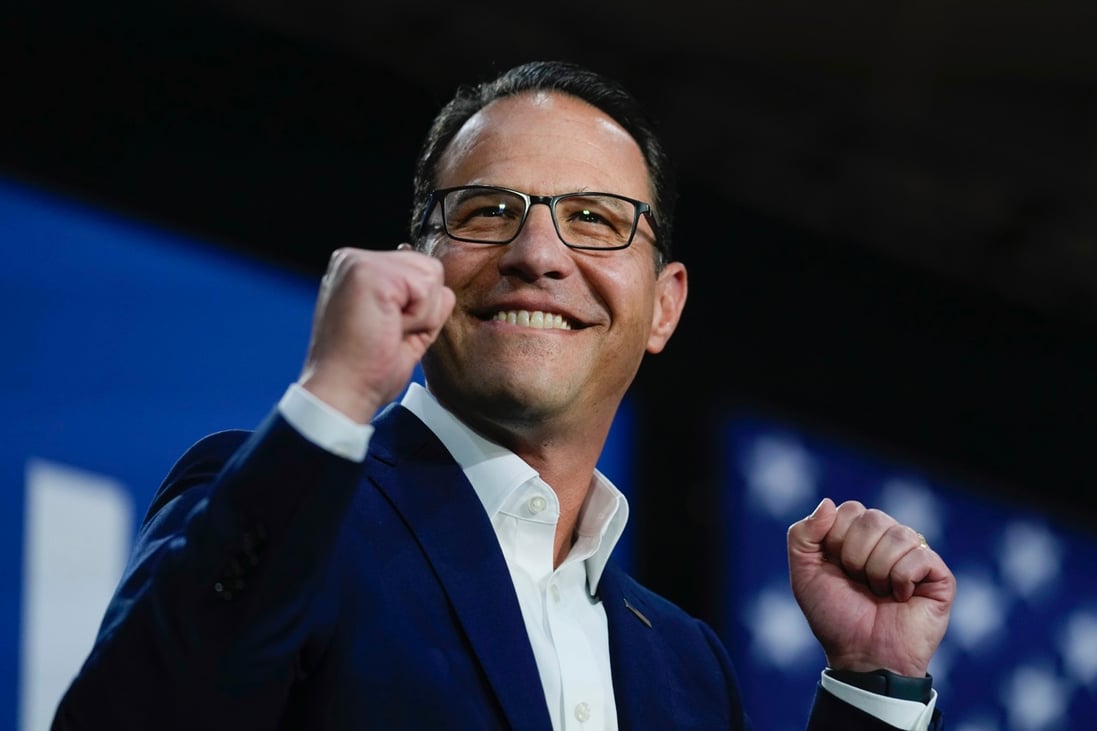
PHILADELPHIA (CN) — Pennsylvania Governor Josh Shapiro and the Trump administration clashed once again in federal court Tuesday, as the Keystone State leader challenged the Department of Agriculture’s revocation of $13 million in funds for local farmers and food banks.Pennsylvania Governor Josh Shapiro and Pennsylvania Agriculture Secretary Russell Redding sued the federal department in June 2025 following the abrupt cancellation of a $13 million Local Food Purchase Assistance program agreement.Instituted to facilitate the purchase of fresh, healthy food from Pennsylvania farmers for distribution to food banks and pantries, the agreement would have supported 189 in-state farms and 14 in-state food banks, according to Pennsylvania officials.Instead, those officials said, the promised funds disappeared overnight, slashing as much as 15% of food banks’ purchasing budgets and eliminating more than 4.4 million meals for food-insecure Pennsylvanians.Arguing the abrupt elimination of the agreement violated the Administrative Procedure Act and due process law, Shapiro sought reinstitution of the program as relief.However, a federal judge in Harrisburg, Pennsylvania, dismissed the complaint in December 2025 for lack of subject matter jurisdiction, finding the agreement contractual, and thus the dispute belonged in the Court of Federal Claims under the Tucker Act.Shapiro promptly appealed.Representing Shapiro in the Third Circuit, attorney Jacob B. Boyer argued the lower court’s designation of the LFPA as a contract was inaccurate, instead presenting it as a cooperative agreement bound by the Administrative Procedure Act rather than the Tucker Act.However, U.S. Circuit Judge Thomas M. Hardiman quickly questioned the accuracy of Boyer’s classification.“Here, you don’t want money,” the George W. Bush appointee said inquisitively.“I would say it this way, Your Honor,” Boyer replied. “If we prevail, there is no sum due immediately. At the time of the termination, there was no money owed out to the-”“If you don’t want money, why are you here?” Hardiman interrupted. “Why bother going through all this effort?”In response, Boyer suggested the lack of an immediate payment pending reversal distinguished the case from a contract dispute.“There wasn’t, at the moment of termination, a specific sum due, or even any entitlement at that moment to payment,” Boyer said. “If ultimately the termination decision is vacated, what follows next is the Pennsylvania Department of Agriculture needs to submit a plan to USDA that needs to be approved; there might be back-and-forth on that.”When questioned by U.S. Circuit Judge Theodore A. McKee — a Bill Clinton appointee — as to whether Shapiro is seeking specific performance, Boyer contended that question is effectively irrelevant.“Specific performance of something that is not a contract is within the scope of APA jurisdiction,” Boyer replied. “What we’re asking for is a decision to vacate the termination. But even if the court were to consider that as tantamount to specific performance, that itself doesn’t resolve it.”Seeking to bolster his argument that the LFPA constituted a cooperative agreement, Boyer pointed to the program’s full title — the Local Food Purchase Assistance Cooperative Agreement Program — noting that the Department of Agriculture specifically named it a cooperative agreement.While Boyer conceded the name is inconclusive on its own, he argued it should be recognized as an indicator to be used with further analysis.“The document itself — the terms of the agreement — corroborate that what we are dealing with here is indeed a cooperative agreement,” he told the appeals panel. “The title matters.”However, representing the Department of Agriculture, attorney Sarah J. Griffin rebutted Boyer’s argument, suggesting the program’s name is irrelevant to the court.Instead, Griffin attacked Boyer’s reliance on a congressional statute clarifying differences between contracts and cooperative agreements, calling it a “red herring” that bears little weight on the case and suggesting the agreement actually qualifies as a procurement contract.“That statute was not designed to speak to the scope of the Court of Federal Claims jurisdiction,” Griffin said. “It was simply designed to promote consistency in operations and expectations….That statute doesn’t purport to govern what is an express or implied contract for purposes of the Tucker Act.”As Griffin continued, asserting the congressional statute “ignores the true reciprocal nature of the agreement,” the appeals panel appeared hesitant to agree.“What is the government getting?” McKee asked.“It’s, of course, getting Pennsylvania spending the money on things that the government wanted them to spend money on,” Griffin replied. “It’s also getting progress reports, financial—”“The bureaucratic stuff, that’s just — you give somebody money, you want to make sure that money’s being used for the purpose for which it’s given,” McKee interrupted. “So the whole accounting purpose behind that, to me, is an underwhelming argument.”Still, Griffin continued, suggesting the degree of reciprocation from Pennsylvania does not factor in — only that the reciprocation exists.“It’s really black-letter law that courts don’t inquire into the adequacy of consideration,” Griffin said. “It doesn’t have to be something grand.”Subscribe to our free newslettersOur weekly newsletter Closing Arguments offers the latest about ongoing trials, major litigation and rulings in courthouses around the U.S. and the world, while the monthly Under the Lights dishes the legal dirt from Hollywood, sports, Big Tech and the arts.Additional Reads
Shapiro, USDA clash over revoked $13 million for food banks, farmers
Full Article
Original Source
Read the full article at Courthousenews →KhanList aggregates and links to publicly available news content. We do not host full articles from third-party sources. Always verify important information with original sources.