
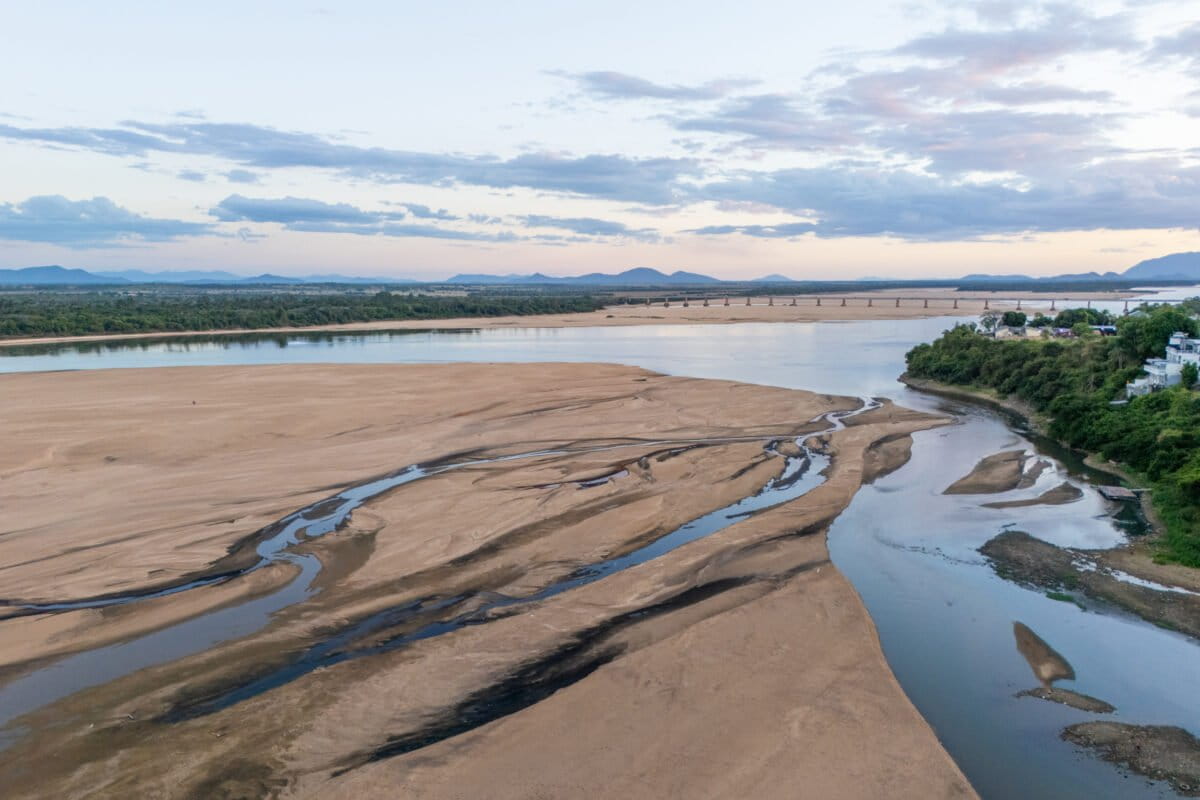
A third El Niño-fueled drought since 2015 has pushed river levels in Roraima, Brazil’s northernmost Amazonian state, to critical lows. Severe drought affected 95% of the state in October, up from 47% in September, according to Brazil’s federal water agency, ANA. Roraima’s main river, the 775-kilometer (482-mile) Branco River, has dwindled, exposing large stretches of sand. People are now able to walk beneath the Macuxis Bridge in Boa Vista, the state capital, local media reported. Upstream, two smaller rivers that feed the Branco, the Tacutu and the Maú, dropped earlier and faster than usual, the water agency said. On Nov. 10, the agency declared a critical water shortage until April 30, 2027, for both rivers, which run through Indigenous territories, including Raposa Serra do Sol and Jacamim. “The trend is still toward a continued decline in water levels in the Branco River basin,” the agency said in a statement, warning of potential disruptions to navigation and water supplies. Between Nov. 16 and 22, Roraima’s fire brigade and disaster response agency took boats with food, medicine, fuel, and water pumps to seven isolated villages along the lower stretch of the Branco, the state government said in a statement. The teams needed shallow-draft boats, piloted by locals, to reach them. In Caicubi, a village with no road or airstrip, some people were stranded for about two weeks. Farther downstream, in Panacarica, the river dried up entirely, and residents had to walk up to 2 km (1.2 mi) to fetch water. Firefighters deliver supplies to riverine communities affected by severe drought. Image courtesy of Cecilia Veloso/Secom. During Roraima’s rainy season, from April to September, rainfall was far below average. The Branco River Basin had about 390 millimeters (15.4 inches) less rain than the historical average in the 12 months from October 2025 to September 2026, ANA said. “For those who live off the river, the water is not just scenery. It is also our roads, work and income,” Fredson Guedes, a local tour guide, told Mongabay Brasil contributor Felipe Medeiros after the Véu de Noiva waterfall, a tourist destination near Boa Vista, dried up. The ongoing drought is likely an impact of the strong El Niño event this year. According to Regina Rodrigues, a leading climate scientist at the Federal University of Santa Catarina in southern Brazil, El Niño events are becoming stronger and more frequent with anthropogenic climate change. “These strong El Niño events generally occurred every 15 years,” she told Mongabay in an audio message. That gap then shrank between the 2015-16 and 2023-24 El Niños. “Now, from 2023-24 to 2026-27, it’s down to three. “We’re already seeing the interval between these strong El Niño events shorten, which is not good,” Rodrigues added. Banner image: The Branco River in Boa Vista, Roraima, Brazil, in October 2026. Image courtesy of William Roth/Secom. Credits Topics
Severe drought dries up rivers, cuts off communities in Brazil’s Amazon
Full Article
Original Source
Read the full article at News →KhanList aggregates and links to publicly available news content. We do not host full articles from third-party sources. Always verify important information with original sources.