
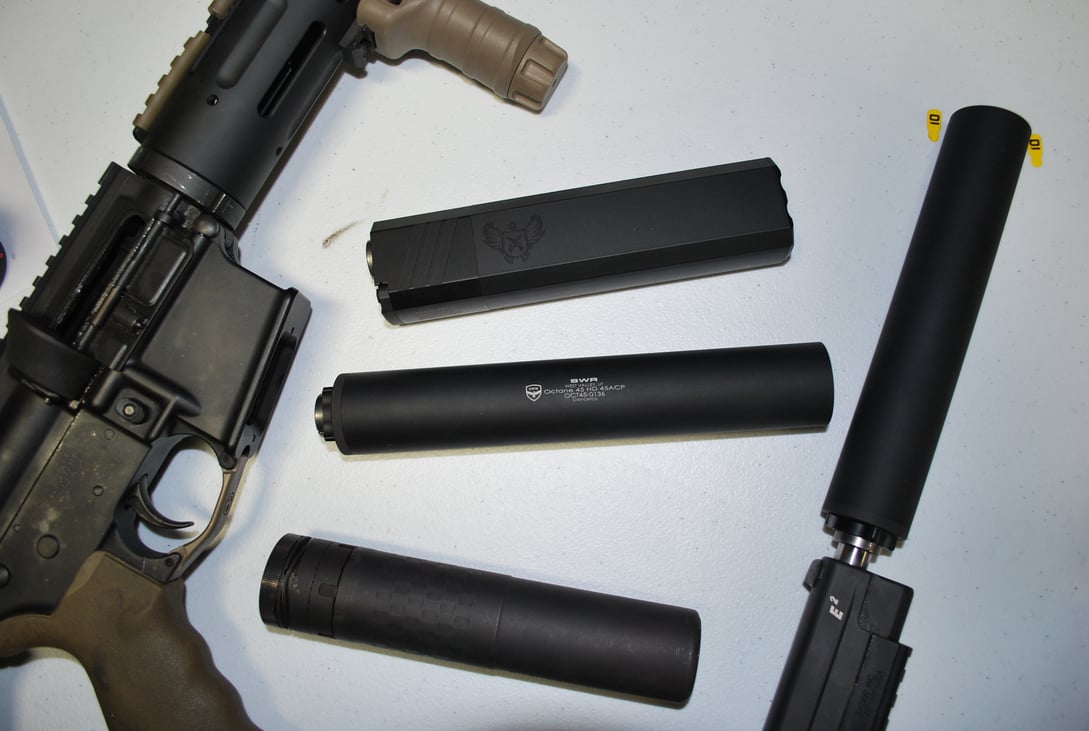
Illinois gun advocates maintained that regulating firearm suppressors runs afoul to their right to bear arms.CHICAGO (CN) — A group of Illinois gun advocates argued before a skeptical Seventh Circuit panel Wednesday that the state’s ban on gun silencers violates their Second Amendment rights.The Illinois criminal code, established in 1961, made it illegal to “possess any device or attachment of any kind used or intended for use in silencing the report of any firearm.” A group of gun rights advocates challenged the law in 2023, and U.S. District Judge David Dugan upheld it. The group appealed to the Seventh Circuit in 2025.Peter Patterson, an attorney representing the gun owners, argued before the three-judge panel that preventing gun owners from using suppressors on their firearms imposes a clear restriction on gun ownership.Patterson cited a recent Supreme Court case, Wolford v. Lopez, in which the high court overturned a Hawaii law that prevented licensed gun owners from carrying firearms on private property open to the public.He noted that Wolford applied the historical analysis test established in the landmark 2022 Supreme Court case New York State Rifle and Pistol Association v. Bruen. The test requires that modern firearm regulations comply with historical tradition.U.S. Circuit Court Judge John Lee, an Obama appointee, pressed Patterson on where courts should draw the line when defining what is necessary for self-defense.“At a minimum, and the only line this court needs to draw in this case is things that make a functional difference to the operation of the firearm,” Patterson, an attorney with the Washington-based firm Cooper & Kirk, said. “And so, as the Fifth Circuit held in Comeaux, there are many functional benefits that are essential to self-defense, provided by suppressors, including reducing noise, reducing recoil, improving accuracy.”U.S. Circuit Court Judge Doris Pryor similarly pressed Patterson to clarify whether a firearm and its suppressor should be considered separate instruments or one combined weapon.“In Wolford, it says, does it concern any form of arms? And so, can we look at [the silencer as] separate and apart from the firearm itself?” the Biden appointee asked. “Are we talking about two different weapons or two different instruments?”Patterson responded that a suppressor has no purpose apart from its use with a firearm.“Illinois’ law would be incoherent if you tried to separate the two because the only reason they’re regulating the suppressor is because of its operation and its effect on the operation of the firearm,” he said. “But even if your Honor were to disagree with me on that and hold that at step two, the form of arms is, you know, a rifle, a pistol, a shotgun, at step three, banning suppressors restricts the possession in carrying of those rifles, pistols and shotguns by prohibiting people from equipping those rifles, pistols and shotguns with suppressors, and obtaining the very real functional benefits that suppressors provide.”Sam Horan, an assistant attorney general for Illinois, argued that Patterson’s characterization of Wolford was inaccurate.“I think it’s worth sort of looking at the consequences of plaintiff’s rule would basically mean anything you can attach to a firearm gets presumptive constitutional protection,” Horan said.Pryor asked Horan whether a ruling in Illinois’ favor would constitute a restriction on the right to keep or bear arms.“I don’t think it would, Your Honor, again, because silencers are not arms,” Horan said. “I think plaintiffs are trying to sort of cast the relevant conduct much more broadly, to sweep in a firearm and then say that because, you know, you can frame this conduct in some way that involves a firearm, that must mean the Second Amendment’s protected, and courts have consistently rejected that.”“The Second Circuit in Gomez, for example, found that a statute restricting firearms without a serial number did not implicate the Second Amendment, because it didn’t restrict the keeping and bearing of arms,” he continued. “So, I don’t think you can say it’s a statute that implicates keeping and bearing, unless it implicates arms, which this statute does not.”U.S. Circuit Judge Candace Jackson-Akiwumi, a Biden appointee, joined Pryor and Lee on Wednesday’s panel. The judges did not indicate when they might rule on the case.This summer, the Seventh Circuit upheld Illinois’ ban on assault rifles. U.S. Circuit Judge Amy St. Eve wrote in the panel’s majority opinion that the ban was consistent with historical tradition.Subscribe to our free newslettersOur weekly newsletter Closing Arguments offers the latest about ongoing trials, major litigation and rulings in courthouses around the U.S. and the world, while the monthly Under the Lights dishes the legal dirt from Hollywood, sports, Big Tech and the arts.Additional Reads
Seventh Circuit hears challenge to Illinois firearm suppressor ban
Full Article
Original Source
Read the full article at Courthousenews →KhanList aggregates and links to publicly available news content. We do not host full articles from third-party sources. Always verify important information with original sources.