
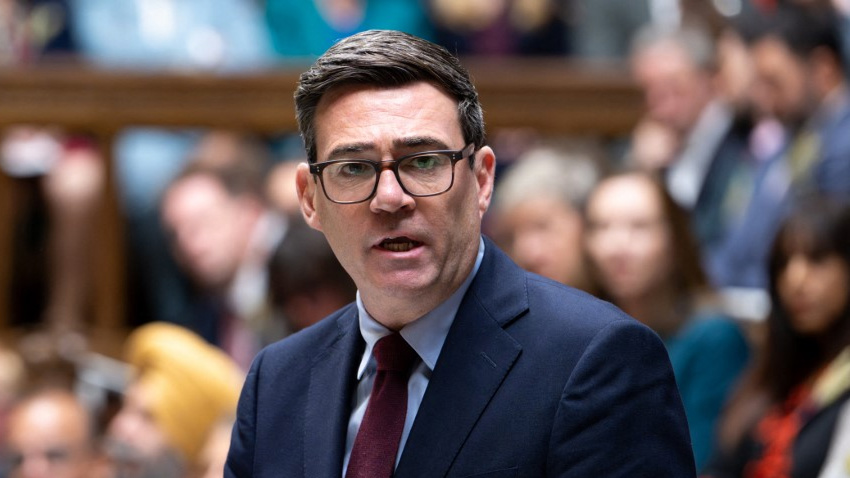
Less than two months have passed since Andy Burnham was installed as British prime minister. He has taken a more relaxed tone than his lacklustre predecessor, Keir Starmer. But there have been growing murmurs of discontent about his failure to deliver substantial changes. On Tuesday, those murmurs were silenced. By imposing a ban on trade with Israeli settlements, Burnham has presided over the most significant change in British foreign policy since Brexit. Tuesday was therefore a day of abject humiliation for Starmer, who was granted two years to call out settler terrorism and ethnic cleansing. Yet rather than taking robust action, he sat on his hands, making Britain complicit. It’s taken Burnham seven weeks to put matters right. New MEE newsletter: Jerusalem Dispatch Sign up to get the latest insights and analysis on Israel-Palestine, alongside Turkey Unpacked and other MEE newsletters For two years, the wretched Starmer failed even to respond to the historic 2024 International Court of Justice (ICJ) ruling, which found that Israel’s presence in the occupied Palestinian territories was illegal. In sharp contrast, the Burnham government’s decision to sanction the settlements goes a long way towards bringing Britain into line with that momentous ICJ judgment. Historic error This principled action has opened a major dividing line between the ruling Labour Party and the Tory opposition. Conservative leader Kemi Badenoch has been praised, and fairly so, for the vigour and confidence she’s displayed at the despatch box, building a reputation as a confident parliamentary performer, and often outshining the wooden Starmer. With Burnham, she is encountering a far more formidable opponent. On Tuesday, the new Labour prime minister enticed Badenoch into a historic error that could define - and potentially wreck - her leadership. It is beginning to feel like Burnham and Miliband have pulled off Britain's first major diplomatic triumph since Brexit When a British government finds itself in dispute with a foreign country, a wise opposition sides with Britain. Not Badenoch’s Tories. Tuesday’s Commons statement from Foreign Minister Ed Miliband immediately drew a battery of abuse, counter-measures and threats from Israel. Badenoch allowed her inexperienced foreign affairs spokesperson, Tom Tugendhat, to echo Israeli talking points, endorsing threats that British national security could be threatened by the move. This is perilous. Badenoch and Tugendhat are siding with a country that has been condemned by every major human rights organisation, including Israel’s own B’Tselem, for committing the crime of apartheid. Their party is supporting Israel while it is in flagrant breach of international law and under investigation at the ICJ for committing the ultimate crime of genocide. Badenoch backs a country that even appears to be threatening to support Argentina’s claim to the Falkland Islands. International alliance There is one further point of burning relevance to British domestic politics. The Burnham government’s decision to ban settlement trade has not been tested yet in an opinion poll. But the majority of the British public, past polling strongly suggests, is likely to support the ban. On Tuesday, Badenoch repeated the Israeli attack line that Miliband has caved to pressure from Britain’s Muslim voters. This assertion makes little sense, and Badenoch’s Tories have produced no evidence to substantiate it. It is certainly true that many British Muslims are appalled by the ongoing settler barbarism in the occupied West Bank, as well as the slaughter in Gaza. But opinion polls show that the British public as a whole - not just Muslims - are appalled by Israeli violence. In my view, Badenoch’s hasty decision on the settlement ban will soon leave her domestically forlorn. And not just domestically. Since his Commons speech on Tuesday, it has become apparent that Burnham has skilfully marshalled an international alliance in favour of the settlement ban. This coalition includes Canada, Denmark, Finland, France, Iceland, Ireland, Norway, Poland, Portugal, Spain and Sweden. There are even provisional indications that President Donald Trump’s United States is relaxed about Britain’s new position. It is beginning to feel like Burnham and Miliband have pulled off Britain’s first major diplomatic triumph since Brexit. It is also important to note that while Miliband’s statement has indeed been greeted with hostility and dismay from Israeli Prime Minister Benjamin Netanyahu’s extreme-right coalition government, serious and well-informed Israeli opinion has welcomed it. Former Prime Minister Ehud Olmert noted: “The British government decision became unavoidable as a result of a continuous effort of ethnic cleansing perpetrated by a large group of Jewish terrorists in the West Bank … Sanctions are directed against the terrorists, not against Israel, and as such they are unavoidable.” Beginning to listen Meanwhile, the respected and well-connected lawyer Daniel Seidemann, a careful student of settlement expansion, rejected the accusation that the UK was “abandoning Israel” or “joining forces with our enemies”, posting on X (formerly Twitter): “Occupation will end, or occupation will be the end of us.” He continued: “There is no greater threat to the viability and the legitimacy of Israel, and nothing [perpetuates] occupation more than the settlements. So I hope that my friends in the UK, in and out of government, will constantly bear in mind that the UK has today done a great service to Israel and the people of Israel.” There are plenty of Israeli voices who agree with Olmert and Seidemann, and like them, fear that Netanyahu is leading Israel to destruction. UK trade ban on illegal settlements is a welcome first step to justice for Palestinians Read More » So do many British Jews. In a supportive statement, Yachad UK noted: “These new policies target the occupation. They draw a clear distinction between the legitimacy of the State of Israel and the settlement enterprise.” Until now, such voices have been ignored by British leaders like Badenoch, Starmer and former Prime Minister Rishi Sunak. Miliband and Burnham have begun to listen. There have been powerful criticisms from the left that Miliband’s package comes far too late. That’s entirely true, but Burnham has only been in office seven weeks, and can’t be blamed for that. It’s also true that this package does not go far enough - though future measures are promised. As a matter of urgency, the Burnham government needs to remove the foolish and arbitrary terrorist designation on Palestine Action. These are early days. But it can already be stated that Miliband on Tuesday delivered the most meaningful speech by any British foreign secretary this century. The views expressed in this article belong to the author and do not necessarily reflect the editorial policy of Middle East Eye.
Settlement trade ban: Burnham succeeds in weeks where Starmer failed for years
Full Article
Original Source
Read the full article at Middleeasteye →KhanList aggregates and links to publicly available news content. We do not host full articles from third-party sources. Always verify important information with original sources.