
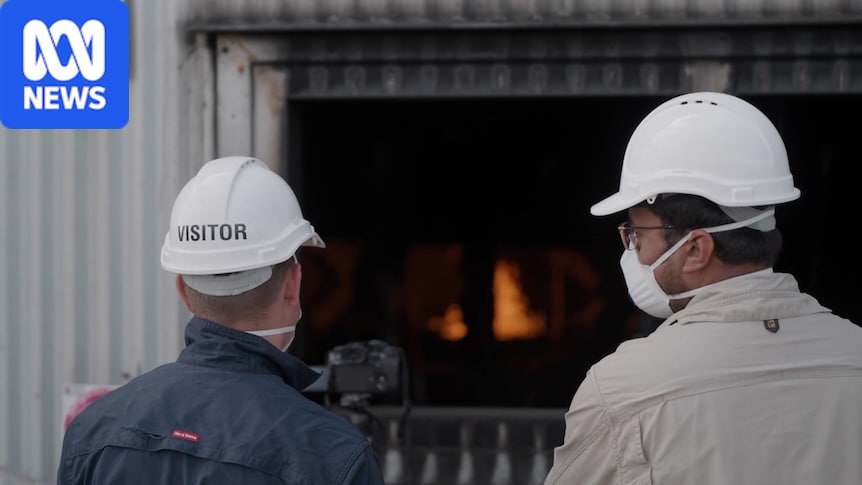
Queensland researchers investigating how to improve the safety of timber houses have set ceiling compartments on fire at temperatures of about 1,000 degrees Celsius.Firefighters supervised the tests, which were monitored with live streaming cameras and heat-and pressure-sensing instruments."It was a pretty unreal experience," University of Queensland's PhD candidate Josh Madden said.The research is central to a PhD project he led and part of a wider body of work at the ARC Research Hub to Advance Timber for Australia's Future Built Environment."For me, being a researcher, I know all the theory behind it … It was pretty eye-opening," he said.Josh Madden has led research into timber buildings and fire safety. (Supplied: University of Queensland)Mr Madden, who has worked as a fire safety engineer, said mass timber was becoming increasingly common in the building sector."Current fire safety guidance was generally built around the assumption that structural materials don't burn," he said."But the issue with timber is that timber actually burns."Mass timber is engineered layers of wood compressed, glued, or nailed together to form uniform panels and slabs.The product is a faster alternative to steel and concrete and can be constructed off-site."In traditional concrete building, you need to wait a month for the concrete to cure," Mr Madden said.The fire testing was carried out at the Queensland Fire Department's training ground at the Port of Brisbane. (Supplied: University of Queensland)"Whereas a timber building can just essentially be like Lego bricks. You can just go in, click it all together."The experiment, conducted at the Queensland Fire Department's (QFD) training ground at the Port of Brisbane, each time slightly changed the design parameters of the cross-laminated timber ceiling compartments, such as the ventilation and ceiling's height."We built these large 12-metre-long compartments which are about 2.5 metres wide," Mr Madden said."We essentially ignite the fire down one end and watch how fire spreads underneath the ceiling."Timber loses strength at about 60C and loses all its strength at roughly 300C onwards.Researchers investigate how the fire spreads through the structures. (Supplied: University of Queensland)"We got some of our temperature readings going up to about 1,000 degrees Celsius."UQ and the QFD have been sharing information to help improve public safety since 2014.QFD fire engineer Mick Conway said understanding new materials and innovative design was crucial to building safer timber structures."By burning materials under experimental conditions, our firefighters are learning things that they otherwise might have had to experience for the first time in a live scenario," he said.The test results are being analysed and will be presented in Mr Madden's final thesis."What we're trying to develop is this sort of design methodology or framework for fire safety engineers to go out and have the confidence to be able to build these buildings," Mr Madden said."If we have the knowledge and expertise to be able to design these safely, hopefully the idea will be that we'll see lots more of these beautiful massive buildings."
Setting timber ceilings on fire in the name safety and research
Full Article
Original Source
Read the full article at Abc →KhanList aggregates and links to publicly available news content. We do not host full articles from third-party sources. Always verify important information with original sources.