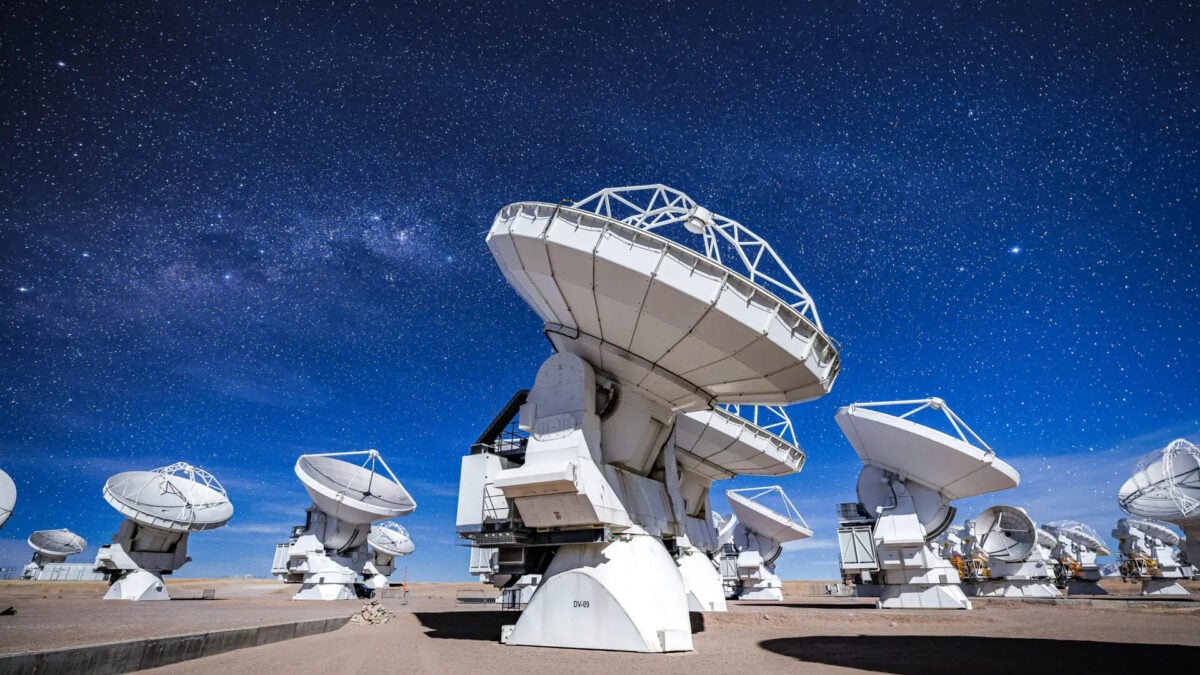
For over half a century, the astronomers and astrophysicists pursuing the search for extraterrestrial intelligence (SETI) have called it the “water hole.” The water hole is a quiet little gap in the cosmic background noise between 1.42 and 1.66 GHz, overlapping with the natural microwave-band frequencies emitted and absorbed by hydrogen and hydroxyl molecules, which react to form water. Researchers have long theorized that our fellow water-loving, carbon-based lifeforms might use this range to broadcast—both due to these frequencies’ obvious symbolic implications and because widespread hydrogen and hydroxyl in interstellar gas absorbs the static cosmic noise in this range. The water hole is not only a clear channel for communication, in other words, but one with real poetic resonance. But SETI scientists’ infatuation with this notion seems to be fading. New research presented by academics in the UK this Friday instead looks beyond the water hole, focusing on narrow-band signals that may be more likely to come from deliberate, directed transmissions. This new search for concentrated narrow-band emissions, they argue, unlocks “an entirely new frequency window for technosignature detection.” It might even catch “accidental leakage or relic signals from extinct civilizations.” “For decades, SETI searches have concentrated on a relatively small part of the radio spectrum. We wanted to ask what might happen if we looked somewhere very different,” as astronomer Louisa Mason, first author on two studies pursuing this new approach, explained in a statement. To start their hunt, Mason’s team pored over archived observational data collected by the Atacama Large Millimeter/Submillimeter Array (ALMA), a telescope high in the Chajnantor desert plateau above Chile. “One of the most exciting things about this work is realising that we’ve surveyed many more stars than initially thought,” Mason said. Retracing your steps The beauty of Mason and her colleagues’ approach is that it offers a new way to reexamine reams of old data that might already have messages from an alien civilization just waiting for us to hear. From ALMA’s archival data, the team surveyed so-called Band 3 information, with a focus on two high-frequency, narrow-band windows around 90.642 and 93.151 GHz, which have wavelengths in the millimeter and submillimeter range. “The millimetre and submillimetre radio bands remain almost completely unexplored for SETI, so this is really about opening up a new area of parameter space to search,” according to Mason, who works as a PhD researcher at the University of Manchester in the UK. The ALMA Band 3 data came with other benefits too. It was collected in very high fidelity—meaning with high resolution along the electromagnetic spectrum—which allowed the team to search for truly narrow-band frequencies between fractions of GHz. In some cases, the data also had a wide field of view, collecting signals from more distant star systems than ALMA’s astronomers had initially intended. Mason’s team calls it “stellar bycatch.” “Even a very small observation can contain a huge number and diversity of stars that we might never have intended to study,” Mason said. Maps to the stars But the team’s work with ALMA is only the beginning. Thus far, Mason and her partners have also started looking through astronomical data collected by the European Space Agency’s retired orbital observatory Gaia, for a study published this past January. The team, which includes the SETI Institute in the U.S., delivered a poster presentation on their ongoing progress Friday at the Royal Astronomical Society’s National Astronomy Meeting in Birmingham, UK. This ongoing work has enhanced the scope of Mason’s narrow-band SETI search by mapping the data to the so-called Besançon Galaxy model of the Milky Way, a data-derived model of our home galaxy built to reproduce the orbits of its many hundreds of billions of stars. Mason says her team has not yet found a confirmed alien signal, but she’s hopeful it’s on the right track. “By combining high-frequency observations with galactic simulations, we can better understand exactly what we’ve searched and where we should look next,” Mason said.
SETI Scientists Think Alien Signals Could Be Hiding in Old Telescope Data
Full Article
Original Source
Read the full article at Gizmodo →KhanList aggregates and links to publicly available news content. We do not host full articles from third-party sources. Always verify important information with original sources.