
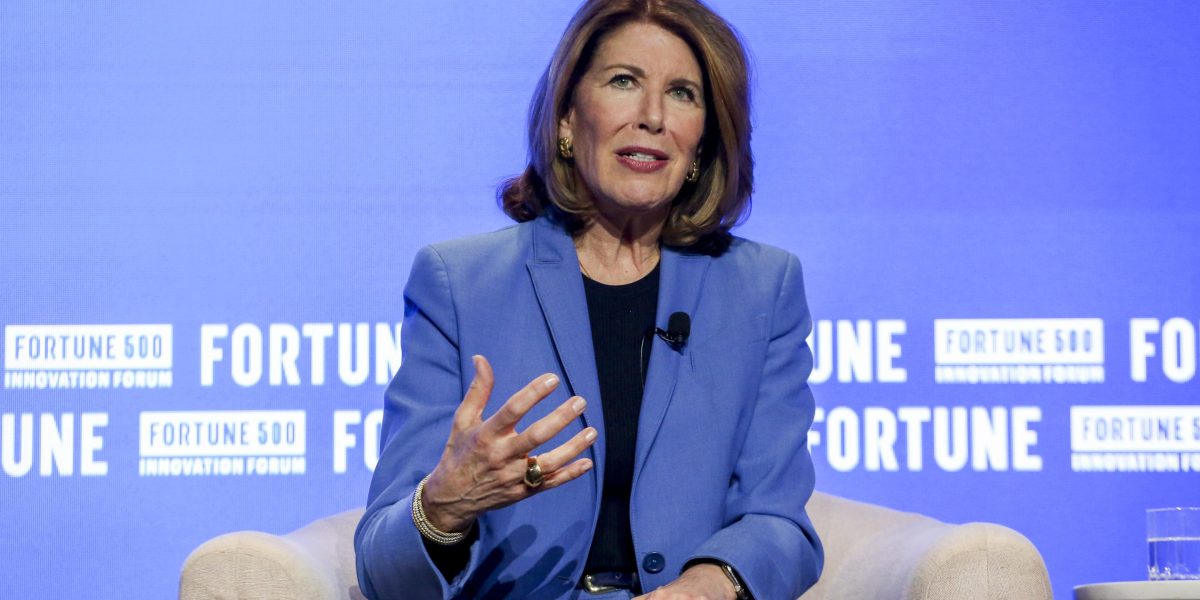
More AI-powered tools and toys are now within the reach of young children, but consumers shouldn’t expect to see the likeness of Sesame Street characters among them. Sesame Workshop president and CEO Sherrie Westin said at the Fortune 500 Innovation Forum in Detroit on Monday that the nonprofit television production company behind Sesame Street would not produce AI-powered toys that look like its characters out of concern it would get in the way of a young child connecting with their parents. It’s part of a larger framework from the nonprofit that doesn’t eschew AI entirely, but seeks out guardrails so that it can augment, not hinder young children’s education. “We decided we will absolutely not do AI-powered anthropomorphic toys because for a young child, if we’re making Elmo AI-powered, that really runs a risk of competing with the important connection between adult and child,” Westin told Fortune AI editor Jeremy Kahn. “That’s where the real learning happens, and having something at that age, we believe, would be detrimental.” New plush toys, like Curio’s Gabbo, are AI-powered dolls intended for children under three. They use chatbot technology, including from OpenAI, to talk back to their child owners and were designed as a screen-free alternative for youngsters. Early research from the University of Cambridge published earlier this year found that while some practitioners believe these toys could support language and communication development, they also don’t have adept social and pretend-play capabilities, and risk misunderstanding or communicating inappropriately with children. One five-year-old in the study said to a toy, “I love you,” and was told in response, “As a friendly reminder, please ensure interactions adhere to the guidelines provided. Let me know how you would like to proceed.” Westin said the decision to not produce anthropomorphic AI-powered toys likely costs the company money, but ultimately did not align with its values. “Sesame is a nonprofit. People don’t always realize that we’re 501(c)(3). We need philanthropic revenue, earned revenue for IP,” Westin added. “And yes, we could have made a lot of money. We had a lot of proposals to at least do prototypes and do research, but we’re just not going to do that.” How Sesame Workshop is using AI Sesame Workshop does not reject the use of AI entirely. At the foundation of Westin’s argument is the pillars of Sesame Workshop’s ethos around the emerging technology, an acronym which the company has dubbed “AI ABCs.” The first “A” represents the need for age-appropriate content, while “I” stands for “inspiring real learning,” where the technology can act as a tool to enable curiosity, not just provide answers. The next “A” referred to advancing accessibility, or bringing knowledge and educational tools to more people with the goal of decreasing the learning gap, and “B” is for “balancing personalization and individualization,” or honing in on a child’s interest, but not at the expense of their ability to discover new topics. The final “C” is what Westin believes is the driving force behind why the company will not create AI-powered Elmo toys. “‘C’ is to complement that circle of care around a child,” she said. “In other words, supporting the caregiver but never replacing the caregiver. And I think that’s probably the most important.” The nonprofit introduced AI about a decade ago, partnering with IBM in 2017 to create a vocabulary learning app that can adapt responses and exercises based on a child’s progress. Sesame Workshop also uses AI on the backend of its website to curate content, such as resources for how to talk to a child about the loss of a loved one, or parental addiction. It has recently gone beyond search optimization to “generative optimization” for AI tools to be able to access and disseminate its content, Westin explained. “We want AI to be coming to Sesame and finding our content and our resources for parents,” she said. “That’s something that I think all organizations are doing now, as they want to make sure that their information is available.”
Sesame Workshop CEO says you’ll never see an AI-powered Elmo toy: ‘We could have made a lot of money … but we’re just not going to do that’
Full Article
Original Source
Read the full article at Fortune →KhanList aggregates and links to publicly available news content. We do not host full articles from third-party sources. Always verify important information with original sources.