
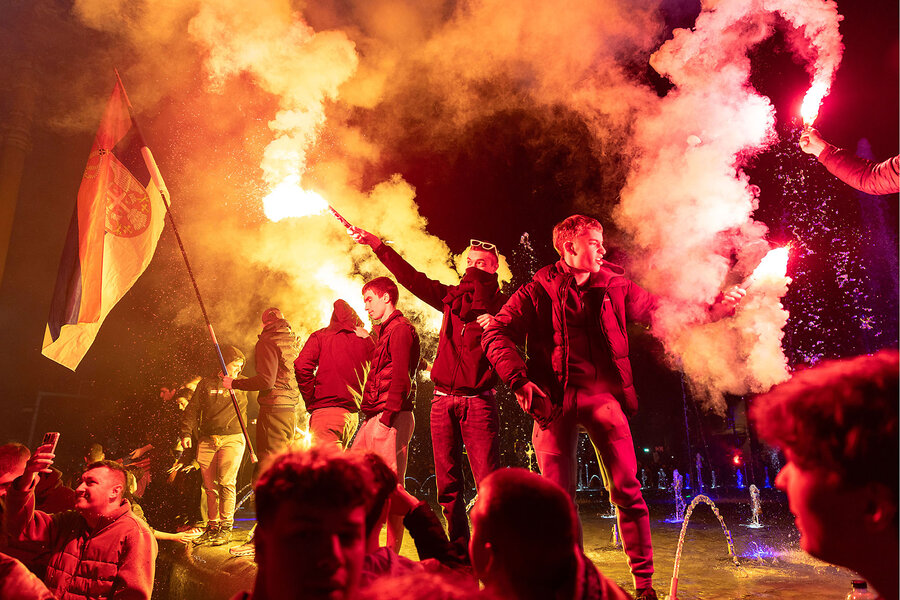
Belgrade, Serbia | Oct. 28, 2026, 5:03 p.m. ET | 4 min read After the Student List’s convincing victory in Serbia’s parliamentary elections on Oct. 25, celebrations in the streets of the capital lasted deep into the night and into the following day.However, little is known about what steps the new winner will take. It will have a comfortable majority in the next Serbian parliament, around 140 of 250 members.Three days have passed since the election ended. The Student List has unveiled a program – simply titled “The Student Plan” – that lays out three general priorities for its government: anti-corruption, expansion of education and innovation, and economic reforms. Yet despite its convincing victory, the Student List still holds no levers of power or authority. Serbia is effectively in an institutional limbo. The new parliamentary majority will not be verified for at least another month. At the same time, there is strong public pressure for change to come quickly, both to the media and to public institutions.But change will come in careful steps, says Slobodan Bubnjević, a physicist and science journalist who is expected to be one of the future Student List’s members of parliament. Like other observers, he says that the real transformation will begin after the election procedure is completed, the mandates are verified, and a lawful transition of power takes place. A transformation of the system that begins any other way, he says, would be illegal and unsuccessful.“A vacuum is felt among the public, but this is about ‘removing the handcuffs’ from institutions, not about anarchy. There is no real legal vacuum. The institutions exist, the procedures are clear, and people in public office have prescribed duties for which they are accountable,” says Mr. Bubnjević.Student List in waitingUntil the new parliament and government are constituted, governmental control remains in the hands of the voted-out Serbian Progressive Party (SNS) and its leader, Aleksandar Vučić. That includes the security services, the army, prosecutors, and the police, as well as the media, most of which is still under the influence of Mr. Vučić and his allies. Ekaterina Shtukina/Sputnik/APSerbian Prime Minister Ana Brnabić (right) and Russian Prime Minister Dmitry Medvedev (center) review the honor guard during a welcome ceremony in Belgrade, Serbia. In addition, the office of the president is currently held by the speaker of the recently dissolved Serbian parliament, Ana Brnabić, one of Mr. Vučić’s closest associates and a former prime minister for several terms. Mr. Vučić held the post for the previous nine years before he resigned in September. That leaves the Student List on its heels while the final tallies are being compiled and the student movement behind the List bloc is voting on the future government’s leadership. But the Student List is “not in some kind of revolutionary interregnum,” says Mr. Bubnjević. “The previous government is in a caretaker mandate, and there will be no attempt by the Student List to govern outside of any legal procedure.”He did not want to speak in more detail about the first steps after taking power, since they are “defined by the Student Plan.” At the top of the plan’s priorities are anti-corruption measures, including the confiscation of illegally acquired wealth, creation of a special prosecutorial police force, the dismissal of police employees “linked to the mafia,” vetting of public officials, and freedom of the judiciary and the media.But “task zero” for the Student List is to manage expectations, says Dušan Spasojević, a professor at the Faculty of Political Sciences – University of Belgrade.“The desire for change is great, and expectations are even greater. Some want everyone in power to be arrested and dismissed, but none of that happens overnight,” Professor Spasojević says. “It looks like the SNS’s tactic will be active resistance and possibly obstruction, that could lead us to a situation in which the Student List has a majority but no ability to use it effectively.”Serbian voices abroadStudent List representatives have not yet appeared on Serbia’s TV stations, but they have shown up abroad, both in Russian and European media. Under Mr. Vučić, Serbia carefully balanced its relationships with Russia and the European Union, and the incoming government appears inclined to do the same. Marko Djurica/ReutersIlija Srdanović, first on the Student List's electoral list and a contender to lead the party's government, celebrates following the first results of the parliamentary elections in Belgrade, Serbia, Oct. 25, 2026. Right after the election on Sunday evening, one future deputy said on the Russian channel RT Balkan that Serbia would not impose sanctions on Russia. Another candidate, who admittedly will not enter parliament, appeared on RT Balkan the next morning, saying that Serbia is “grateful to the Russian Federation for the favorable gas arrangement.” Deepen your worldviewwith Monitor Highlights.Politics with respectGet political stories with respectful analysis.There‘s a world of new ideas in everyBooks newsletter.There‘s more to life, enrich yours withCulture & Learning weekly.Follow humanity‘s discoveries withScience & Nature stories in your inbox.Gain a spiritual perspectivefrom the stories in your inbox.Want to understand the deeper impact of critical events? Learn the Monitor‘s insight.Already a subscriber? Log in to hide ads. Ilija Srdanović, a cardiologist and the top candidate on the Student List for parliament, gave several statements to the media on Tuesday – but in Croatia and Montenegro. He said that the Student List’s core values are “very similar to European civilizational values,” and that he sees no obstacles to improving cooperation and continuing Serbia’s integration into the European Union. Serbia has been a candidate for EU membership since 2012, but over the past five years that process has been completely stalled.Dr. Srdanović said that the first and most important goal is “creating the conditions for the rule of law, equality, freedom, media and personal freedoms, as well as respect for democratic principles.” ALREADY A SUBSCRIBER? LoginReal news can be honest, hopeful, credible, constructive.The Christian Science Monitor was founded in 1908 to lift the standard of journalism and uplift humanity. We aim to “speak the truth in love.” Our goal is not to tell you what to think, but to give you the essential knowledge and understanding to come to your own intelligent conclusions. Join us in this mission by subscribing.
Serbia’s students have won. Why their revolution still has to wait a bit longer.
Full Article
Original Source
Read the full article at Csmonitor →KhanList aggregates and links to publicly available news content. We do not host full articles from third-party sources. Always verify important information with original sources.