
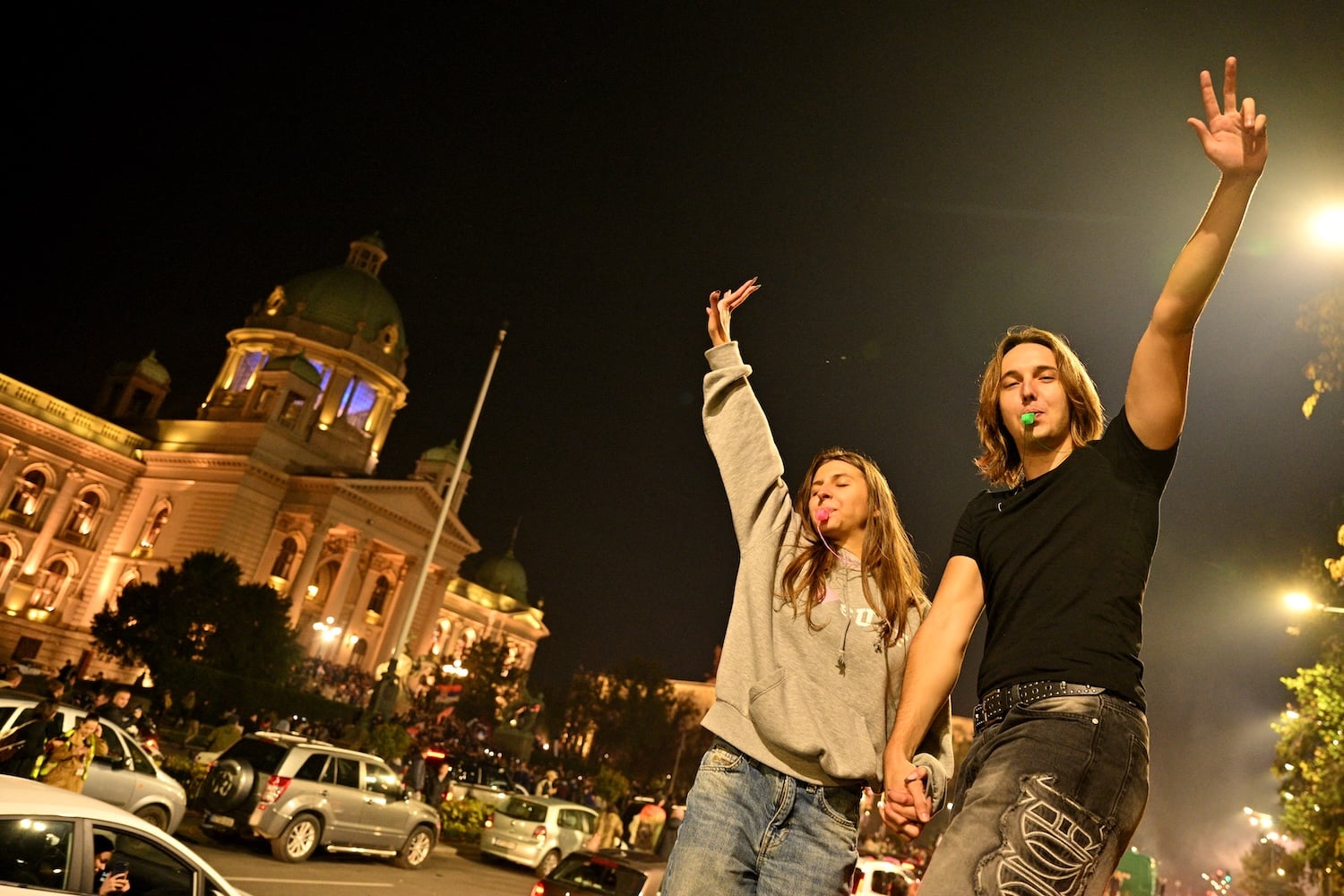
The stunning majority victory of the Student List in Serbia’s parliamentary elections on Oct. 25 was a vital reprieve for a beleaguered continent. As furious youth protests sweep across Europe, Gen Zers in Serbia have proved that youth can achieve transformative change through nonviolent political engagement. The extraordinary discipline, diligence, and organization exhibited by Serbian students over two pressure-filled years are worthy of a Nobel Peace Prize. The improbable bid to dislodge the corrupt regime of former President Aleksandar Vucic, which held all instruments of power, also offers a seminal opportunity for the United States and European Union, in and beyond the region. Serbia’s neighbors have often voiced skepticism of the student-led movement, which includes hard-line Serbian nationalists along with pragmatists who grasped the need to blunt Vucic’s charge that the students and their supporters are “anti-Serb.” But Serbian students have created an inspiring, viable model for channeling mass discontent within the political process—provided the new government succeeds. The stunning majority victory of the Student List in Serbia’s parliamentary elections on Oct. 25 was a vital reprieve for a beleaguered continent. As furious youth protests sweep across Europe, Gen Zers in Serbia have proved that youth can achieve transformative change through nonviolent political engagement. The extraordinary discipline, diligence, and organization exhibited by Serbian students over two pressure-filled years are worthy of a Nobel Peace Prize. The improbable bid to dislodge the corrupt regime of former President Aleksandar Vucic, which held all instruments of power, also offers a seminal opportunity for the United States and European Union, in and beyond the region. Serbia’s neighbors have often voiced skepticism of the student-led movement, which includes hard-line Serbian nationalists along with pragmatists who grasped the need to blunt Vucic’s charge that the students and their supporters are “anti-Serb.” But Serbian students have created an inspiring, viable model for channeling mass discontent within the political process—provided the new government succeeds. Fully capitalizing on the dramatic student-led triumph in Serbia means first understanding its ingredients. The sharp contrast between Serbia’s constructive students—operating in a hostile environment—and their attention-hogging counterparts in liberal France is teeming with lessons. First among them is the commitment to nonviolence. While student unrest featured from the outset of the French school protests, it was the opposite—violence inflicted on peaceful student protesters in Belgrade—that sparked the nationwide student movement in Serbia. A key factor in attracting nationwide support, as opposed to fleeting press attention and opportunistic rallies, was Gandhian student restraint, even as the regime escalated provocations and attacks, notably after a third mass protest in late June 2025. Unlike the protests that brought down former President Slobodan Milosevic, demonstrators occupied no government buildings, only university faculties. In Novi Sad, the site of the train station tragedy that cost 16 people their lives and ignited nationwide outrage, university students proudly were at pains to show the care they exercised over the facilities. Determination to achieve change—not vitriol—propelled the collaboration and collective decision-making that were central to the success of the movement. Second, Serbian youth have focused on the essential needs of society, over parochial demands on the cost and conditions for education. Sacrifice—demonstrated in blistering, long-distance marches, marathon bike rides, and tedious meetings—instead of instant gratification is the hallmark of this successful movement. While French youth storm the Bastille, Serbian students have fanned out across the country, creating citizen groups in large towns and small villages, rekindling the belief of ordinary people in participatory democracy. Third, the movement did not dogmatically reject engagement in the electoral process, as many student activists do across the globe. Anti-corruption protesters in Bosnia-Herzegovina a decade ago, for example, fell for this mistake. Initially, the Serbian students refrained from any political stance, demanding only that the government discharge its legal and moral duties to the victims of the Novi Sad tragedy. After the resignation of Prime Minister Milos Vucevic in January 2025, the students called for a transitional government to prepare for new elections. It was government intransigence in the wake of the massive rally that March—the largest gathering in Belgrade since the end of World War II—that convinced the students to change course. A clear majority of students understood and accepted their unique role as the only untainted political actor with the standing to oust the regime at the polls. Unlike many of their youth counterparts in the United States, Serbian students recognized their lack of life experience as a handicap in running for office or running a government office. Instead, they turned to the public, allocating a proportional number of candidate positions to each university faculty across the country. Applicants endured strict vetting, thorough interviews, and several rounds of selection. Only those enjoying a solid reputation in their respective fields cleared the bar. One absolute criterion dominated the selection process: Nominees could have no political affiliation or background whatsoever. Astutely, the students grasped that the so-called professional Serbian opposition, benefiting from state funding, operating through patronage, and widely seen as ineffectual, would have no credibility with voters. Indeed, the few opposition parties that contested the elections—including the longtime leading opposition party, the Party of Freedom and Justice, headed by former Belgrade Mayor Dragan Djilas—have, as of this writing, failed to clear the threshold. Marking the new political era, even the governing party of former Prime Minister Ivica Dacic—a fixture in Serbian politics and the leader of the Socialist Party of Serbia, founded by Milosevic—also will likely fail to enter parliament. Now is the moment for the United States and EU to advance political, economic, and people-to-people contact between Serbia and its former Yugoslavia neighbors, restoring trust lost to years of Serbian revisionism under Vucic. Indulged by a pliant EU and both the Biden and Trump administrations, Vucic’s Serbia became the most potent platform for Russian and Chinese influence in all of Europe and the primary source of regional discord. As much as it detests Europe, the Trump administration now needs to actively support the Brussels-led dialogue between Serbia and Kosovo. And with the Serbian presidential election looming in December, Brussels must move with rare alacrity to support and sustain a successful transition from the entrenched, would-be autocracy of Vucic. Strong economic performance under Vucic led his Serbian Progressive Party to retain more than 100 seats in the Serbian parliament, a far greater seat percentage (some 41 percent) than former Prime Minister Viktor Orban’s Fidesz party now holds in neighboring Hungary (albeit with a similar share of the electorate). Unknown is how many loyalists Vucic will still control in government, particularly in the security services. This makes rationalizing—under clear, accountable authority—the disparate internal security agencies that served the regime an urgent priority. For its part, the Trump administration should quickly pin the long-delayed ouster of the Russian owners of Serbia’s national oil company on the caretaker government led by Vucic’s party, before it leaves office. When it returns, the Senate should swiftly confirm Michael Young, a rare qualified administration nominee, as ambassador to Serbia, with the admonition that rule of law—not crony capitalism—is the foundation for increased, expedited U.S. investment. They can take inspiration from Serbia’s students. Although they were widely characterized as “leaderless,” the hundreds (not thousands) of core student activists who engineered this historic election victory actually embodied the essential qualities of leadership: sacrifice; persistence; devotion to the cause, not to personal interest; courage; collaboration; effective communication; sophistication; and, above all, integrity.
Serbia’s Student Protesters Deserve a Nobel Prize
Full Article
Original Source
Read the full article at Foreignpolicy →KhanList aggregates and links to publicly available news content. We do not host full articles from third-party sources. Always verify important information with original sources.