
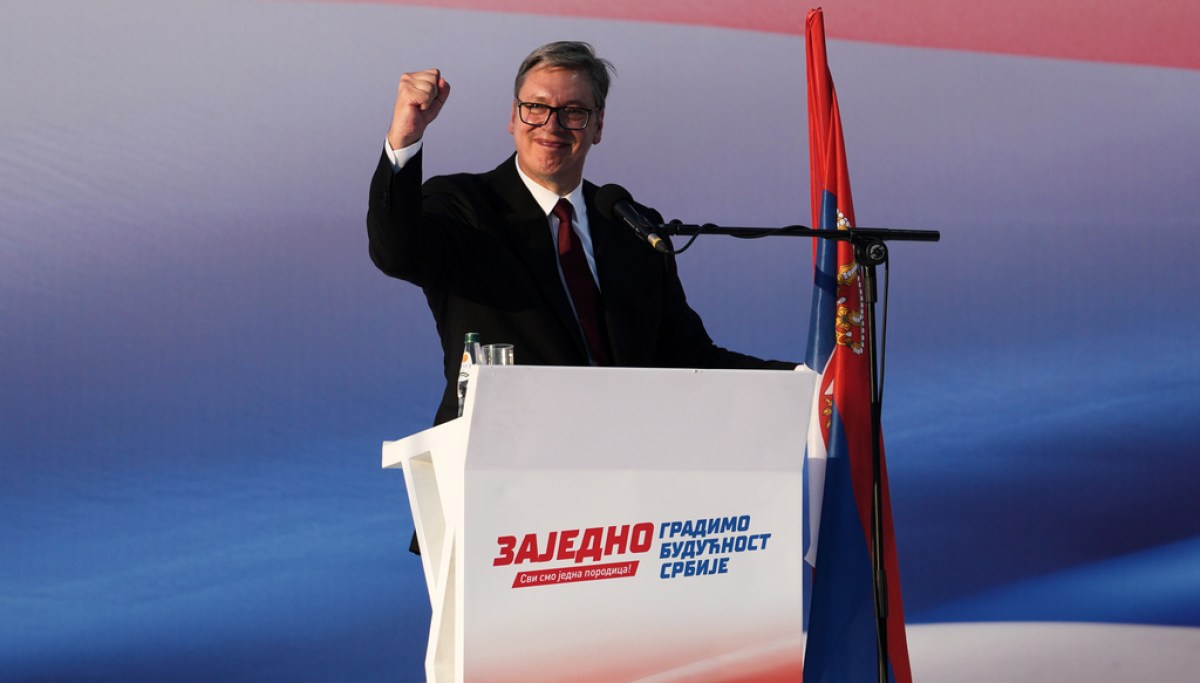
President Aleksandar Vucic of Serbia conceded defeat Sunday in an election that pitted him against a student-led movement. Those students managed to turn public anger into an electoral force capable of removing a ruling party that once looked invincible.Now they must turn that force into a functioning government.The preliminary results give the Students’ List 53.2% of the vote, with Vucic’s SNS trailing at 39.8%. Turnout was the highest since the breakup of Yugoslavia in 1992. Students succeeded even as Vucic brought the full weight of the state to bear. International and local monitors had voiced concern about a campaign marked by the use of state resources for political gain, near-total government control over the media, and attacks against activists. On polling day, independent monitors reported dozens of irregularities, such as the photographing of ballots, which suggested pressure on voters and attempted vote-buying. Throughout, Vucic denounced the student movement as a foreign-led attempt to unseat him. Vucic had been in power for around 14 years. He resigned as president in September to run for prime minister, seeking to extend his rule and to catch the opposition off guard. The maneuver, however, did not turn out as he expected. Vucic seems to have paid a price for the force he unleashed. His government’s response to the protests sparked concern over police violence, detentions, and thuggery. The intimidation seems to have deepened public anger and handed the students the moral high ground.Vucic had been endorsed by Russian President Vladimir Putin and had the support of Patriarch Porfirije of the popular Serbian Orthodox Church. Yet, Moscow’s blessing and the Church’s alignment both proved weak against the mood of the electorate. On election night, Vucic blamed Serbia’s independent media, alleged interference by unnamed European countries, and an “American deep state” for the loss.The students now face a different test. Their movement displaced the traditional opposition as the main vehicle for political change, with many established parties eventually backing their list. The ticket was headed by Ilija Srdanovic, a 56-year-old cardiologist and full professor at the University of Novi Sad. A parliamentary majority gives the movement the numbers to form a government, but the next step is choosing who will lead it. The choice of prime minister remains open, and the movement must now distribute responsibilities and select ministers.Serbia’s international direction also remains unsettled. Opposition to corruption brought together voters with different views of Europe, Russia, and Kosovo. The movement’s victory creates an opening to repair relations with the European Union, but some of its representatives have also opposed sanctions on Russia and supported Serbia’s refusal to recognize Kosovo’s independence. How those positions will translate into government policy remains to be seen.HERE ARE THE STATES WITH VOTER ID ON THE BALLOT THIS NOVEMBERWhatever comes next, Serbia joins Hungary as a striking signal for the region. Leaders who narrowed democratic space and civil liberties were eventually overwhelmed by the voice of dissent. Both cases point to the lesson that repression has its limits when the will for change is broad and determined enough. Every ruler, however entrenched, remains vulnerable to such a force.That message will resonate in Tbilisi, Tirana, and other capitals.
Serbia votes for change. What comes next?
Full Article
Original Source
Read the full article at Washingtonexaminer →KhanList aggregates and links to publicly available news content. We do not host full articles from third-party sources. Always verify important information with original sources.