
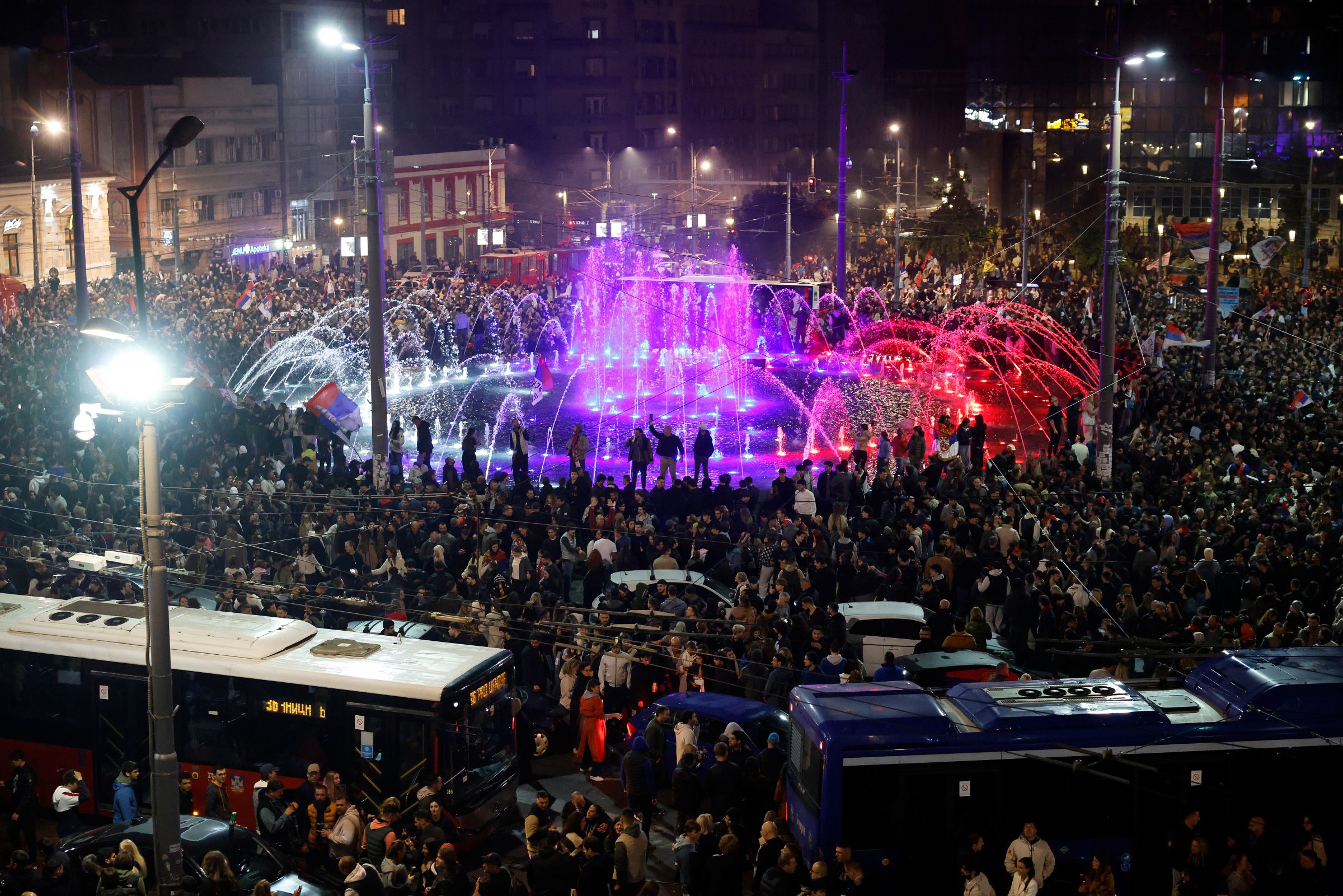
(CN) — After Hungary, it was Serbia’s moment to celebrate the end of an authoritarian regime far into the night.A student-led protest movement ousted Aleksandar Vučić, Serbia’s long-serving leader, in Sunday’s parliamentary elections, marking a major turning point for Serbia and the wider Balkans.Vučić conceded late Sunday after his right-wing nationalist Serbian Progressive Party, or SNS, was defeated by the Student List, a leaderless, broad-tent alliance of university professors, experts, public figures and farmers, most with little or no political experience.The Student List won about 53% of the vote to SNS’s 39%, with turnout nearing a record 70%.The victory capped nearly two years of student protests that began after a renovated train station canopy collapsed in Novi Sad in November 2024, killing 16 people, many of them students. The disaster exposed corruption and fraud behind the renovation, while the government’s failure to prosecute those responsible and its crackdown on protesters fueled public anger.Celebrations erupted in Belgrade after Vučić conceded, echoing those in Budapest this April when Péter Magyar’s broad-based opposition party, Tisza, ousted Prime Minister Viktor Orbán after 16 years in power.Aleksandar Vucic, leader of the right-wing Serbian Progressive Party (SNS) speaks at the party headquarters, after conceding defeat in the parliamentary election in Belgrade, Serbia, Sunday, Oct. 25, 2026. (AP Photo/Darko Vojinovic)As in Hungary, Vučić’s defeat was aided by Serbia’s opposition parties coalescing behind the Student List.“Large segments of the public in both countries perceived their respective elections as a ‘now or never’ moment,” said Mak Kasapovic, an expert on the Balkans with Oxford Analytica, a political consultancy firm.Vučić and his Serbian Progressive Party have dominated Serbian politics since 2012, with Vučić serving as prime minister and president since 2014. His party grew increasingly unpopular over its authoritarianism, links to organized crime and corruption.“It is a historic result,” said Aleksandar Matković, a politics researcher at the Autonomous University of Barcelona. He became involved in Serbia’s student movement when faculty blockades began in 2024.“The Student List did not simply defeat the ruling party,” he said in an email. “It broke the monopoly of party politics itself.”Daniel Bochsler, a political scientist at Central European University in Vienna, compared Sunday’s result to the 2000 elections that brought down Slobodan Milošević’s regime.“This seems to be the most important political turn since the electoral revolution of 2000,” he said in an email. He was in Belgrade for the elections.Unlike Milošević, Vučić did not contest the results, Bochsler added. “Probably, they only accepted this decision at the last second, realizing their unexpectedly large defeat,” he said.There were fears Vučić would refuse to hand over power. Similar concerns surrounded Orbán, but both surprised their fiercest critics by conceding on election night.With the vote and celebrations over, however, the Student List and its novice parliamentarians face the difficult task of naming a prime minister, forming a cabinet and agreeing on a policy agenda.The movement spans a broad ideological spectrum, including greens, left-wing intellectuals, conservatives, frustrated nationalists, progressives, liberals and pro-Russian voices, united by a desire to oust Vučić.“This is also a very fragile victory,” Matković said. “It is better understood as the beginning of a political experiment: Can a decentralized, self-organized movement translate its energy into governing?”He noted Vučić’s “party apparatus remains intact and may try to obstruct or wait for the coalition to fragment.”Bochsler warned the new government could face derailment from Serbia’s “deeply authoritarian secret services” and organized crime groups with ties to the Vučić regime.He recalled how Zoran Đinđić, a reform-minded former prime minister, was killed in 2003 because “he wanted to unravel these structures.”Kasapovic expected the new government to initially focus on anti-corruption and judicial reforms because they are “seen as the lowest common denominator in the movement.”On foreign policy, he said Serbia would likely move closer to the European Union while maintaining good relations with Russia and China. Serbia relies heavily on Russian energy, while China has become a major investor.Serbia is seeking EU membership, but its path is complicated by several issues, most significantly its conflict with Kosovo. Serbia does not recognize Kosovo’s independence, viewing it as the result of an illegal NATO military intervention in 1999.The Student List largely avoided discussing Kosovo during the campaign but was forced in May to issue a position paper declaring it “an integral part” of Serbia, in line with the Serbian Constitution.“Kosovo’s independence remains a taboo issue in Serbia,” Bochsler said. “Nobody with the ambitions to gather public support will touch this.”Kasapovic said the new government would likely back away from stoking tensions over Kosovo. However, he said that does not mean it will be more likely to resolve the territorial dispute — if anything, it may be less capable than Vučić.“Vučić had the political capital and nationalist credentials to potentially make tough compromises” with Kosovo, Kasapovic said.“This will remain an area where any ‘mistake’ by a new government will be exploited by the SNS, or other more radical nationalist parties,” he added. “I expect a new government to tread a delicate line.”For now, the hope is for an era of renewal for Serbian democracy.Matković said Serbia has an opportunity “to develop a more democratic and participatory political culture, one less dependent on strongmen, party patronage and clientelism.”“The key question is how cohesive that majority will be,” Kasapovic said. “If the movement manages to stick together, Serbia could see changes quite quickly.”Courthouse News reporter Cain Burdeau is based in the European Union.Subscribe to our free newslettersOur weekly newsletter Closing Arguments offers the latest about ongoing trials, major litigation and rulings in courthouses around the U.S. and the world, while the monthly Under the Lights dishes the legal dirt from Hollywood, sports, Big Tech and the arts.Additional Reads
Serbia celebrates the end of the Vučić regime
Full Article
Original Source
Read the full article at Courthousenews →KhanList aggregates and links to publicly available news content. We do not host full articles from third-party sources. Always verify important information with original sources.