
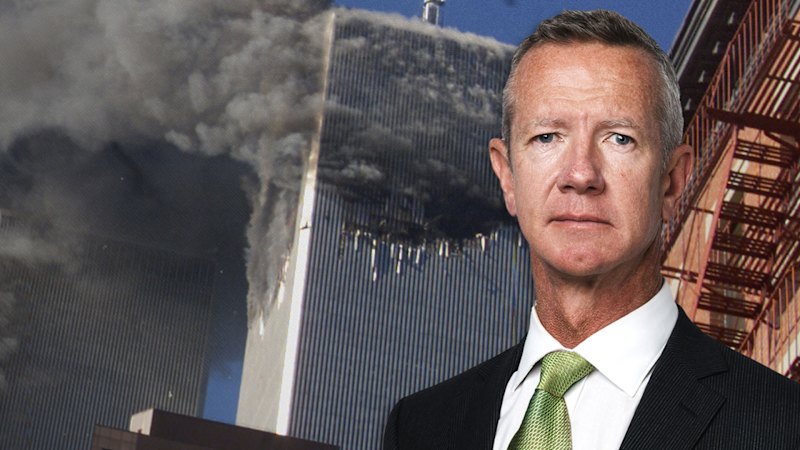
September 10, 2026 — 7:30pmOn September 11, 2001, Peter Hartcher was living outside Washington, DC. It was a regular Tuesday for the then-foreign correspondent, who had sent his children to school as normal and planned to spend the day reporting on then-prime minister John Howard’s visit to the US capital.Howard had travelled from Australia for what was meant to be an uneventful commemoration of the 50th anniversary of the ANZUS Treaty – until two planes struck New York’s World Trade Centre towers, and one struck the Pentagon, in what remains the deadliest act of terrorism in modern history.“We didn’t know whether this was a one-off attack or the beginning of a war launched by a foreign adversary that was going to escalate in the days following,” Hartcher reflects to host Samantha Selinger-Morris on The Morning Edition podcast 25 years on.“There were hours where we just knew absolutely nothing really about what was going on ... that moment of uncertainty, that pregnant moment was perhaps the most terrifying of all.”On Howard’s flight home, aboard Air Force Two, he decided to invoke the treaty for the first – and only – time, ultimately committing Australian troops to a two-decade conflict in Afghanistan.“There were pockets of schadenfreude, the anti-American fanatics and all the rest of it, but overwhelmingly there was just a tremendous upwelling of support and sympathy for the US,” says Hartcher. “And countries were prepared to do anything to help the US at that moment.”But what were the costs, and rewards, of this full-throated support? What lessons has the US learnt, and failed to learn, 25 years on from the attack that changed the world? What does this mean for Australians today?Click the player above to listen to the full episode, watch it on YouTube below, or read on for an edited extract of the conversation.Selinger-Morris: Before we started recording, you said that you think the September 11 attacks actually exposed what’s perhaps the fatal flaw with American strategic thinking. Tell us what you meant by that.Hartcher: Well, in the case of 9/11, I would say it’s twofold. First is the question of terrorism itself. Why do terrorists use terrorism? It’s a doctrine that is used by the weak against the strong. It’s asymmetric: “I don’t have the strength to confront you directly. So I’m going to find an indirect way to take advantage of you.” And terrorism works by hoping to provoke an overreaction. The weak hope to provoke the strong into overreacting and turning, therefore, their own strength against themselves.Selinger-Morris: So it becomes an act of self-harm.Hartcher: Exactly. It provokes the stronger partner, in this case the US, into an overreaction. And that’s precisely what happened. The US fell for the trap, caught up in anger, a lust for vengeance among much of the public, shock and a need to project strength to the domestic and international audience.The US really overdid it and launched what then became 25 years of failed war at enormous cost. Thousands of American soldiers injured and killed, over $US1 trillion spent on what were ultimately two failed wars, Afghanistan and Iraq.Afghanistan at least was justifiable. Iraq was a fictional threat, a terrible choice. But in both cases, bad strategy was applied. And this is part two.So part one, in my view, of the weakness that this revealed was an American gullibility to fall for the terrorist trick. Really, it’s just a trick to generate shock, to provoke an overreaction.A total of 2977 victims died in the September 11, 2001, terrorist attacks, which sparked two decades of war in Afghanistan and almost a decade of war in Iraq.APAnd the second is a misapprehension of the value and the premium on strategy over firepower. We saw it in Vietnam. The US didn’t learn the lesson there. We saw it in Afghanistan, we saw it in Iraq, and now today we see it in Iran.Massive firepower itself does not produce success. Strategy – the successful application, the intelligent application, of firepower is called strategy. And that’s what’s missing in every one of those examples.It’s a John Wayne mentality projected onto national strategy. As long as you’ve got a big gun, and you shoot lots of bullets, you’re going to win. Well, again, and again we see that that’s failed ... every time the strategy fails, it damages US confidence in the future use of power.We saw that in Iraq and Afghanistan. So we see JD Vance takes the vice presidency of the US and says, “War is terrible. I was abused. We were tricked. It was a lie. It was a shocking travesty. We’ll never do it again.” And Trump elected on the basis of not starting wars, but then falling for the same trap ultimately of a reckless application of military force without due concern for strategy.To listen to the full episode with Hartcher, who explains further how the conflict in Iran is a demonstration of the strategic lessons the US failed to learn in the wake of 9/11, and what it means for Australia’s alliance with the US, click here.Start the day with a summary of the day’s most important and interesting stories, analysis and insights. Sign up for our Morning Edition newsletter.More:September 11 attacksAnalysisExtremismPodcastsThe Morning Edition podcastTrump's AmericaSMH & The Age podcastsFrom our partners
September 11 led US to launch 25 years of ‘failed war at enormous cost’
Full Article
Original Source
Read the full article at Smh →KhanList aggregates and links to publicly available news content. We do not host full articles from third-party sources. Always verify important information with original sources.