
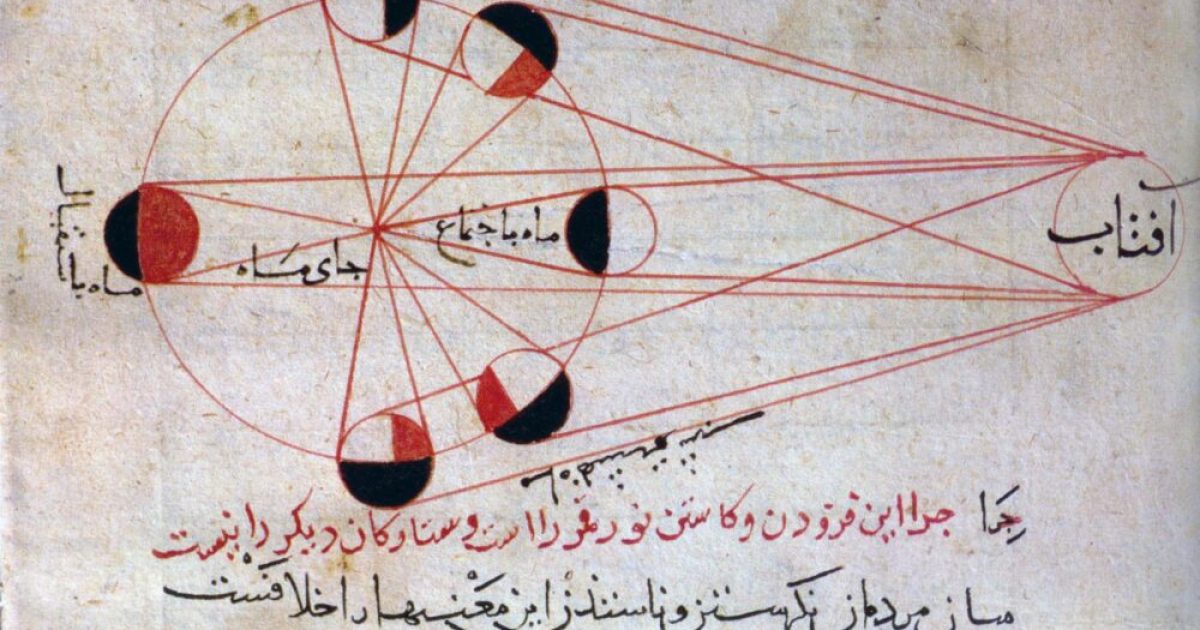
Today in the history of astronomy, an Islamic polymath is born. | Published: September 4, 2026 Al-Biruni's astronomical work included observational diagrams and mathematical context, as in his chart of the lunar phases. Credit: Al-Biruni/Public domain, via Wikimedia Commons Born in Kath, Khwarezm – a region that today would be cover parts of Uzbekistan, Kazakhstan, and Turkmenistan – Abu Raihan Muhammad al-Biruni was a man of many scientific talents. His extensive travels throughout the Middle East and modern India and his self-education in Greek, Syriac, Hebrew, and Sanskrit helped him produce respected works in mathematics, history, medicine, and geology. In the field of astronomy, his theorems and publications laid the groundwork for much future study. Al-Biruni speculated on the motions of the Earth and the nature of the Milky Way, challenged accepted beliefs that the solar system was geocentric, and even estimated the radius and circumference of Earth using his own trigonometric calculations. (He came within 10.4 miles [16.8 kilometers] of the modern value!) Al-Biruni wrote several books on astronomy, including a lauded encyclopedia of astronomy and a text that sneakily teaches its reader astronomy, mathematics, geography, and the basics of an astrolabe while purporting to be an exploration of astrology – a discipline he was no great fan of. Although his works weren’t translated in time to influence medieval Europe, al-Biruni is today recognized by historians as an intellectual precursor of the Renaissance astronomers like Copernicus, Brahe, and Kepler. Elisa Neckar is senior production editor of Astronomy magazine, and the editor of the Today in the History of Astronomy feature on Astronomy.com.
Sept. 4, 973 C.E.: The birth of al-Biruni
Full Article
Original Source
Read the full article at Astronomy →KhanList aggregates and links to publicly available news content. We do not host full articles from third-party sources. Always verify important information with original sources.