
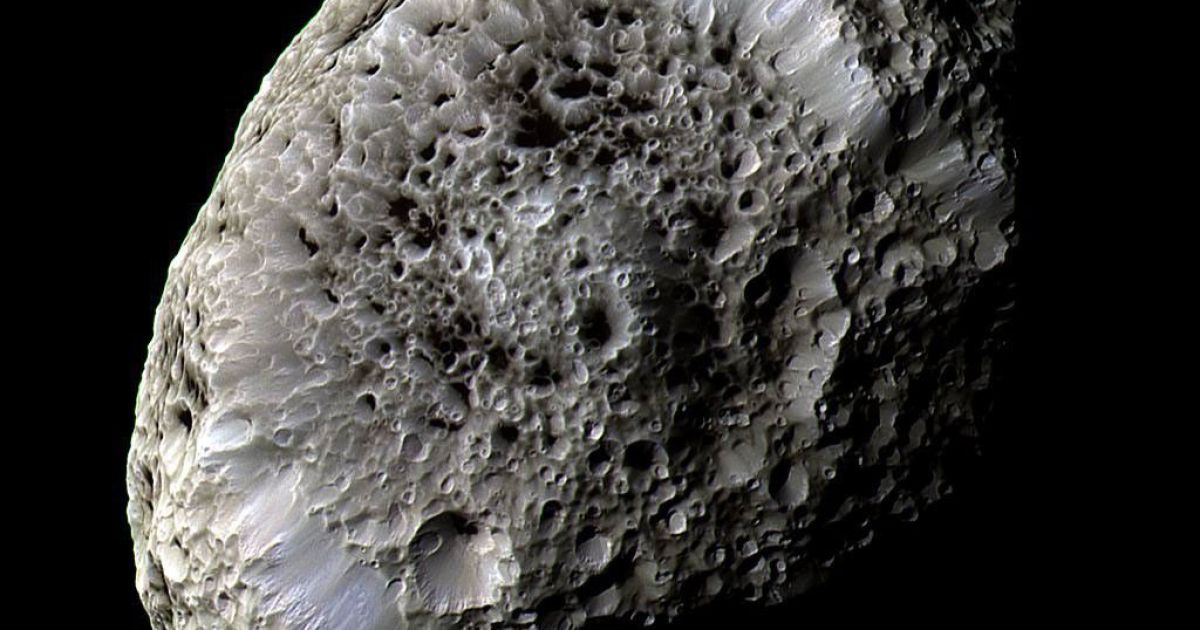
Today in the history of astronomy, we get our first close-up look at potato-shaped Hyperion. | Published: September 26, 2026 The false-color image captured by Cassini during the Sept. 26, 2005, flyby highlights Hyperion's intensely porous surface. Credit: NASA/JPL-Caltech/Space Science Institute Resembling a lumpy chunk of coral floating through space, Hyperion is one of the weirdest moons not just of Saturn, but in the whole solar system. Its shape is irregular, its rotation is chaotic, and it looks oddly spongelike. On Sept. 26, 2005, Cassini completed its first flyby of this bizarre moon, giving NASA both true- and false-color views of its surface. Cassini also measured a strong electrostatic charge on Hyperion’s surface, the first on any space object besides Earth’s Moon: A stream of electrons from Hyperion washed over Cassini, giving it the equivalent of a 200-volt shock from 1,200 miles (2,000 kilometers) away. The charge was unexpected, as Hyperion was thought to be inactive, and highlighted potential dangers for both robotic and human space explorers on future visits to airless planetary objects. Elisa Neckar is senior production editor of Astronomy magazine, and the editor of the Today in the History of Astronomy feature on Astronomy.com.
Sept. 26, 2005: Cassini visits Saturn’s weirdest moon
Full Article
Original Source
Read the full article at Astronomy →KhanList aggregates and links to publicly available news content. We do not host full articles from third-party sources. Always verify important information with original sources.