
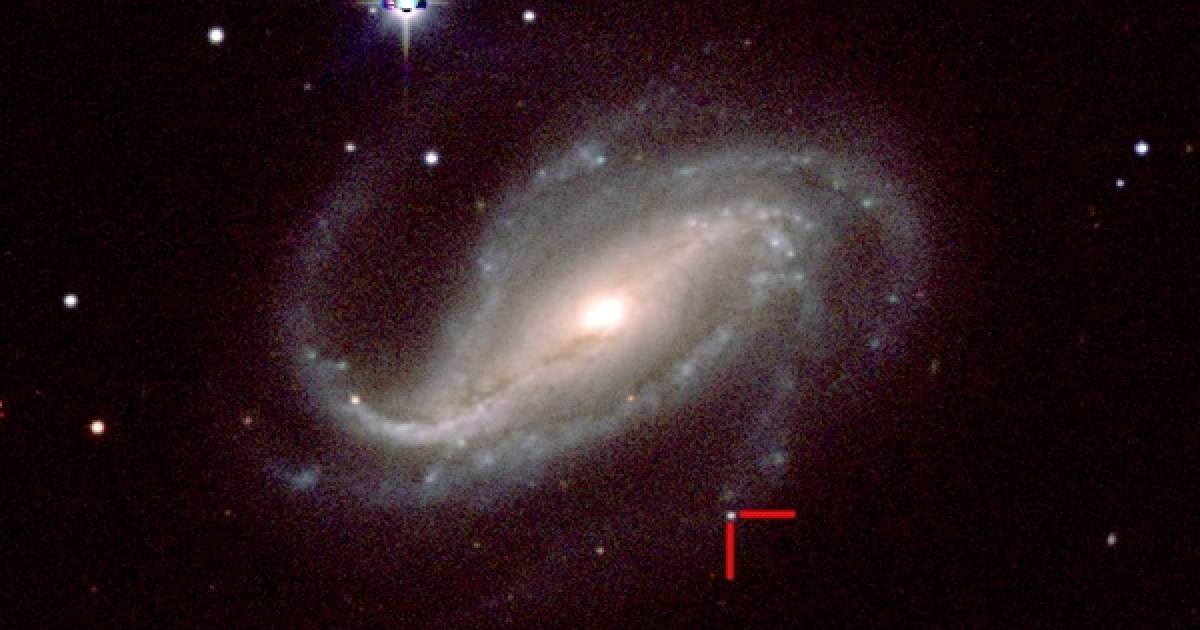
Today in the history of astronomy, an amateur astronomer photographs the early moments of a supernova for the first time. | Published: September 20, 2026 Supernova 2016gkg (indicated by red bars) is in the spiral galaxy NGC 613, located 70 million to 80 million light-years from Earth. On Sept. 20, 2016, Víctor Buso captured the initial burst of light from this supernova. Credit: UC-Santa Cruz/Las Campanas Observatory On Sept. 20, 2016, Victor Buso was testing a new camera in his rooftop observatory. An amateur astronomer from Rosario, Argentina, Buso shot a series of images of spiral galaxy NGC 613, which is about 70 million to 80 million light-years away in Sculptor. Checking to see how the new camera had worked, Buso reviewed the photos that he had just taken across the span of about an hour. There he saw a point of light not present in the first few shots, then appearing and shining faintly, and then beginning to rapidly brighten for about 25 minutes. Buso had captured an incredibly rare event: the first minutes of light emerging from the shock breakout of a supernova explosion. It was the first known observation of such an event, and provided data for an international research team to validate models of stellar explosions. Elisa Neckar is senior production editor of Astronomy magazine, and the editor of the Today in the History of Astronomy feature on Astronomy.com.
Sept. 20, 2016: Spotting a supernova shock breakout
Full Article
Original Source
Read the full article at Astronomy →KhanList aggregates and links to publicly available news content. We do not host full articles from third-party sources. Always verify important information with original sources.