
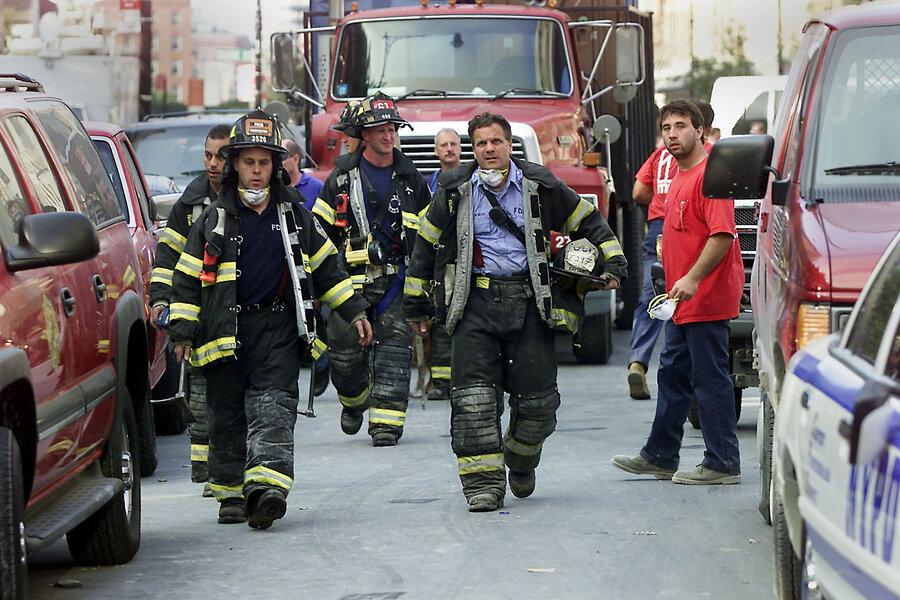
Twenty-five years. Anniversaries are ready pegs for journalists, sometimes reached for too automatically. We asked ourselves, What’s different about remembering 9/11 this year other than the neat framing of a quarter century?Our newsroom conversations revealed an instructive generational divide. For our younger colleagues, born in the years just before or after the worst-ever attack on American soil, Sept. 11, 2001, is a history lesson. The wars and social ferment it spawned are to them what the Vietnam War and Watergate were to the children born in the late 1960s or early 1970s: events their parents carried. They have their own list of formative disruptions: the iPhone, Donald Trump, the pandemic, and climate change.The 25th anniversary of 9/11 inspired Melanie Stetson Freeman to reflect on her experience photographing New York City in the days after the twin towers fell. She wasn’t allowed near the site. “I worked around the edges,” she writes in this issue, capturing exhausted firefighters, worshippers at churches and mosques, “people writing words of love and encouragement on the pavement in chalk.” In a city without an off switch, what struck her most was “a calm strength and resolve. People seemed kinder, more thoughtful.”The world today is a theater of geopolitical rivals asserting civilizational identity. Xi Jinping evokes China’s “continuous civilization” to justify the “necessity of reunification” with “China’s sacred territory” of Taiwan. Vladimir Putin, in denying the existence of Ukrainian national identity, describes the “gathering of Russian lands” as “continuing the tradition of ancient Russian statehood.” (Fred Weir explores this in his story in this issue.) India’s Hindu nationalist Prime Minister Narendra Modi characterizes his country as the “oldest living civilization in the world.”Even Mr. Trump has adopted such language. “We are going to forge the freest, most advanced, most dynamic, and most dominant civilization ever to exist on the face of this Earth,” he told Congress last year.There was a moment, though, 25 years ago, when competition and conflict fueled by religion and culture – a “clash of civilizations,” as late Harvard professor Samuel Huntington put it in the early years after the Cold War – met a firm and symbolic rebuke. Six days after the attack, as Howard LaFranchi recounts, President George W. Bush drew a sharp distinction between violent jihadism and the faith it claimed to serve.“The face of terror is not the true faith of Islam,” Mr. Bush said at the Islamic Center of Washington. Reciting a verse from the Quran, he added, “In the long run, evil in the extreme will be the end of those who do evil.”Now, as then, the world is churning over the identities of peoples and nations based on either ethnicity and religion or the values and rights inherent in all mankind.
Sept. 11 has become history. It still shapes the news.
Full Article
Original Source
Read the full article at Csmonitor →KhanList aggregates and links to publicly available news content. We do not host full articles from third-party sources. Always verify important information with original sources.