
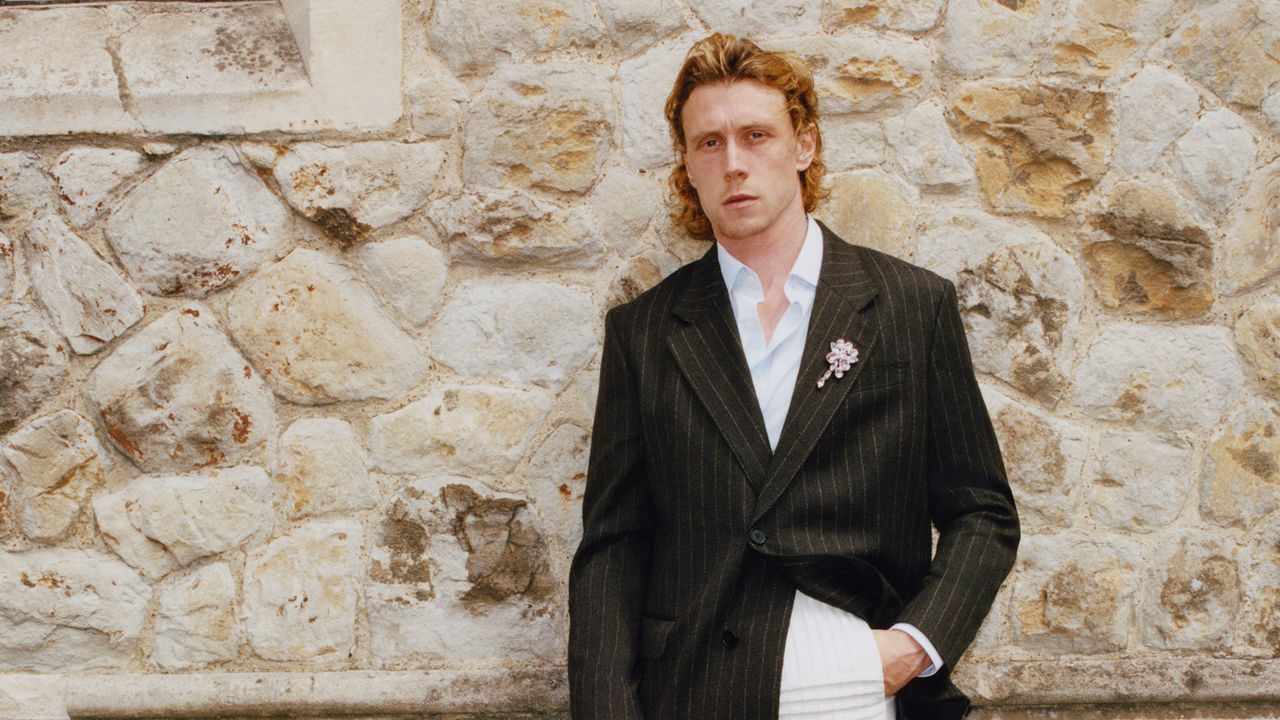
After a long season of indie filmmaking, the British actor best known for starring in 1917 is back with a crowd-pleasing Sense and Sensibility adaptation. Tom Ford, among others, is charmed. Soon you will be too.Jacket, shoes, and socks by Simone Rocha. Shirt by Boss by Beckham. Pants by Stefan Cooke.The summer scene in London’s Richmond Park was cinematically pastoral. Across miles of sprawling fields, red deer grazed on what’s left of the grass after a heatwave. Parakeets—not native to the area but descendants of London Zoo escapees—provided spontaneous pops of Gatorade green in the sky. At sunrise on this particular July day, before the joggers and dog walkers filtered through the gates, when it was still dead quiet, the animals were joined by a lone man: the actor George MacKay, who cycled over from his nearby home to recite lines aloud without the risk of drawing sideways glances.“There was no one here,” MacKay says proudly as we walk around the same spot together a couple hours later. He gestures at the few foot gap between us. “I saw four woodpeckers this far away.”Coat and pin by Simone Rocha. By MacKay’s usual standards, this kind of prep work is quaint. He is a fastidious and immersive actor, and he likes to go deep in the lead-up to production. A few years ago, while preparing to shoot the indie Wolf, where he played a man who believes he…is one, he would go to Hampstead Heath at 5:30 a.m. and crawl around on all fours for as long as he could get away with it. For 2020’s True History of the Kelly Gang, he spent some time living in the bush in Tasmania, chopping wood and riding horses to embody the nomadic swagger of real-life Aussie outlaw Ned Kelly. But after a long run of out-there indie roles in the years since his mainstream breakout in Sam Mendes’s World War One drama, 1917, the 34-year-old actor has entered a more traditional period of his career.MacKay (pronounced muh-kye, if you’re wondering) and I are meeting here as it feels like an appropriate setting to talk about the forthcoming earthy adaptation of Jane Austen’s Sense and Sensibility, in which he plays the romantic lead. But his look today—long hair dyed blond with heavy brown roots—reflects another role: Cry to Heaven, the long-awaited third movie from creative polymath Tom Ford, which was shot earlier this year. (“I just don’t get a haircut between jobs,” MacKay says.) And the lines he was running at dawn? They were for the delicious-sounding Ocean’s Eleven prequel he’s about to shoot with Bradley Cooper and Margot Robbie, set during the 1962 Monaco Grand Prix.Shirt, pants, and scarf by Saint Laurent by Anthony Vaccarello. MacKay has come prepared. He’s wearing a flowy navy shirt and a pair of Celine sunglasses. After thanking me more than once for making the relatively short journey from east to west London, he produces a bottle of sunscreen and offers it up, before rubbing daubs of the stuff onto his face. Then he explains his plan for our morning: a 45-minute walk to the middle of the park where we can get a coffee that will “taste so good,” followed by a 45-minute return journey. He sets a timer on his phone to ensure we stay on track. He knows the place well, having grown up nearby.Just after we set off, as if on cue, a horse-drawn buggy passes up ahead, providing a tidier segue into Sense and Sensibility than I ever could have. In the film, MacKay steps into the formidable riding boots of Edward Ferrars, a role made iconic by Hugh Grant in Ang Lee’s 1995 version. It’s the classic Austen setup: Ferrars is a floppy-haired, reserved, but morally upstanding gentleman who falls for the suddenly destitute Elinor Dashwood, played here by Daisy Edgar-Jones. So far so straightforward, until, of course, various complications arise. Throughout the film, MacKay and Edgar-Jones have to do a lot with little dialogue, as Edward and Elinor bumble around each other, their feelings bubbling just beneath the surface of what they are willing to articulate. Even against the lofty expectations set by Hugh Grant and Emma Thompson 30-odd years ago, MacKay and Edgar-Jones really nail it, and the movie succeeds on the strength of their romantic tension alone.“There’s a quiet kind of oceanic love between them because it’s deep and it’s heavy,” MacKay says. ”It has the power of fireworks, but not the visibility of fireworks.”MacKay’s immersive work on the film involved sending letters back and forth with Edgar-Jones in character, and decidedly not watching the 1995 version. “I hadn’t watched it, and I didn’t want to,” he says. “Because you’re either going to want to cherry-pick the best bits because they were so brilliant, or actively go against them [even though] that’s the best choice anyway.”He was anxious about taking on this particular role, perhaps in part because playing the guy whom the audience needs to fall for is not really something you can train for. “This is probably the most romantic role [I’ve done],” MacKay says, as he sidesteps a pile of deer poop. “If I’m really honest, of course there’s a slightly self-conscious question of: Am I up to it? And you don’t want to say that out loud because that doesn’t feel inherently like the men that are romantic leads, brimming with confidence and chutzpah.”Jacket and shirt by Dunhill. Pants by Huntsman. Shoes by Stefan Cooke. Socks by London Sock Co. Ring, his own. Edgar-Jones, however, reckons he was the perfect man to play Edward. “He imbued Edward with such depth of emotion and restrained feeling,” she says, “bringing all the intensity to their love story each day on screen.”I suggest that Edward represents a strand of masculinity that feels rare, though not extinct, in the modern era—where respect and honor are valued above bravado. And it sounds like that’s exactly what made the character appeal to MacKay. “That level of courtesy and respect and sort of a kind of quiet romantic presence, it felt like…. It’s a nice man to step into his shoes, especially nowadays.”George MacKay’s life has changed a lot in the years since 1917 ran the awards-season gamut in 2020, but it hasn’t played out quite as I expected. That film was that rare thing in the modern movie era: a meticulously crafted drama that was both a huge commercial success (taking in $446 million at the global box office) and an awards darling (it was nominated for 10 Oscars and won three). And it lived and died by MacKay’s performance—as a British soldier sent on an apparent suicide mission across enemy lines at the sharp end of WWI, the camera tracks him for the entire run time. It fell upon him to perfectly sell the emotion—and, perhaps more difficult, the active repression of emotion—brought on by the horrors he’s living through.Watching that movie in a packed cinema in 2019, I felt like I was witnessing the ascension of another massive British movie star. But MacKay’s role choices in the six years afterwards read more like someone trying to hide from the spotlight than embrace it. As we arrive at the kiosk in the center of the park, after he insists on paying for my coffee (which actually did taste so good), I ask him what has been guiding his career decisions since then.Shoes by Simone Rocha. Pants by Ferragamo. There are two sides to it, he explains, as we sit opposite each other on picnic benches. For one, his biggest takeaway from making 1917 was a newfound fascination with the technical side of moviemaking. As the film was set up to look like two long, continuous shots, it required a hell of a lot of planning and constant collaboration with every department. “We rehearsed for four months, and most days we’d rehearse the scene and then the key grip would come in, the head of makeup, the head of costume, Roger Deakins, director of photography…. And they would discuss how we achieved that shot. And I got to be party to those discussions,” MacKay says. “To be inside the filmmaking process as an actor, it was so mind-expanding and fascinating and brilliant.”On the other side, there was his first brush with all the trappings of a major movie rollout. The publicity tour and the awards circuit that followed were unlike anything he’d experienced before—and it also took him out of actually filming anything for a while. “That’s the longest that I wasn’t on a film set,” MacKay says. “When it looked like you were busier than ever because you’re doing talk shows, and there’s posters and there’s awards talk and all that kind of stuff.”So, when the script for Wolf, about a man who feels like his true nature is being repressed, came across his desk, MacKay followed his nose. It was an indie made for under $3 million, but MacKay believed in the project. 1917’s success, at least at the box office, was a bit of a surprise. Maybe Wolf could follow suit. One of the main draws, he says, was the opportunity to work with Terry Notary, a legendary movement coach and “animal specialist.” “The Square was a film that blew me away, and particularly the scene with the ape man, and that man is Terry,” he says. “So you go, you’re going to get to spend four weeks learning how to be an animal with Terry. It’s like, that’s it. That’s exactly what I want to do!”And that was how it went for several years. He made The Beast, a sci-fi predominantly in French, in which he and Léa Seydoux played out the past lives of a couple of star-crossed lovers across space and time. He made & Sons, in which he plays a documentary filmmaker who discovers his stepbrother is actually his father’s clone (!). And he made Rose of Nevada, about a Cornish fisherman who gets trapped in the past. None of these roles were the kind of thing you’d expect from an actor who just led a very popular war movie.Clothing and tie by Tom Ford. Gloves by Seymoure. Along the way, he got to really dig into characters, and that helped him understand himself better too. In the lead-up to shooting Rose of Nevada, he asked the director Mark Jenkin to interview him in character—a technique he likes to use to get inside their skin. The first time they sat down to do this was a more expressive “therapy session.” But the second interview proved to be more revealing. “Then I did one just like, Can I just try him just as he would be? I found he barely said anything. And it was so lovely. If he didn’t have anything to say, he wouldn’t. And I actually found that so comfortable. And I think maybe for whatever reason, I almost jump to fill silence in my own life a bit more than maybe I would if it was totally up to me. I’d probably keep shtum a lot more.”MacKay jokes that for the purpose of our conversation today, that attitude would be quite unhelpful—disconcerting, even. But it seems to me that MacKay—and this goes against a lot of what we hear about actors who like to truly submerge themselves in their characters—doesn’t put his needs above anyone else’s. Actually, his reputation as one of cinema’s good guys precedes him.Jacket (on top) by Celine. Jacket (underneath), pants, and cuffs by Prada. T-shirt by Sunspel. Glasses by Oliver Peoples. Belt by W. Kleinberg. Shoes by Carmina. Socks by London Sock Co. Over email, Tom Ford describes him as “the kindest and most considerate person on set. Not only to the other actors, but to the crew. The entire production team fell in love with him. I’m afraid that I did too.”Edgar-Jones has a similar perspective. “I remember watching him learn a TikTok dance with Bodhi, who played little Margaret, for hours,” she says. “He always made the effort to introduce himself to absolutely everyone on set and thank them after each day. Every set is better with George there.”Sense and Sensibility director Georgia Oakley recalls a moment during filming when MacKay went above and beyond for Edgar-Jones. “There was a day when Daisy was filming in a large crowd of extras and needed someone to give her an eyeline for spotting Edward,” she says. “George wasn’t required for the shot, but he spent the whole day standing in the crowd so that she had someone to play to. Anyone could have done it, and George could probably have had the day off, but he wanted to do it for his scene partner.”As we begin our walk back toward our starting point, I notice MacKay bending down to pick stuff up off the ground. He does it so fast that I barely register it at first. But then he does it again, and I realize that he’s collecting garbage—a candy wrapper here, a plastic bottle cap there—and putting it in his pocket to later deposit in the trash can. It makes sense then that MacKay found resonance in Edward, a man who puts propriety above his own happiness. “In Jane Austen and then [screenwriter] Diana Reid’s interpretation of the story, you get someone that really cares about the ‘trash’ that they leave behind,” he says. “So I really revered that selflessness in Edward.”So, what changed for MacKay to precipitate his return to the mainstream? Somewhat ironically for a man who spent the wee hours performing to no one, it has a lot to do with an audience. As the father of two young children, he has started going to the cinema more, to watch movies aimed at broad crowds. “I maybe previously have considered the filmmaker above the audience, about it being about a personal process, or filmmaker over everything,” he says. “Going to the cinema again I’m like, oh no, I’m an audience member. I want to be entertained.”It’s not so much about throwing everything he learned from years in indie cinema away, but finding that middle ground between art and entertainment once again. Sense and Sensibility does it beautifully. The Ocean’s Eleven prequel certainly will too. Margot Robbie and her production company, Lucky Chap, I suggest, have proven their ability to turn auteur-driven movies into blockbusters with the likes of Barbie and Saltburn. ”It really is such a beautiful mix of these auteur visions for a mass audience,” MacKay agrees. “And all with something to say as well. Not just for the trickery of like, let’s get Spielberg to do a Marvel.”Coat, pants, belt, and scarf (worn at waist) by Celine. Sweater by Prada. Boots by Manolo Blahnik. Cry to Heaven, on the other hand, is more likely to skew toward the artier side of things. The film is based on the novel of the same name by Anne Rice, about castrato opera singers in 18th-century Italy. But how closely Ford will stick to the text is unclear, as is MacKay’s role. “I can’t say too much, but it’s a wonderful character within it,” he says. I can tell MacKay is keen to pay due respect to Ford and let all that information unfurl when his director wants it to. He won’t confirm if he got to work with Adele, who will feature in her first acting role, or whether the movie is indeed set in the same era as the book, saying only, “I think it will look extraordinary.” Ford, he says, stands out from other directors for his “strength and clarity of vision.” But he is hesitant to go into much detail about his blossoming friendship with Ford, who, the weekend prior to our meeting, had taken MacKay as his guest to Wimbledon. Ford is less anxious, later telling me: “I cannot wait to work with him again, and I believe that we have become true friends.”As we approach the park gate where MacKay and I get ready to part ways, he brings up the balance he’s been working on—deciding whether to do a movie because it’ll give him a great personal experience or teach him about himself, versus considering its potential impact on an audience or box office appeal. The internal versus the external motivation. He’s still trying to figure it out. “It’s just a very human thing, isn’t it?” he says. “To constantly be recalibrating, how much is for the outer world, how much is for me? And also that’s a constant question that I think is never going to have a fixed answer.”And then, maybe in part because he’s been basking in the outdoors for several hours, he brings it back to the natural world. “Some of the time the question is like, well, if I stay put, be a rock in the river and it all goes round, how does that work?” he says. “Or actually, do you just go with the current for a little bit, and where do you end up?”PRODUCTION CREDITS:Photography by Joyce NGStyling by Marc FornéGrooming by Nadia Altinbas using OribeTailoring by Nafisa ToshProduction by Chloé MedleyA version of this story originally appeared in the October 2026 issue of GQ with the title “George MacKay Gets Romantic.”Sign up for Manual to receive useful advice on style, health, and more, six days a week.Ben Allen is GQ's Culture Editor. He writes and edits features and reviews and has profiled Nicole Kidman, Willem Dafoe, Kirsten Dunst and Glen Powell for GQ. He has written for the Guardian, Condé Nast Traveller, Dazed and more. You can email Ben at ben.allen@condenast.co.uk and find him on Twitter ... Read More
‘Sense and Sensibility’ Star George MacKay Aims to Please
Full Article
Original Source
Read the full article at Gq →KhanList aggregates and links to publicly available news content. We do not host full articles from third-party sources. Always verify important information with original sources.