
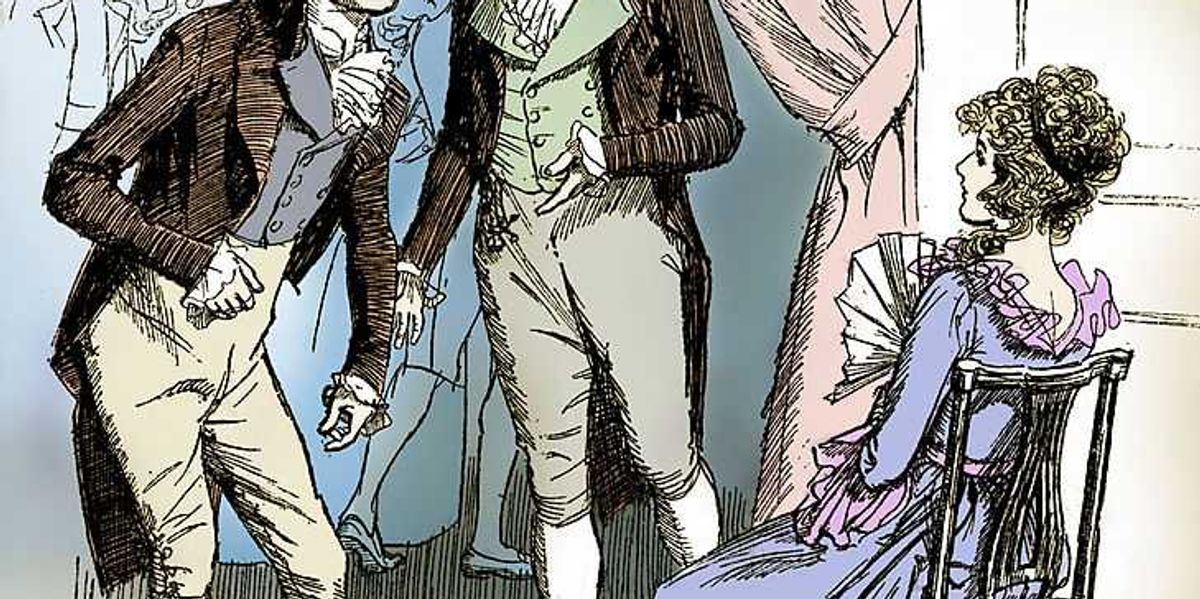
I must admit, I liked the new “Sense and Sensibility.” It received a 78% rating from critics and an 89% rating from audiences on Rotten Tomatoes. But the reviews I read missed the very thing that drew me to the movie: a truth that tugs deeply at the human heart. Perhaps unintentionally, this adaptation points us toward it.Those familiar with the star-studded 1995 version, featuring Emma Thompson, Hugh Grant, Kate Winslet, and Alan Rickman, will find a different tone here. The film opens with Marianne watching a caterpillar crawl across her finger. The image foreshadows a question: How does a caterpillar become a butterfly? It must cease to be what it was to become something more beautiful.The 21st-century American dating scene is morally repulsive and existentially empty. Many remain trapped in sensations and appearances, unable to find reality.The title describes the tension between sense and sensibility. What happens when we follow our feelings without questioning appearances? And what do we miss if we are always sensible and careful? A few details of the story help make the point.Elinor, the older sister, practices self-discipline and urges Marianne to do likewise. Marianne insists that sincerity requires following her passions wherever they lead. That difference shapes how each sister seeks love.After their father dies, the family estate passes to his son from an earlier marriage. His dying wish was that the son care for his stepmother and half-sisters. Instead, the son and his wife offer little help. Their greed leaves the women without the dowries that might help them marry and with few means of establishing an independent life.As they prepare to leave their home, Elinor meets Edward, her sister-in-law’s brother. His moral character contrasts with his sister’s miserliness. Edward and Elinor are plainly compatible, yet something prevents him from proposing.The family moves in with kind, if sometimes annoying, distant relatives. Marianne meets two men: Colonel Brandon, reserved and controlled, and Willoughby, dashing and passionate. She mistakes Brandon’s reserve for a lack of feeling and finds Willoughby irresistible. But Willoughby, too, leaves without proposing.In London, the truth emerges. Willoughby intends to marry a wealthy woman. Edward, meanwhile, had been promised to Lucy Steele when they were young. Though Lucy has lost her fortune, Edward refuses to abandon his commitment. His mother disinherits him, giving his inheritance to his younger brother. Elinor bears the news with dutiful resolve.RELATED: The most dangerous evil can look remarkably like good Amanda Cassingham-Bardwell/Getty ImagesMarianne’s broken heart, meanwhile, brings her to despair. During a serious illness, she says she willed herself to die. Colonel Brandon reveals Willoughby’s earlier cruelty: He seduced Eliza, the widow of Brandon’s brother and a woman Brandon had once loved, impregnated her, and abandoned her. Both Eliza and her unborn child died. Then comes the scene that made this movie an A+ for me — one the 1995 version omitted.Willoughby visits Marianne during her illness. Brandon arrives, seizes him, drags him outside, and challenges him to a duel. Willoughby aims to kill but misses. Brandon, a trained soldier who could have killed him, fires into the air. It is an act of mercy, and passion governed by moral conviction rather than appetite. Willoughby flees, defeated.This display of passion stirs Marianne’s heart. She begins to look past appearances and recognize Brandon’s moral character. He offers the reality of what she had wanted all along.Here is the point, and perhaps why so many young women are drawn to this movie without knowing quite why: We long to love and be loved. The film calls us to consider love in its purest form. The good characters do not need to fornicate with multiple partners to discover whom they prefer. The villain does that. It is an indictment of contemporary culture.When we love someone, our happiness becomes bound up with that person’s happiness. We are not atomistic individuals pursuing only our own ends. Our longing to love and be loved also leaves us vulnerable to sorrow. That is why the question of whom we love, and why, cannot be answered by feeling alone.RELATED: Why does God allow the wicked to win elections? Klenger/iStock/Getty ImagesBut the story does not end there. Like all art, it symbolically points to something higher. In this sense, it is a Christian movie. It points to the Bridegroom’s love for his Bride. Christ loves his Bride and suffers for her redemption. His Bride has been seduced by Satan, who hides the worst reality behind the most attractive appearances. Christ lays down his life for her. Where Willoughby’s passions consume others, the love of the Bridegroom gives itself away. This is the difference between the attractive appearance of love and its reality.Brandon likewise risks death to confront a Lucifer-like character. His willingness to face death reveals the love that wins Marianne’s heart. Unlike the 1995 film, this version does not end with weddings. Marianne’s final conversation with Brandon shows her learning to love what is real, not merely what appears attractive. Elinor finally expresses her love for Edward. The caterpillar has become a butterfly. The Bridegroom’s love is what makes the butterfly beautiful.Young women, I believe, long for this love. Yet the 21st-century American dating scene is morally repulsive and existentially empty. Many have not learned Marianne’s lesson. They remain trapped in sensations and appearances, unable to find reality.All human love will fail us. But this movie points us to Christ the Bridegroom, who saves his Bride. The story of human history ends with a marriage and a butterfly.
‘Sense and Sensibility’ has a message modern dating won’t like
Full Article
Original Source
Read the full article at Theblaze →KhanList aggregates and links to publicly available news content. We do not host full articles from third-party sources. Always verify important information with original sources.