
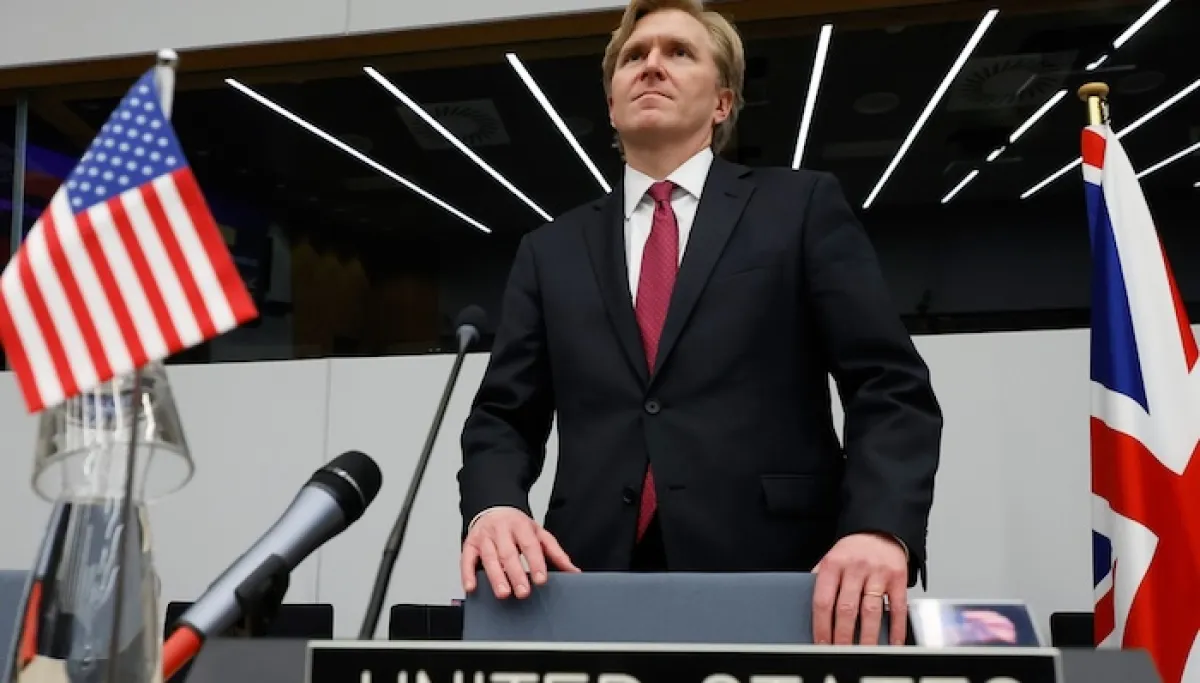
Two senior Pentagon officials are in Poland to meet with leaders of a select group of NATO countries on Tuesday that the United States believes are meeting its obligations.Undersecretary of War for Policy Elbridge Colby and Undersecretary of War for Acquisition and Sustainment Michael Duffey are meeting with the “Bergen Group,” which the Pentagon described in an unattributed announcement as “a select group of NATO allies that are rapidly and fully meeting their Hague Commitments, are serious about deterrence and defense, and have the scale to contribute.”The meeting on Tuesday will include representatives from NATO, U.S. European Command, and the State Department. The group met in Bergen, Norway, in June. The Pentagon’s press release did not specify which countries are included in the Bergen Group or what specific requirements NATO countries need to meet to be included in it.The Trump administration — including Secretary of War Pete Hegseth — have aggressively pushed NATO countries to increase their defense spending to reduce their reliance on the U.S. for military support. Their goal is to create a “NATO 3.0,” in which European countries lead the defense on the continent with less direct support from the U.S.In June, Hegseth announced a new Pentagon review of its European footprint. The U.S. would be reducing its fighter jets, strategic bombers, submarines, and more in Europe, with the expectation that European countries would fill the gaps left behind. He acknowledged at the time that some countries would meet the U.S.’s new expectations while others may be more reluctant.“NATO will be a two-way street. It’s only common sense,” he said in Brussels at a NATO defense ministers meeting. “It’s a review some countries will fail, and others will pass with flying colors.”The alliance agreed last year to bump the defense spending minimum requirement from 2% of a country’s Gross Domestic Product (GDP) to 5%, though countries have until 2035 to reach the new benchmark.Most European countries, and the NATO alliance, view its biggest threat to be Russia, which is currently in the midst of the largest land war in Europe since the end of World War II more than 80 years ago. The Trump administration is continuing to push for an end to the conflict, though Russian leaders have not shown an interest in ending the war.Steve Witkoff, an envoy for the president, has led the administration’s negotiations alongside the president’s son-in-law and former adviser, Jared Kushner. Witkoff said on Monday that the U.S. would “mediate working-level negotiations” between Russia and Ukraine in Abu Dhabi, United Arab Emirates, next week.HUNDREDS EVACUATE UKRAINIAN CITY OF OLESHKY AS PART OF MELANIA TRUMP-BROKERED CEASEFIRE“Additionally, American negotiators will meet this week in Brussels with representatives from France, Germany, the United Kingdom, the EU, and NATO to discuss security guarantees for Ukraine, Europe’s post-war security architecture, and economic opportunities to support Ukraine’s reconstruction,” he said. “We look forward to building on the progress made in Kyiv, Oslo, and St. Petersburg toward a comprehensive, durable peace agreement that delivers lasting security for generations to come.”The negotiations come after the conclusion of the six-day localized ceasefire in Oleshky, a front-line Russian-occupied city where the last remaining residents have spent years living under occupation, constant bombardment, and threats, with little food or resources.
Senior Pentagon leaders meet with NATO allies ‘that are rapidly and fully meeting’ their commitments
Full Article
Original Source
Read the full article at Washingtonexaminer →KhanList aggregates and links to publicly available news content. We do not host full articles from third-party sources. Always verify important information with original sources.