
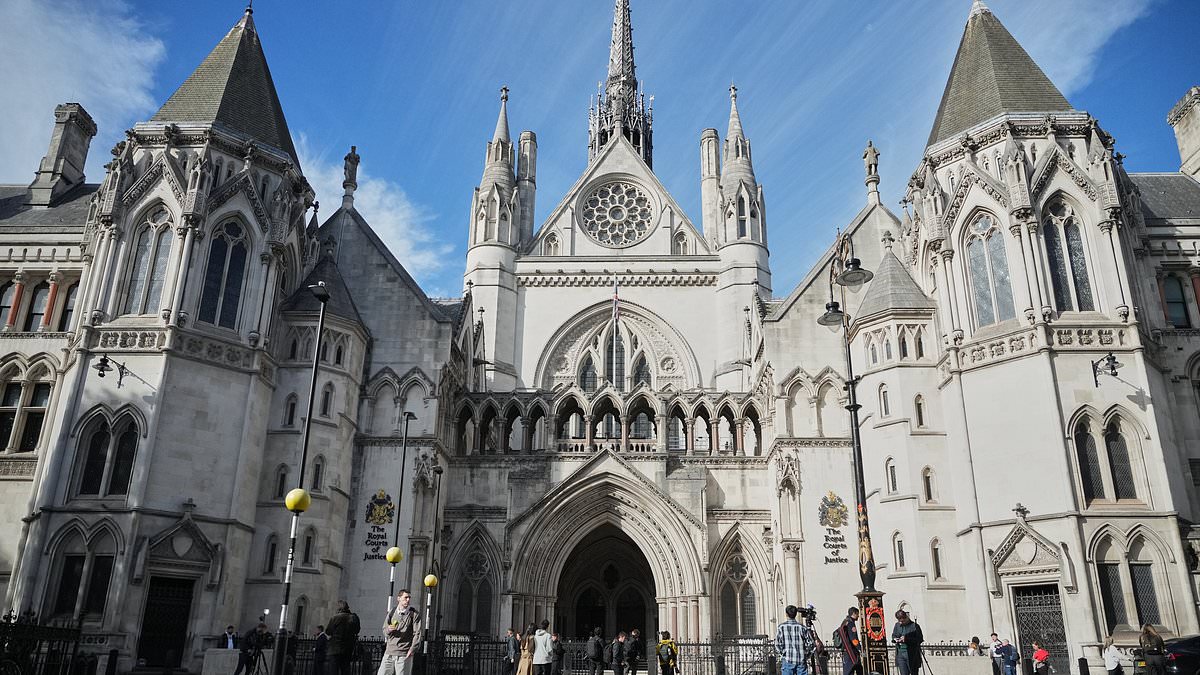
Do you have a story? Email rory.tingle@dailymail.co.uk Published: 08:19 EDT, 3 November 2026 | Updated: 08:22 EDT, 3 November 2026 A senior CPS prosecutor accidentally cited a fictitious legal precedent after using an AI-generated answer while researching a child rape case. Ravinder Dhillon cited the entirely made-up case during a High Court hearing to decide whether a child should be prosecuted for the rape of his younger sister. Her explanation for relying on the imaginary case was described as 'unsatisfactory' by two High Court judges.The solicitor used an AI response generated during an Internet search, it is understood. Experts have repeatedly warned about AI hallucinations being submitted as evidence and said these errors have the potential to 'change the course of a person's life'. In July, the CPS admitted putting hallucinated cases before the High Court in an extradition appeal. There have been dozens of other instances of hallucinations coming before judges, mainly by people representing themselves in employment tribunal cases. In the latest case, lawyers for a boy who was 11 when he allegedly raped his seven-year-old sister were challenging the decision to prosecute him. Ravinder Dhillon cited the AI hallucination during a High Court hearing to decide whether a child should be prosecuted for the rape of his younger sisterThey claimed prosecutors had failed to consider representations from social workers, youth workers and a forensic psychologist. Ms Dhillon was arguing in favour of the prosecution continuing and included in her written submissions a detailed reference to a case she called CPS – R v J [2024] EWCA Crim 3529. This turned out not to exist. The solicitor said her citation had been an error and that she had been referring to a decision by the House of Lords 14 years earlier. Judges called this explanation 'unsatisfactory' but accepted her mistake had not altered the outcome of the case - which was for the prosecution to be allowed to continue. However, legal experts described the error as 'serious'. 'This was used as a legal source to argue for the prosecution of a child and that legal source doesn't exist: that's a serious failure,' Brian Flanagan, an associate professor of law at Maynooth University in Ireland, told the Guardian. 'It calls into question norms of trust in the law where we treat authorities as precious things. You can't make them up; it's out of bounds. AI increases the risk that is going to happen because of the time you can save. 'It is not great for any professional to do this, but when the professional is working for the state it takes on a different aspect, because the power of the state is immense.' In June 2025, Dame Victoria Sharp, then president of the King's Bench Division, called on the Bar Council and the Law Society to consider steps to curb the issue of AI hallucinations being entered as evidence 'as a matter of urgency'. She said there were 'serious implications for the administration of justice and public confidence in the justice system if artificial intelligence is misused' Stuart Harvey, CEO of Datactics, said: 'This isn't the first time an AI hallucination has been put in front of the High Court, and these are not minor errors as they're informing decisions that can change the course of a person's life.'Our justice system needs much better verification given people's freedom is at stake. If the data behind a decision cannot be traced to a trusted source, it shouldn't be relied on. 'Banks have to show the data behind every lending decision, and courts should expect the same standard for any case put in front of them, especially as AI hallucinations become more common.'A CPS spokesman said: 'The CPS has a strict artificial intelligence policy which limits its use so that it is not used to make legal decisions and there must be human checks for accuracy.'In this case, a challenge was made to a CPS decision to charge two youths with the rape of another child. The High Court rejected the challenge to our decision making and the criminal proceedings will therefore continue.'Following the challenge, we identified an error had occurred from conducting legal research using the internet. As soon as this error was identified, it was remedied and an internal review was carried out to establish how this had occurred and to check that no other cases have been affected. Following the rapid review we shared learnings, including that caselaw must be cited from trusted legal sources.'
Senior CPS prosecutor accidentally references non-existent case after using AI during child rape High Court hearing
Full Article
Original Source
Read the full article at Dailymail →KhanList aggregates and links to publicly available news content. We do not host full articles from third-party sources. Always verify important information with original sources.