
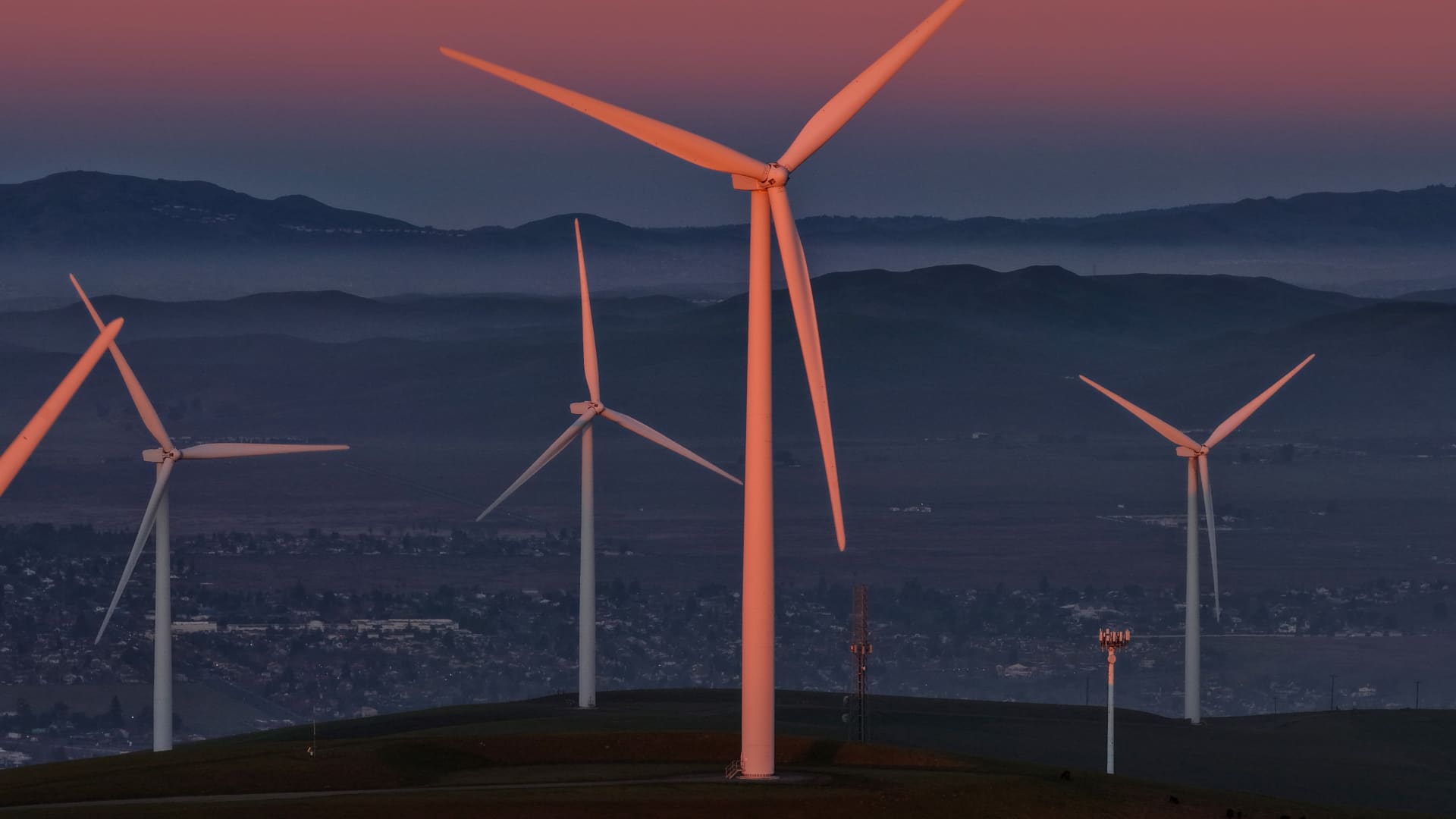
An aerial view of wind turbines at the Altamont Pass wind farm on Jan. 13, 2026 in Livermore, Calif.Justin Sullivan | Getty ImagesThe Senate on Thursday passed a long-sought bill to ease the nation's environmental permitting laws and overhaul electrical transmission regulations, a crucial step toward boosting construction for the energy and technology industries.Senators voted 62-33 to pass the bill, which split Democrats just weeks after they flipped enough seats from Republicans in the midterm elections to give them majorities in both chambers of Congress in January. The bill, known as the Bipartisan American Affordability and Jobs Act of 2026, is projected to lower energy costs for consumers while weakening some environmental laws to speed up the permitting process. The vote offers a window into the fissures forming in the Democratic Party as it prepares to assume full control of Congress in January and tries to address the affordability crisis that catapulted it to power. More Democrats voted against the permitting measure than voted for it. Still, more than a dozen — including Senate Minority Leader Chuck Schumer, D-N.Y. — voted to pass it over the objections of climate groups and tribes to get the bill across the finish line. "It's going to be legislation that's really going to make the biggest difference for the next 100 years, especially bringing down carbon emissions once this president is gone," Sen. Ruben Gallego, D-Ariz., told reporters on Thursday before the vote. Gallego supported the measure. The bill's Senate passage is a key step to it becoming law, but it would also need to clear the House before heading to President Donald Trump's desk.Democratic supporters of the bill touted its cost benefits as a win after they ran campaigns on affordability, and pointed to a massive glut of clean energy the bill could bring onto the grid. Opponents lamented rollbacks to the nation's bedrock environmental protection laws favored by the fossil fuel industry and Republicans, and warned the measure could offer carte blanche authority to the data centers undergirding artificial intelligence. "No big, bipartisan bill is going to be perfect for everyone, but we have a real opportunity to make electricity more affordable for families. Working people can't afford to wait another few years for us to get this done," Sen. Martin Heinrich, D-N.M., the incoming chair of the Senate Energy and Natural Resources Committee and an author of the bill, said in a statement to CNBC. From left, R-W.Va., Sen. Martin Heinrich, D-N.M., and Sen. Sheldon Whitehouse, D-R.I., hold a news conference on the Bipartisan American Affordability and Jobs Act in the U.S. Capitol on Wednesday, September 30, 2026.Bill Clark | Cq-roll Call, Inc. | Getty ImagesHeinrich brokered the agreement with his counterpart Sen. Mike Lee, R-Utah, along with Sens. Sheldon Whitehouse, D-R.I., and Shelley Moore Capito, R-W.Va., the top Democrat and Republican on the Senate Environment and Public Works Committee. "Earlier this month, Americans sent a clear message: They want Congress focused on making their lives more affordable. That's precisely what this permitting reform bill will do," he said. Getting to a final vote was acrimonious. Senators amended the package in the weeks leading up to the vote to address concerns from Native American tribes, which objected to changes in their participation in permitting. "I'm not going to sit around and let these data centers scar our treasures," Sen. Ron Wyden, D-Ore., told reporters Thursday about the push for his amendment, which would have blocked data centers from being built on public lands. Sen. Ron Wyden, D-Ore., is seen during votes in the U.S. Capitol on June 17, 2026.Tom Williams | Cq-roll Call, Inc. | Getty ImagesClean energy and fossil energy groups both cheered the bill's passage in the Senate. As negotiated, the bill would benefit both renewables and fossil fuels. Artificial intelligence and the broader tech industry also stand to benefit — despite the bill's provision forcing hyperscalers to pay for upgrades to the grid — as power-hungry data centers demand more electricity.The American Clean Power Association, a group that represents renewables, said it was "a clean energy bill that will modernize America's energy systems and lower consumer prices."The American Petroleum Institute, which represents the oil and gas industry, called the bill a "major breakthrough on historic permitting reforms that would deliver more affordable energy for consumers, cut costly delays, and build much-needed critical infrastructure."Renewables would benefit largely from the bill's electricity transmission component, along with measures aimed at blocking Trump from cancelling already-permitted wind and solar projects. New solar and wind projects are often bottlenecked by a lack of transmission able to deliver power to the grid. Rhodium Group, an economic research firm, estimates the bill would allow an additional 17 to 249 gigawatts of clean energy to be built by 2040. Natural gas exports would rise 8% to 15% beyond a 76% to 145% rise already accounted for under current policy. Greenhouse gases would be reduced by 5 to 148 million metric tons annually in 2040. "A lot of Democrats are involved and supportive in this deal because expanding grid capacity would integrate a lot of clean energy," said Rob Gramlich, the founder and president of Grid Strategies, an energy consulting group. "Republicans are maybe less interested in that benefit, but they do care about economic growth and serving new large loads. And I think members on both sides of the aisle are pretty well aware that we're doing much less grid investment here in the U.S. compared to other countries." Gramlich added that "you can't get to 60 to 80% of our grid from renewable energy without a significant expansion of grid capacity." The bill now heads to the House, where Republican leadership is expected to attempt to pass it. Trump also supports the deal. But as in the Senate, Democrats are expected to be divided. "Democrats promised to lower bills, cut pollution, and protect ratepayers," said Rep. Scott Peters, D-Calif., a longtime champion of permitting reform. "Voters are giving us a chance to show we mean it. BAAJA does all three. We should pass it before the end of this Congress."House Natural Resources ranking member and likely incoming Chair Jared Huffman, D-Calif., meanwhile, urged Democrats to say no to the permitting bill. "Don't believe the lie that this terrible bill, exactly as drafted, is the last, best and only chance to ever do permitting reform," he said. "We can produce a better deal."
Senate passes BAAJA permitting reform bill backed by AI, energy sectors
Full Article
Original Source
Read the full article at Cnbc →KhanList aggregates and links to publicly available news content. We do not host full articles from third-party sources. Always verify important information with original sources.