
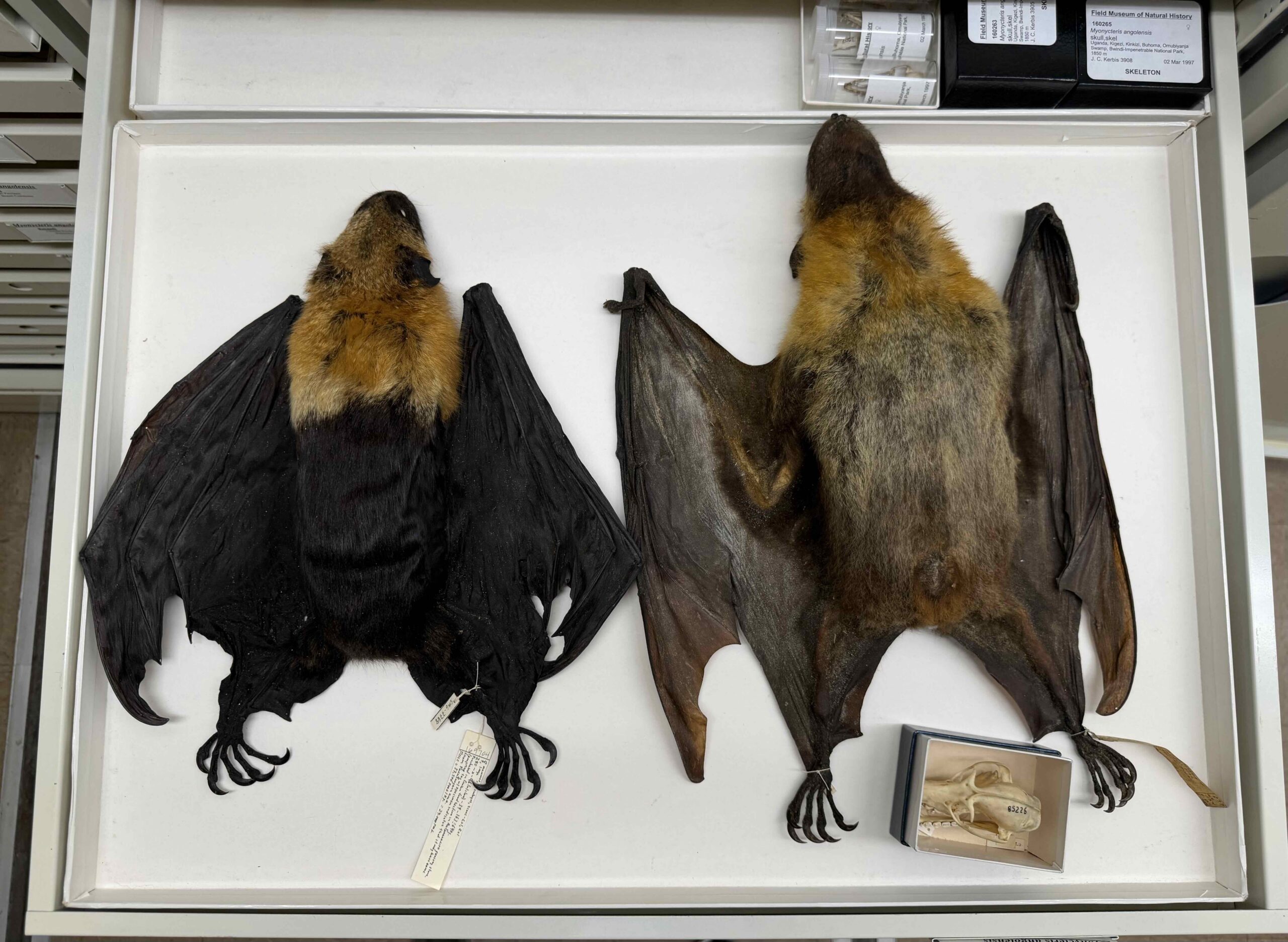
Madagascar’s largest fruit bat is getting smaller, and hunting may be partly to blame, a recent study suggests. The Malagasy flying fox (Pteropus rufus) feeds mainly on fruit and nectar, making it an important pollinator and seed disperser. But the species is also hunted for meat, both for subsistence and commercial sale. Hunting is legal in Madagascar from May to September each year; some hunters use nets to catch bats for food, while others shoot them with shotguns to sell in markets and restaurants. Researchers from the Field Museum of Natural History in Chicago, U.S., first noticed the apparent change while observing the bats in the wild. The animals seemed smaller than specimens held in the museum. “I was thinking about a million different angles to explain why the bats were getting smaller,” Emily Cornelius Ruhs, the study’s lead author a postdoctoral researcher at the Field Museum’s Negaunee Integrative Research Center, said in a statement. “I wondered if it was related to changes in temperature or habitat.” Co-author Steve Goodman, also from the Field Museum, suspected commercial hunting, which had intensified from the 1980s onward, might be a factor. To investigate, Ruhs and Goodman measured the skulls and teeth of 121 Malagasy flying fox specimens collected over the past 150 years. They found the bats’ skulls had become significantly smaller since 1980, while their teeth had not. The researchers suggest this could indicate that hunters are selectively shooting larger bats because they yield more meat. “If you’re the biggest bat in the sky, you might be the easiest target. You’re also going to provide a hunter with the most meat,” Ruhs said. She cautioned, however, that the study doesn’t prove hunting caused the bats to shrink, only that the two trends are correlated. Targeting larger bats could also have implications for the species’ reproduction. Mid- to large-sized adults are likely to be sexually mature, the authors write. The species reaches sexual maturity at more than 2 years, and then births just one pup after a gestation period of more than six months. Vincent Florens, an ecologist at the University of Mauritius, who wasn’t involved in the study, told Smithsonian Magazine that the fruit bat “has a big ecological role, because the dissemination of seeds is extremely important for the reproduction of plants and also for the regeneration of forests.” Ruhs and Goodman write in their paper that the reduction in the bats’ size could also affect the species’ ecological role by limiting the size of the fruits they can eat and the seeds they can disperse. Acknowledging that the Malagasy flying fox is an important food source in some parts of Madagascar, Ruhs said it was “critical to figure out ways to protect the bat populations.” Banner image: Two Malagasy flying fox specimens from the Field Museum’s collections. The smaller specimen on the left is from 1995; the larger specimen is from 1948. Image © Field Museum. Credits Topics
Selective hunting may be making Madagascar’s largest bats smaller, study says
Full Article
Original Source
Read the full article at News →KhanList aggregates and links to publicly available news content. We do not host full articles from third-party sources. Always verify important information with original sources.