
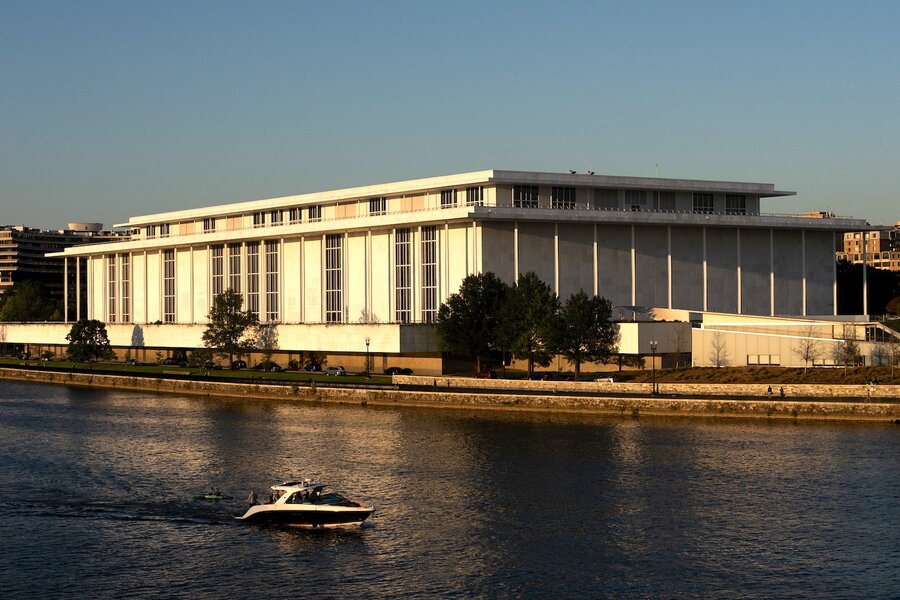
The standoff over Washington’s iconic Kennedy Center underscores the current place of the arts in America in ways that are both symbolic and substantive.On Tuesday, the complex formally known as the John F. Kennedy Center for the Performing Arts formally closed to the public. The move followed President Donald Trump’s monthslong effort to rename and remake the center in his vision, which disrupted norms and expectations around political, artistic, and cultural touchstones.Like most buildings that are several decades old, the center needs repairs and updates. Mr. Trump says his star power would attract the needed millions – but will only be exerted if he receives recognition. If not, the president threatened Wednesday, the complex could be “ripped down.” “The Kennedy Center is empty and in peril. Its community is in anguish,” read a headline in Thursday’s Washington Post. Describing it as “perhaps the most authentically populist major arts center in the country,” columnist Philip Kennicott noted how it “attracted the black-tie crowd and guys in cargo shorts; [and] jostled tourists and locals together.”It’s clear there are deep civic and artistic ideals and attachments to the center, which Congress unanimously dedicated in January 1964 as a “living memorial ... the sole national monument” to the country’s recently slain president.A U.S. district judge has twice ruled this year that only Congress, not the executive, has the authority to rename any part of the 17-acre complex. On Thursday, he also ruled that any demolition or new construction requires 30 days advance notice. Amid the legal and political back-and-forth, it’s worth recalling the capacity of the arts and artists for bold reinvention. Over the ages, they have flourished under beneficent patrons and times of peace, as well as survived periods of paucity and tyranny. They’ve transformed – and been transformed by – politics and society. Through it all, the arts have nourished and given expression to humankind’s inherent bent toward creativity, harmony, and originality.Thus, in the current Kennedy Center drama, some in the arts world are seeing and seizing unexpected opportunities.The Washington National Opera company moved its 2026 program to nearby George Washington University – and plans to adapt coming performances to a range of venues around the city. In August, the National Symphony Orchestra announced a “transformative expansion of our regional and national footprint.” In addition to playing around Washington, it will tour the Midwest and California.“Music should be taken to where people are,” Music Director Gianandrea Noseda told the Post, emphasizing a need “to reconnect with people” because “love and respect is the best marketing.”“Can [the center] be something more, something better, something built for what the arts need today,” arts and culture writer Douglas McLennan pondered in the online ArtsJournal in June. His suggestion? Becoming a touring and co-production network, “a presence that shows up in the many American cities that have no flagship of their own.” Such a showing up for citizens echoes a vision Kennedy expressed in support of the National Cultural Center envisioned by his predecessor, President Dwight Eisenhower. Deepen your worldviewwith Monitor Highlights.Politics with respectGet political stories with respectful analysis.There‘s a world of new ideas in everyBooks newsletter.There‘s more to life, enrich yours withCulture & Learning weekly.Follow humanity‘s discoveries withScience & Nature stories in your inbox.Gain a spiritual perspectivefrom the stories in your inbox.Want to understand the deeper impact of critical events? Learn the Monitor‘s insight.Already a subscriber? Log in to hide ads. “Art is the great democrat calling forth creative genius from every sector of society, disregarding race or religion or wealth or color,” said Kennedy at a 1962 fundraiser featuring, among others, opera singer Marian Anderson, comedian Danny Kaye, and a 7-year-old prodigy, Yo-Yo Ma.“After the dust of centuries has passed over our cities,” he added, “we ... will be remembered not for victories or defeats in battle or in politics, but for our contribution to the human spirit.” ALREADY A SUBSCRIBER? LoginReal news can be honest, hopeful, credible, constructive.The Christian Science Monitor was founded in 1908 to lift the standard of journalism and uplift humanity. We aim to “speak the truth in love.” Our goal is not to tell you what to think, but to give you the essential knowledge and understanding to come to your own intelligent conclusions. Join us in this mission by subscribing.
Seizing opportunity from Kennedy Center drama
Full Article
Original Source
Read the full article at Csmonitor →KhanList aggregates and links to publicly available news content. We do not host full articles from third-party sources. Always verify important information with original sources.