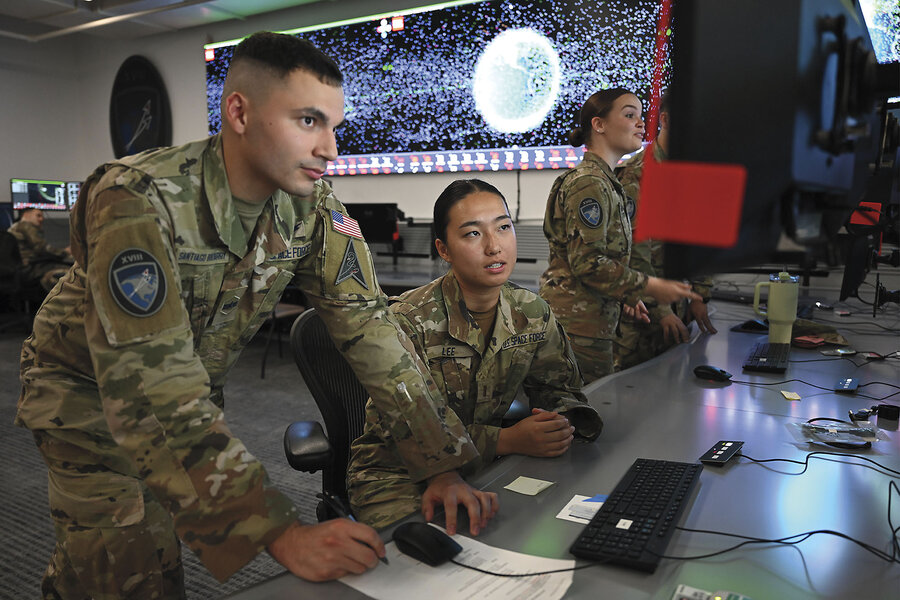
In June of last year, with the United States and Israel poised to launch massive strikes against Iranian nuclear facilities, troops in America’s newest military service, the U.S. Space Force, were preparing for battle.In the shortgrass prairie of Colorado, electromagnetic-warfare specialists pored over satellite signals, looking for signs of adversaries trying to tamper with U.S. military communications. Some of the Guardians, as Space Force troops are known, received firearms training – for the first time since boot camp.They then packed up an arsenal of antennas and headed to the Middle East, ready to jam signals so that B-52 bombers could fly safely to their targets. Why We Wrote This Space Force, the new U.S. military service designed to ensure American space superiority, was tested in Iran and Venezuela missions. With a proposed $71 billion budget, it conducts “dynamic space operations.” Here’s what this means for everyday Americans. Many in the military were focused on whether Iran would escalate or de-escalate, says Col. Gerrit Dalman, who was leading the Space Force Crisis Action Team. But for those in his branch, another big question loomed: How would the Space Force prove its worth?Military culture is forged in large part by waging war, but the Space Force had yet to be battle-tested. Iran was the first conflict that would have active participation from the service President Donald Trump has called “my baby,” and which has seen its proposed budget more than double in the past year.In planning for Iran, commanders were confident in what they could contribute to the war effort, but conscious, too, of building a legacy. “One of the biggest strategic challenges for the Space Force is not potential adversaries. It’s not the pace of change in technology,” Colonel Dalman says. “It’s telling our story.” Courtesy of Gerrit Dalman U.S. Space Force Col. Gerrit Dalman, during a break in electromagnetic warfare training, enjoying Ka’ena Point in Hawaii in 2022. Growing painsWhen President Trump created the Space Force during his first term, there were jokes. The insignia, for one, bears a striking resemblance to the “Star Trek” emblem. It did not help that actor Steve Carell in 2020 launched the satirical television series, “Space Force,” as the actual service was standing up, say some Guardians, who add that they still rarely make it through an airport in uniform without being stopped by someone surprised that the force is not just a Netflix show.It soon became clear, however, that the service was on the front lines of the next generation of warfare, as China and Russia joined the space arms race. And many were eager to sign up for the wonder of working in, and with, space.When Colonel Dalman was a child in Juneau, Alaska, for instance, his dad would wake him in the middle of the night to see the northern lights. In 1993, he watched hours of NASA live video of the first servicing mission for the Hubble Space Telescope. “Sounds exciting until you realize it’s four hours of a guy in a spacesuit turning a wrench,” he says.Seeing the Earth spin below the astronauts imbued him with a sense of possibility – one he has retained as he considers the opportunity the Space Force has to set an example for the rest of the world on how to extend the American sense of “right” to this new frontier.This marvel of exploration often dovetails with martial aims. One of the most striking examples of this came in May with a suggestion from a major security nonprofit that, to win the space race, Guardians should deploy to the moon. Dave Grim/U.S. Space Force A view of the the Upgraded Early Warning Radar (UEWR) facility at Cape Cod Space Force Station, Massachusetts, May 9, 2024. “The anarchic nature of space habitation, particularly on the Moon, dictates that the nation to first secure ... lunar human presence will be able to set [the] norms, standards, and legal frameworks to their advantage,” wrote retired Space Force Col. Kyle Pumroy, a former senior fellow at the Mitchell Institute for Aerospace Studies, whose funders include America’s largest defense contractors.“The prospect of China exercising hard power projection on the Moon,” he added, “is a reasonable extension of China’s clear track record of terrestrial territorial expansion through military means.”In his last public speech as the Space Force’s Chief of Space Operations on July 16, Gen. Chance Salzman warned that “if conflict extends into space, none of us will be able to avoid the war zone” since orbits “do not adhere to national boundaries.”Preventing space from turning into a conflict zone is, he said, “the ultimate team sport.”The notion of “space wars”Concerns about the weaponization of space have been around since the inception of space exploration. Back in 1957, while the world was debating whether it would be acceptable under international law to fly a satellite over another country, Russia launched Sputnik 1. Emitting a steady beep that could be picked up by radios, it alarmed Americans, including Pentagon officials, but also answered the question of satellite overflight, establishing norms that hold to this day.Operation Desert Storm in 1991 was widely considered the “first space war,” when the Pentagon used satellites to track Iraqi troop movements and navigate using GPS, which was relatively new at the time. Space-based missile-warning systems helped U.S. forces quickly detect Iraqi Scud missiles. Satellite photos helped locate hidden Iraqi tanks. David Dozoretz/U.S. Space Force Members of the 18th Space Defense Combat Squadron, a unit assigned to U.S. Space Force, observe orbital data at Vandenberg Space Force Base, California, Oct. 4, 2024. In the years since, American military analysts have kept close tabs on the country’s competitors as they have made moves to catch up. China last summer completed the first-ever refueling of a satellite in geostationary orbit, more than 22,000 miles above Earth. This is the orbital zone where many of the world’s most sensitive satellites, including nuclear command links, are located.Officials in the U.S., which has yet to demonstrate such capabilities, were watching closely because the complex maneuver also means that China could jam, shove, or closely inspect its adversaries’ satellites now, too.There are also existential scenarios. U.S. Space Command ran a war game in March that involved a Russian nuclear device that could wipe out thousands of U.S. satellites, along with worldwide services such as GPS.It is not hypothetical, analysts argue.In 2024, Biden administration officials warned that Russia was deploying testing technology for such a device, known as a fractional orbital bombardment system. China is pursuing these space weapons as well.And this is where the race comes in: Such weapons are, officials say, in large part a response to concerns that Beijing and Moscow have expressed about the constellation of U.S. satellites. These include those developed with commercial ventures, such as SpaceX’s Starshield, a partnership designed to keep U.S. networks working even in the face of attacks against its satellites. Amber Mullins/U.S. Space Force U.S. Space Force Guardians, assigned to the 4th Electromagnetic Warfare Squadron, conduct training and maintenance with the Counter Communications System, at Peterson Space Force Base in Colorado, July 2, 2025. An increasingly crowded skyAs other countries have joined Russia and the U.S. in space, congestion and jockeying for orbital slots are on the rise. Over the past five years alone, the number of objects in orbit, including satellites and debris, has increased by 600%, according to Space Force officials.In 2007, China blew up one of its own satellites, a move that added an estimated 30% to existing space debris.Russia did the same thing with one of its own satellites in 2022, leaving behind debris that the International Space Station has been repeatedly forced to dodge.As congestion grows, so has the challenge – entrusted to Space Force Guardians – of identifying and tracking any object larger than a basketball.Guardians must keep close tabs on satellite signals as well. It’s no small task.Space tools like “Bounty Hunters,” a system of sensors, software, and antennas that act as “celestial detectives,” pinpoint the origin of signals that could interfere with, say, communications between commanders and troops.While space operations are a strong point for the high-tech U.S. military, it is also an Achilles’ heel, as America’s adversaries seek out vulnerabilities, says Tech Sgt. Brian Wood, the senior enlisted leader of the 16th Electromagnetic Warfare Squadron,“They want to see what they can get away with,” he says. Tech. Sgt. Luke Kitterman/U.S. Space Force U.S. Space Force Guardians monitor workstations in the Combined Space Operations Center at Vandenberg Space Force Base in California. The center operates 24 hours a day, seven days a week – continuously coordinating, planning, integrating, synchronizing, and executing space operations. To that end, the force also uses weapons such as the Counter Communications System to jam communications. “We can say, ‘I want this terrorist leader or this commander to be unable to communicate at this particular time,’ ” Colonel Dalman adds.Commercial opportunitiesThe telltale giant golf balls at Buckley Space Force Base, on the western edge of America’s high plains, are radar domes designed to protect the sensitive antennas inside. But the radomes, as they are known, also serve to conceal the direction the antennas are pointing, keeping other nations’ spy satellites from gathering intelligence on U.S. operations.Here at Buckley, Capt. Rebecca Christensen works in satellite communications in Space Delta 8, where Guardians protect classified communications for deployed U.S. forces.While Captain Christensen was a cadet at the U.S. Air Force Academy, the Pentagon started the Space Force, and upon graduation, she became the 35th officer in the force. She’s friends with Nos. 7 and 8. John Ayre/U.S. Space Force U.S. Space Force Capt. Rebecca Christensen works in Space Delta 8, where Guardians protect classified communications. The captain has not looked back.“I get to feel like I’m doing a good thing here,” she says.Consider just the commercial opportunities from the force’s work. The global space economy, which was $613 billion in 2024, is projected to triple to $1.8 trillion by 2035, notes Colonel Dalman. And in 2024, more human beings – 20 people – were in space simultaneously than ever before. Those figures, experts say, will only get larger. Beijing’s Tiangong space station will soon put additional astronauts in orbit. If space tech companies get their way, there could be a single starship with 100 passengers on a tourist flight.This will mean more jobs for the U.S. Space Force to do, such as, say, on-orbit rescues, experts say. And Congress hasn’t yet tasked any federal agency with “planetary defense,” the term for deflecting incoming comets or asteroids. But there are Guardians thinking about that, as well.Midnight HammerIn June of last year, Tehran launched 19 ballistic missiles at Al Udeid Air Base, a U.S. military installation in Qatar. Guardians detected and tracked the fast-moving targets, then handed them off to Patriot missile-battery forces for shootdown.Officials say this was the largest single Patriot missile launch in U.S. history. It remained a difficult defense, even though Iran provided prior warning to avoid escalating the conflict.Midnight Hammer – the operational name of the U.S. mission to strike Iranian nuclear facilities last summer – was also “one of the first really tangible opportunities for a new service to act like a service during a time of battle,” says Colonel Dalman.Defense Secretary Pete Hegseth, Air Force Gen. Dan Caine, the chairman of the Joint Chiefs of Staff, and President Donald Trump, who created the Space Force in 2019 during his first term, all acknowledged the Guardians’ work in Midnight Hammer, and, in the months to come, during U.S. operations in Venezuela as well. Jonathan R. Mallard/U.S. Space Force A U.S. Space Force Guardian recites the oath of enlistment during a graduation ceremony at Joint Base San Antonio-Lackland in Texas, Dec. 18, 2025. This praise, and some of the details that came with it, is also time-honored military strategy: Show your opponents what you can do, and they might be less likely to test limits.“Space Force is my baby,” President Trump said during his State of the Union address in February. “It’s becoming so important.”At the NATO summit in Ankara, Turkey, earlier this month, Mr. Trump cited Space Force technology being used, he said, to secure Iranian nuclear sites like so-called Pickaxe Mountain, bombed by the U.S. military last year. “We have cameras—that’s called Space Force…that can read the badge of the person going over to a site.” If they catch anyone trying to dig up enriched uranium, “They get blown up,” the president added.The service, in a nod to the military’s growing reliance on Space Force technology, is set to see its budget more than doubled in the White House’s latest defense spending proposal, to $71 billion in 2027 – up from $31.6 billion in 2026. The money reflects the pace of current operations, officials say, but also acknowledges Pentagon concerns about the kinds of activities America’s adversaries are undertaking in space.“Being able to achieve certain effects in space is critical to being able to win future wars,” says Col. Raymond Brushier, who took over for Colonel Dalman after he retired in November as director of current operations at the service’s Combat Forces Command. (The Space Force changed the name last year from Space Operations Command, or SpOC, avoiding the acronym’s “Star Trek” reference.)Space, Colonel Brushier adds, is “the ultimate high ground.”
Seeking to double its budget, Space Force readies for next frontier of warfare
Full Article
Original Source
Read the full article at Csmonitor →KhanList aggregates and links to publicly available news content. We do not host full articles from third-party sources. Always verify important information with original sources.