
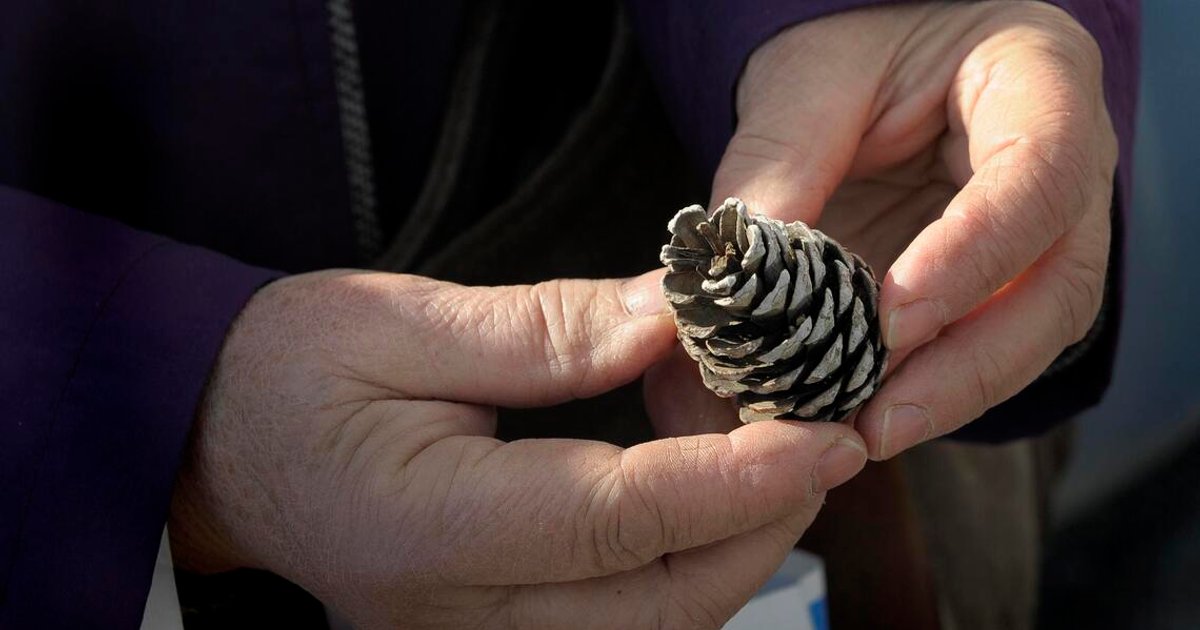
MORIOKA, Japan – Seeds from the “miracle lone pine” tree in Japan’s Rikuzentakata, Iwate Prefecture, the only tree on its beach to survive the tsunami triggered by the 2011 Great East Japan Earthquake, will be stored at the Millennium Seed Bank in Britain as early as 2026.The conservation facility stores seeds to safeguard wild plants against extinction driven by natural disasters and development.The original tree died in 2012, just a year after the massive earthquake. But over nearly 15 years, researchers cultivated genetically identical successor saplings and collected their seeds, ensuring the lone pine’s genetic line survived.By preserving these seeds for future generations, the project aims to pass down the memories and lessons of the disaster.The campaign to preserve the miracle pine for future generations began in April 2011, just a month after the disaster.About 60 members of the pine rescue project – including researchers from Tokyo-based Sumitomo Forestry and volunteers from landscape gardening businesses in Iwate Prefecture – gathered along the coast of Rikuzentakata.Authorised by the municipal government, team members collected branches from the lone pine standing amid the debris. The goal was to propagate successor saplings and harvest their seeds, amid fears the pine would not survive the damage caused by the seawater.“We wanted to pass down the genetic legacy of the lone pine – a symbol of our recovery – to the future,” recalled Yoshiei Yonai, 71, the then head of the Japan Landscape Contractors Association’s Iwate chapter.In May 2012, the pine was confirmed dead after seawater rotted its roots.The municipal government later reinforced the dead pine with carbon fibre and other materials to maintain it as a monument. Meanwhile, the project team pursued its quest to grow successor trees, moving the cuttings to Sumitomo Forestry’s facilities in Ibaraki and Saitama prefectures.In their bid to resurrect the tree, researchers relied on grafting – a technique with a 2,000-year history. The method involved attaching the harvested cuttings directly to the living branches of another established, rooted pine.However, the team struggled with the grafting process as pine resin seeped into the joints. Of the about 200 attempts, only three saplings grew successfully.The team carefully nurtured these saplings, finally harvesting a substantial batch of seeds from one of them in October in 2025.“Grafting was challenging, and we had no choice but to keep trying again and again,” said Kentaro Nakamura, 59, director of the Forest and Landscape Research Centre of Sumitomo Forestry. “Local voices hoping to preserve the pine kept us motivated.”Alongside the cultivation of the successor trees, a project took shape to preserve seeds at the Millennium Seed Bank in Britain. In 2012, the year following the disaster, the Royal Botanic Gardens, Kew, which administers the bank, approached Sumitomo Forestry to request seeds.While the plan was initially abandoned because no seeds could be obtained, Kew approached the company again in October 2024, and the storage agreement was finalised in May 2026.The seed bank, located at Kew gardens’ wild botanical garden Wakehurst in Sussex, southern England, preserves 2.5 billion seeds from approximately 40,000 species — representing about 15% of the world’s plant species — in a vault at minus 20 deg C.The seeds are scheduled to be sent to Britain by the end of 2026, with about 200 seeds to be deposited annually over the next five years or so.Richard Deverell, the director of Kew, said that the miracle pine is an extraordinary tree and that the botanical gardens are proud to receive its seeds.
Seeds from Japan’s only tree to survive the 2011 tsunami to be stored at a British seed bank
Full Article
Original Source
Read the full article at Straitstimes →KhanList aggregates and links to publicly available news content. We do not host full articles from third-party sources. Always verify important information with original sources.