
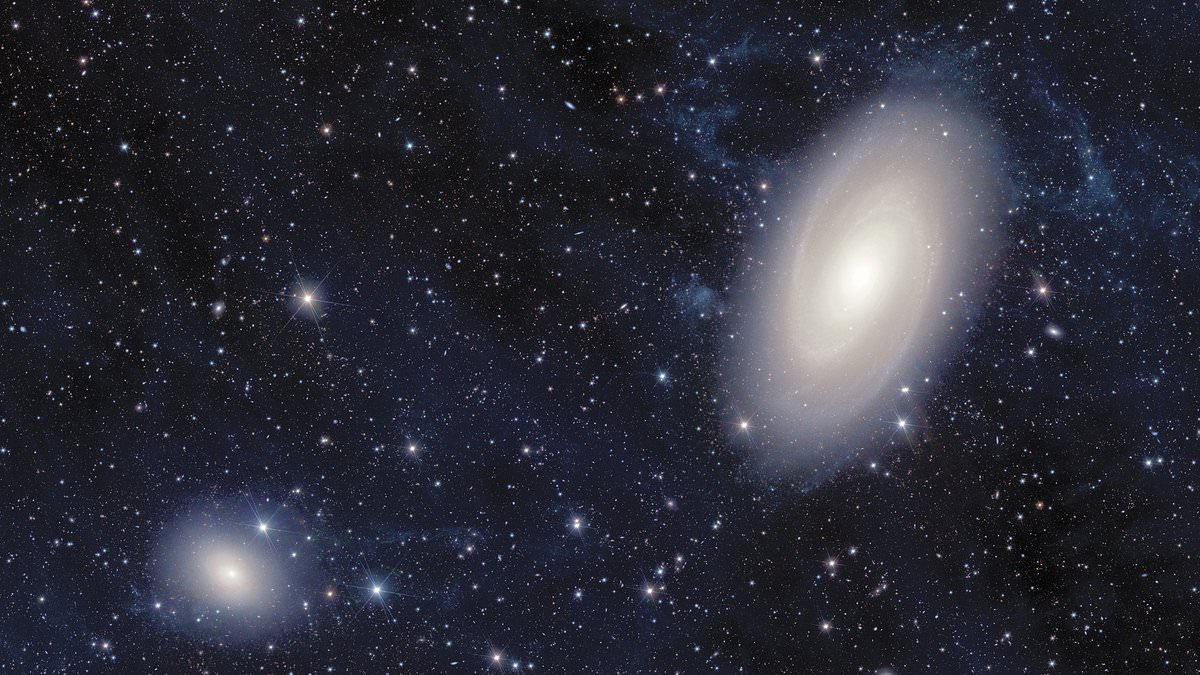
The European Space Agency's (Esa's) Euclid space telescope has unveiled its first major batch of cosmic images, capturing the light from more than a billion stars, galaxies and other celestial objects across a vast swathe of the sky.The dazzling release covers an area equivalent to around 9,500 full Moons and marks the first significant data dump from the mission since its launch in 2023.The telescope has spent the past 13 months surveying deep space from a vantage point high above Earth's atmosphere.Euclid's latest release contains images of more than 900 million galaxies stretching billions of light-years into the distance.Scientists say its observations will form the foundation of the most detailed 3D map of the Universe ever created.'This is a change in scale from Euclid's previous releases, which included a few days of observations over around 60 deg² of sky,' Valeria Pettorino, Esa's Euclid project scientist, said.'We're now releasing more than a year of data covering a significantly larger area. This unlocks ground-breaking science.' Euclid's latest release contains images of more than 900 million galaxies stretching billions of light-years into the distance. Pictured: The Abell 3128 galaxy cluster, a collection of hundreds of galaxies located about 800 million light-years away The central region of the M81 Group, a collection of galaxies located roughly 12 million light-years away Euclid's survey regions (yellow) overlaid on a full-sky map generated from data collected by the Gaia and Planck space telescopes The project is designed to help answer some of the biggest mysteries in modern astronomy, including the nature of dark matter and dark energy.Together, these invisible forces are thought to make up around 95 per cent of the cosmos, yet remain poorly understood.Among the discoveries are around 15,000 candidate gravitational lenses, where the gravity of massive foreground galaxies bends and distorts light from objects far beyond them.Researchers say the catalogue is larger than all previous collections of strong gravitational lenses combined.These natural cosmic magnifying glasses allow astronomers to weigh galaxies and map otherwise invisible dark matter.'Strong lensing provides unique insight into the dark Universe, allowing us to 'weigh' individual galaxies, including their invisible dark matter, and explore how the Universe is expanding,' Natalie Lines, a member of the Euclid Consortium from the University of Portsmouth, said.'Over ten years ago, we forecast that Euclid would revolutionise the field of strong lens discovery. That day is finally here.' The majestic disc of Messier 81, a spiral galaxy 12 million light-years from Earth, accompanied by the tiny dwarf galaxy Holmberg IX Among the discoveries are around 15,000 candidate gravitational lenses, where the gravity of massive foreground galaxies bends and distorts light from objects far beyond them NGC 1291, a ring galaxy some 33 million light-years from Earth, shown in extraordinary detail by the Euclid space telescopeWhat is the Euclid mission? The Euclid space telescope will create a map of the universe across space and time by observing billions of galaxies out to 10 billion light-years, across more than a third of the sky. Euclid will explore how the universe has expanded and how structure has formed over cosmic history, revealing more about the role of gravity and the nature of dark energy and dark matter. Dark matter makes up most of the mass of galaxies and galaxy clusters, and is responsible for the way galaxies are organized on grand scales. Dark energy, meanwhile, is the mysterious influence driving the accelerated expansion of the universe. Source: ESA/Harvard The treasure trove also includes more than 60 million quasar candidates, the brilliant centres of distant galaxies powered by supermassive black holes.Some of these quasars date back to a time when the Universe was only five per cent of its current age.Scientists have also gathered spectra, or light fingerprints, from more than 160 million cosmic sources.By splitting starlight and galaxy light into rainbow-like patterns, researchers can calculate how far away these objects are and begin placing them within a giant three-dimensional map of the cosmos.The release contains roughly 1.7 million gigabytes of data, making it one of the largest space surveys ever undertaken.There are also stunning panoramic mosaics, showing the night sky in unprecedented detail.'These are far more than beautiful pictures; today marks a scientific milestone in our study of the cosmos,' Esa's Director of Science, Professor Carole Mundell, said. 'This major Euclid data release represents the largest space-based survey of its kind, laying the foundation of future discovery in a new regime for astronomy and demonstrating the excellence of European technology, science and international collaboration.' This photo, taken just days prior to its launch in 2023, shows Euclid being secured on SpaceX's Falcon 9 rocket A previous image of Messier 78, released by Euclid: The colourful image looks like a bizarre species of jellyfish but it's actually a nebula - a huge cloud of gas and dust where stars are born The telescope has spent the past 13 months surveying deep space from a vantage point high above Earth's atmosphereEuclid ultimately aims to observe billions of galaxies across more than a third of the entire sky.The spacecraft is searching for clues to the vast cosmic web, the gigantic network of dark matter filaments that acts as the Universe's underlying scaffolding.Although impressive, the newly released observations represent only about 14 per cent of the area Euclid will eventually survey.Scientists say this is just the beginning, with even bigger and more detailed releases expected over the coming years as Euclid gradually assembles humanity's most comprehensive map of the Universe.Professor Andy Taylor of the University of Edinburgh, who leads the UK Science Ground Segment for the mission, said: 'These huge, ultra-high-definition images from Euclid are a gamechanger for astronomy.'Euclid is proving itself to be a 'Super-Hubble Space Telescope', with the same high resolution but over large areas of the sky, taking just days to see more of the cosmos than Hubble has ever seen in its decades of operation.'It is an exciting time for astronomy as we turn these amazing images into a 3D map of the Universe, creating a laboratory to probe dark matter and dark energy.'
See the universe like NEVER before: Euclid mission releases its first major batch of photos - capturing the light of more than a billion objects across an area of sky as big as 9,500 full Moons
Full Article
Original Source
Read the full article at Dailymail →KhanList aggregates and links to publicly available news content. We do not host full articles from third-party sources. Always verify important information with original sources.