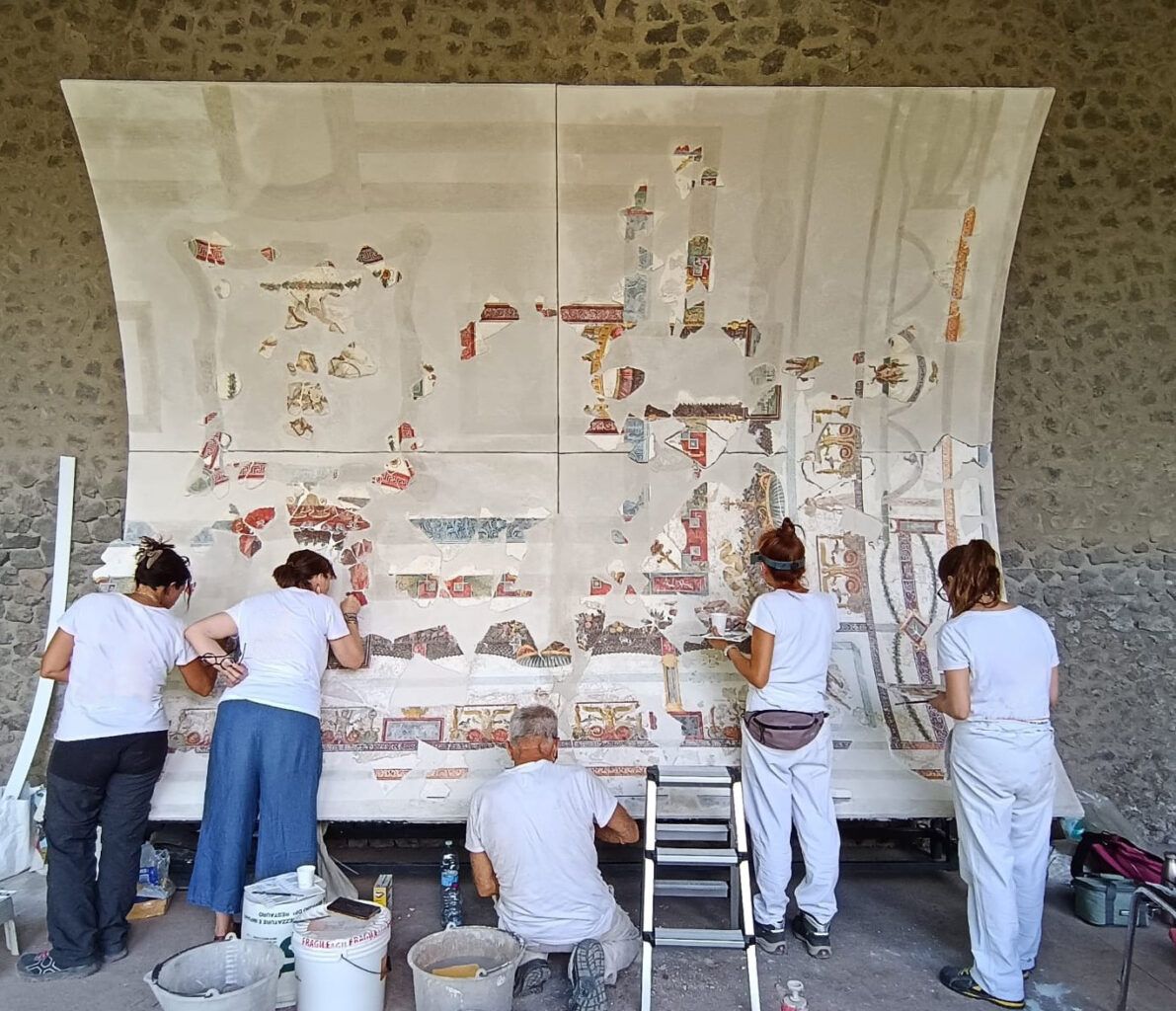
Located in the banquet hall of a home with an adjoining bakery, the fresco shows the mythological romance of Dionysus, the god of revelry and wine, and Ariadne, the Cretan princess Archaeologists created a curved support structure that mimics the ceiling’s original shape. Pompeii Archaeological Park Archaeologists at Pompeii have partially reconstructed a rare ceiling fresco depicting scenes from Greek mythology. The ceiling was once located inside the banquet hall on the upper floor of a home with an adjoining bakery in Pompeii, the ancient Roman town on the southwest coast of Italy preserved for centuries following the eruption of Mount Vesuvius in 79 C.E. Since 2023, archaeologists have slowly collected hundreds of fragments of plaster from the elaborately decorated ceiling, which they think had a curved, vaulted shape. They recently created a support structure that mimics the ceiling’s original shape, then began piecing together the plaster fragments like a puzzle. So far, they’ve reconstructed more than a quarter of the ceiling from roughly 1,000 fragments—and they plan to keep going. The support structure is designed so they can continue adding more pieces as they excavate and restore them. The fresco shows the mythological romance of Dionysus and Ariadne. Pompeii Archaeological Park Archaeologists unveiled the reconstructed ceiling last week during an international workshop on research activities in the ancient city, according to a July 24 statement from the Pompeii Archaeological Park. “Italy is a world leader in archaeological restoration, and Pompeii, with its team of restorers, plays a central role in that effort,” Gabriel Zuchtriegel, an archaeologist who serves as the director of the park, tells the Italian news agency ANSA, as reported by Euronews’ Greta Ruffino. “That is why we are pleased to share the results of our conservation projects with the world, as they also provide opportunities for research and exchange.” Though archaeologists have discovered numerous wall frescoes at Pompeii, they’ve only found around 20 ceiling frescoes, per the New York Times’ Elisabetta Povoledo. That’s because Pompeian ceilings were usually made from wood, which was lined with reeds and covered in plaster. In many cases, those organic materials have decomposed, leaving little behind for archaeologists to find. So far, archaeologists have reconstructed about a quarter of the ceiling fresco. Pompeii Archaeological Park It took a while for researchers to figure out what the banquet hall ceiling fresco depicts. But, per the Times, they’ve determined that it shows the mythological romance of Dionysus, the god of revelry and wine, and Ariadne, the princess who helped the Athenian hero Theseus slay the Cretan minotaur and escape the labyrinth. Archaeologists previously identified the building as a “bakery-prison.” Here, they think enslaved individuals toiled under inhumane conditions, spending long hours working with donkeys to grind grain in a tiny space with little light. The structure is located in the Regio IX area of Pompeii, where archaeologists also discovered a fresco featuring a pizza-like flatbread and an electoral campaign inscription. Did you know? A god by any other name Bacchus is the Roman name for Dionysus. The ceiling fresco builds on similar Dionysian discoveries at Pompeii. Last year, archaeologists uncovered a series of large frescoes depicting female followers of Dionysus engaged in secretive cult rituals. The frescoes, which have a dark red backdrop, cover three walls of a banquet hall inside the House of Thiasus, a residential complex that dates to the first century B.C.E., more than 100 years before Mount Vesuvius’ devastating eruption. Archaeologists think the home might have been topped by a 40-foot tower that was destroyed during the disaster. You Might Also Like Get the latest stories in your inbox every weekday. More about: Ancient Rome Archaeology Art Games and Competition History Italy Myth Pompeii Religion Volcanoes
See a Rare Ceiling Fresco From Pompeii That Archaeologists Are Carefully Reassembling, Piece by Piece, Like an Ancient Puzzle
Full Article
Original Source
Read the full article at Smithsonianmag →KhanList aggregates and links to publicly available news content. We do not host full articles from third-party sources. Always verify important information with original sources.