
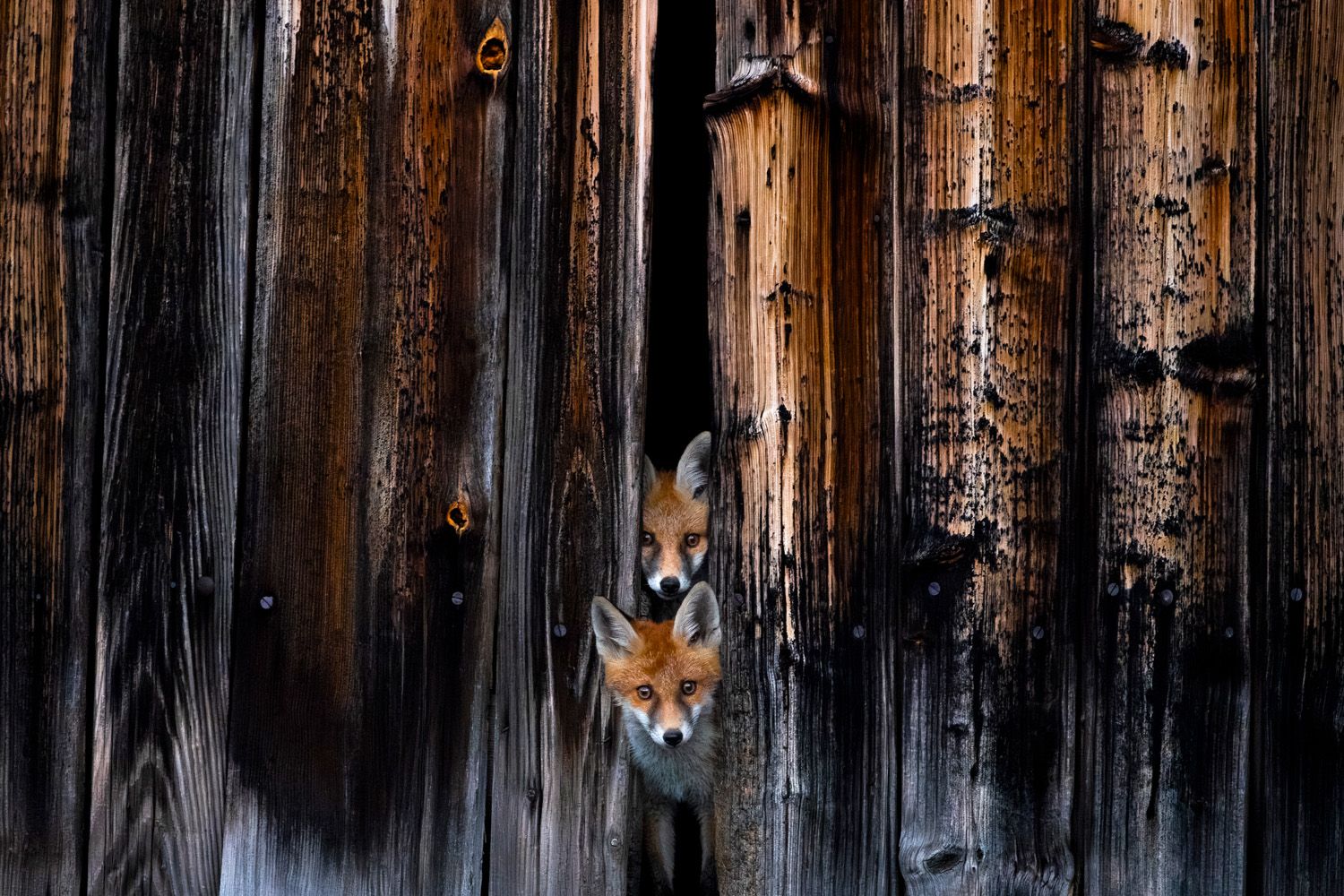
Smart News | October 28, 2026 3:46 p.m. From tranquil landscapes to a thunderous flock of seabirds, the recognized photos reveal stunning scenes of often-hidden aspects of the natural world Little housemates, mammals, highly commended: When walking home from school in Switzerland, photographer Marc Siegle spotted a young red fox. He found a family with four cubs living in a nearby barn and photographed them as they peered through the door. Siegle later learned that the barn’s owner eventually scared the foxes away, throwing stones at them so they would scatter. “Moments like these remind me how important it is to look out for the wild animals that share our world with us,” Siegle writes in a statement.Marc Siegle / European Wildlife Photographer of the Year 2026 See 18 Captivating Images From the European Wildlife Photographer of the Year Contest From tranquil landscapes to a thunderous flock of seabirds, the recognized photos reveal stunning scenes of often-hidden aspects of the natural world October 28, 2026 3:46 p.m. Little housemates, mammals, highly commended: When walking home from school in Switzerland, photographer Marc Siegle spotted a young red fox. He found a family with four cubs living in a nearby barn and photographed them as they peered through the door. Siegle later learned that the barn’s owner eventually scared the foxes away, throwing stones at them so they would scatter. “Moments like these remind me how important it is to look out for the wild animals that share our world with us,” Siegle writes in a statement. Marc Siegle / European Wildlife Photographer of the Year 2026 Surrounded by dozens of hibernating horseshoe bats holding tight to the ceiling of a mine tunnel, one would be forgiven for taking in the scene by simply looking up. But as photographer Imre Potyó walked through this restricted-access environment in Hungary’s Börzsöny Mountains, where he has been documenting bats for 13 years, he instead looked down. Because the bats occasionally get up from their roost to hunt, they leave behind droppings that accumulate in a layer on the ground. In a photograph that just won the German Society for Nature Photography’s European Wildlife Photographer of the Year contest, Potyó took a macro look at a small pin mold that had grown in a whitish layer on the guano. By shifting focus, he captured both the filaments of the mold and the bats in the background. Hidden Worlds, overall winner: Pin mold grows from a coating of bat guano on the floor of a mine tunnel in Hungary. Imre Potyó captured this photo without disturbing the hibernating bats, seen in the background, during a controlled bat count. Imre Potyó / European Wildlife Photographer of the Year 2026 “This image speaks to a larger truth about the natural world: Much of life exists beyond our immediate awareness, in places we seldom visit and among organisms we rarely notice,” says contest judge Tom Gilks, managing director of the Nature Picture Library and pictures editor for BBC Wildlife magazine, in a statement. “At a time of unprecedented biodiversity loss, many of these worlds are disappearing before they have even been properly documented, let alone understood,” Gilks adds. Wildlife photographers try to make those mysterious worlds less obscure, bringing into focus the rare, tiny, gut-wrenching and beautiful aspects of nature. They strive to take Earth’s biodiversity—even miniscule organisms and those found in remote locations—and share it with the world. Since 2001, the European Wildlife Photographer of the Year competition has highlighted images that “celebrate the beauty of our planet, reveal its vulnerability and send a clear message for its protection,” according to the contest. This year, amateur and professional photographers from 46 countries submitted more than 26,000 entries, setting a record for participation. An international jury whittled down this pool of photos to 107 winners across nine categories and two special prizes. All the contest’s winners, runners up and highly commended images can be seen on the German Society for Nature Photography’s website. Here’s a selection of some of those photographs, from a secretive cat to a playful sea lion and a glowing crab. Border Conflict, birds, highly commended: Eurasian skylarks (Alauda arvensis) congregate in a meadow in southern Poland’s Barycz Valley, where photographer Michal Michalski has been watching them for years. “They often arrive when the landscape still appears barren and lifeless,” Michalski writes in a statement. But then, the birds begin their aerial duels for breeding territory. “What was, only moments ago, a place of complete stillness now fills with calls and territorial disputes.” Michal Michalski / European Wildlife Photographer of the Year 2026 Microcosm, other animals, highly commended: On the forest floor on Greece’s Mount Olympus, the underside of a fungus (Pluteus atrotomentosus) appears to glow red. An ant crawls across the mushroom’s gills as if it’s in “a tiny, illuminated cathedral,” photographer Agorastos Papatsanis writes in a statement. “Within just a few square centimeters, an entire ecosystem unfolds at our feet.” Agorastos Papatsanis / European Wildlife Photographer of the Year 2026 Unequal Pair, plants and fungi, highly commended: An icy lake had trapped some water lilies beneath its transparent sheath, but repeated freezing and thawing led some leaves to rise to the surface. “Only their frost-covered outlines remained on the clear ice—a fascinating subject unlike anything I had ever seen before,” photographer Hannu Ahonen writes in a statement. Hannu Ahonen / European Wildlife Photographer of the Year 2026 The Florist, mammals, highly commended: An unusually large batch of purple and white flowers bloomed in Botswana in 2023, as early flooding and high water levels brought extra moisture to the floodplains of the Chobe River. Photographer William Steel, lying flat in his boat, positioned his camera at the water’s surface as an African elephant waded through, picking blossoms with its trunk. William Steel / European Wildlife Photographer of the Year 2026 Playing by Necessity, underwater world, highly commended: A young California sea lion chases a feather in the waters of Mexico’s Archipiélago de Espíritu Santo National Park. “In the past I have also captured imagery of them playing with everything from rocks to sea stars and even pufferfish,” photographer Henley Spiers writes on Instagram. This type of play builds skills that the juveniles will need to hunt and survive later in life. Spiers adds that in the face of threats like entanglement by fishing gear and climate change, “It is more important than ever that young sea lions in Mexico grow to a healthy adult state.” Henley Spiers / European Wildlife Photographer of the Year 2026 Secret Paths, birds, winner: Common cranes, seen here in Poland, become very vulnerable during their molt, when they lose their flight feathers for several weeks. Bound to the earth, they keep hidden from predators in vegetation and move between their roosting areas and feeding grounds through “secret paths” in reeds, writes photographer Jan Wieczorek in a statement. Jan Wieczorek / European Wildlife Photographer of the Year 2026 Forest at the Edge, plants and fungi, winner: In Alaska, where the boreal forest and tundra meet, lichens and mosses grow amid small shrubs and sparse trees. Photographer Fortunato Gatto traipsed through waterlogged ground to capture this scene of an ecosystem recovering from fire. “The photograph captures a landscape poised between destruction and renewal,” Gatto writes in a statement, “a powerful symbol of the profound transformation taking place across a rapidly warming Arctic.” Fortunato Gatto / European Wildlife Photographer of the Year 2026 The Cat and a Thousand Lanterns, mammals, winner: Surrounded by fireflies, a European wildcat walks through the mountains of Alto Mugello, Italy, a vital wildlife corridor. Photographer Lorenzo Shoubridge set up a hidden camera trap that was nearly invisible to passing wildlife to avoid disturbing them. “European wildcats,” Shoubridge writes in a statement, “lead exceptionally secretive and elusive lives and are regarded as indicators of healthy, species-rich ecosystems.” Lorenzo Shoubridge / European Wildlife Photographer of the Year 2026 A Seal’s Worst Nightmare, mammals, highly commended: Photographer Audun Rikardsen positioned a motion sensor on the ice and a camera underwater to get a seal’s-eye view of a polar bear’s favored hunting strategy. The predators wait at seals’ breathing holes to snatch their prey when they come up for air. “The bear then lay down and slept for nine hours, leaving me unable to retrieve my camera,” albeit temporarily, Rikardsen writes in a statement. Audun Rikardsen / European Wildlife Photographer of the Year 2026 Mirror Image, landscapes, highly commended: A still lake reflects a Canadian landscape of mountains, grasses and clouds, “transforming the scene into a perfect dialogue between reality and reflection,” writes photographer Mauro Tronto in a statement. Mauro Tronto / European Wildlife Photographer of the Year 2026 Sky Surfer, birds, highly commended: Tens of thousands of breeding seabirds created a great din as Sandra Kenyon watched them flying around the Arctic island of Hornøya in the Barents Sea. “The deafening calls and the swirling movements of immense flocks passing just a few meters overhead were truly breathtaking,” Kenyon writes in a statement. Common guillemots offered the chaotic backdrop to this photo, while a larger European shag came in for a landing. Sandra Kenyon / European Wildlife Photographer of the Year 2026 Furry Ghost, other animals, highly commended: Photographer Marco Colombo shined an ultraviolet light while taking nighttime photos off the coast of Sardinia in the Mediterranean Sea. In a rock pool, this fluorescent hairy crab lit up “like a shaggy ghost in the darkness,” Colombo writes in a statement. Biofluorescent creatures absorb light and re-emit it at another wavelength, such as absorbing UV rays and emitting them as visible colors. Marco Colombo / European Wildlife Photographer of the Year 2026 Umbra, landscapes, runner-up: From nearly 7,000 feet high in the mountains of Jotunheimen, Norway, photographer Orsolya Haarberg watched a total lunar eclipse. The stunning celestial phenomenon lit the moon up in red as the sun cast Earth’s shadow onto our natural satellite. Toward the end of the eclipse, she captured this shot of the moon above a glacier. “Over the years, the glacier has steadily retreated, and its solitary, brilliant white form against the dark landscape evoked the image of an embryonic Earth, cradled within the vastness of the universe,” Haarberg writes in a statement. Orsolya Haarberg / European Wildlife Photographer of the Year 2026 Sun Gliders, other animals, highly commended: On a trip to Botswana’s Okavango Delta, photographer William Steel watched dragonflies outside his residence. He focused the camera so that the sun appeared with bright spokes and waited for the insects to fly into the frame. “The real challenge was getting the fast-flying dragonflies into focus,” Steel writes in a statement. “I particularly like how the out-of-focus dragonfly in the foreground creates a repetition of shapes and adds depth to the image.” William Steel / European Wildlife Photographer of the Year 2026 Angel of Death, birds, highly commended: A black vulture extends its wings while standing on the carcass of a caiman. Based on a long wound seen on the reptile’s neck, photographer Andy Parkinson speculates that the animal was killed by a tourist boat. This region of Brazil, paradoxically, is protected because tourists seek experiences of wild jaguars, but this instance shows how the industry can also cause harm. “The lesson, as always, is to tread lightly when in the habitats of animals that we seek to experience,” Parkinson writes on Instagram. The vulture was unable to scavenge from the carcass, but a jaguar soon appeared and ate it. Andy Parkinson / European Wildlife Photographer of the Year 2026 At Home in a Feather Star, underwater world, highly commended: A small crinoid shrimp, blending in due to its pattern and color, camouflages among the yellow-tipped bristles of a feather star. Off the coast of the fishing village of Tulamben in Bali, Indonesia, photographer Luis Arpa captured this “intimate glimpse” of the scene, he writes in a statement. Luis Arpa / European Wildlife Photographer of the Year 2026 You Might Also Like Get the latest stories in your inbox every weekday. More about: Animals Birds Fungus Insects Mammals Nature Nature Photography Photographers Photography Plants Prey and Predators Reptiles Wildlife
See 18 Captivating Images From the European Wildlife Photographer of the Year Contest
Full Article
Original Source
Read the full article at Smithsonianmag →KhanList aggregates and links to publicly available news content. We do not host full articles from third-party sources. Always verify important information with original sources.